
Are current AI really reliable or a scam?
-
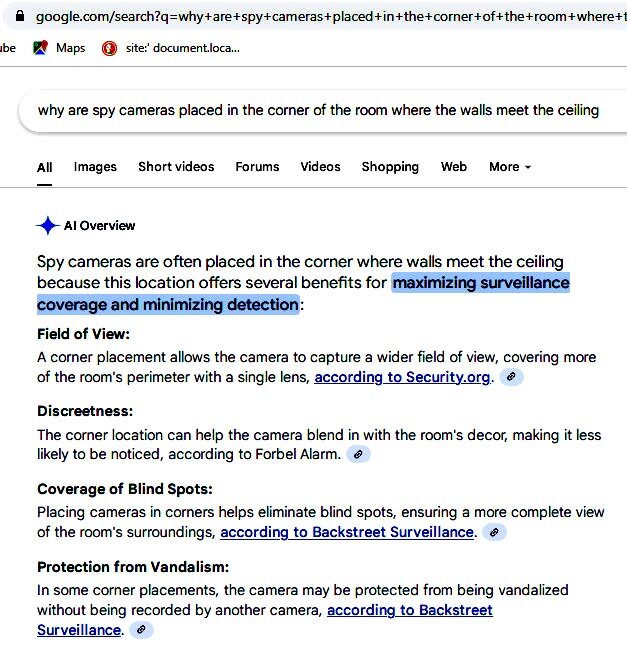
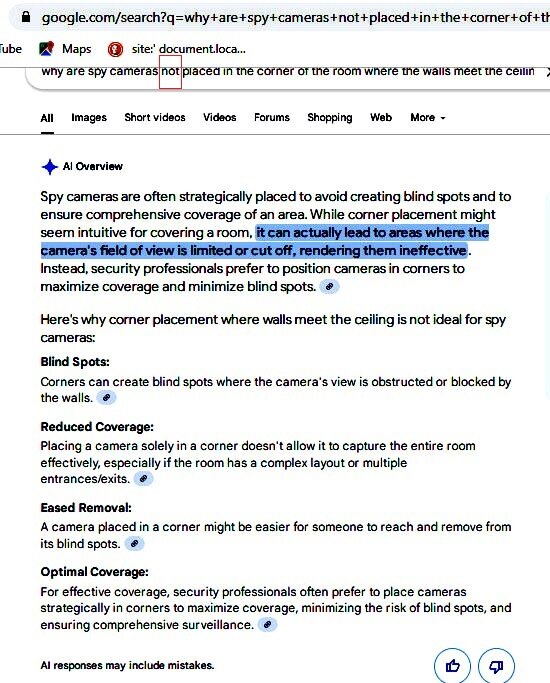
Here are two screen-captures of returns from the Google AI.
The AI seems to copy what you ask and provide weak contradictory answers.
Compare the response to my first question with the response to my second slightly different question!
First question:
"why are spy cameras placed in the corner of the room where the walls meet the ceiling"Second question:
"why are spy cameras not placed in the corner of the room where the walls meet the ceiling"(I've colored and emboldened the word "not" in the second question to show the difference from the first! I've also placed a red rectangle around the word "not" on the second image! )
There are TWO screen-captures uploaded here. Each image starts with the web browser's ADDRESS BAR !!
(The text in blue on both images was not highlighted by me; it is part of the output.)
Here are two screen-captures of returns from the Google AI.
The AI seems to copy what you ask and provide weak contradictory answers.
Compare the response to my first question with the response to my second slightly different question!
First question:
"why are spy cameras placed in the corner of the room where the walls meet the ceiling"Second question:
"why are spy cameras not placed in the corner of the room where the walls meet the ceiling"(I've colored and emboldened the word "not" in the second question to show the difference from the first! I've also placed a red rectangle around the word "not" on the second image! )
There are TWO screen-captures uploaded here. Each image starts with the web browser's ADDRESS BAR !!
The first paragraph in the second AI overview is contradictory.
“It (corner placement)can lead to areas where the camera’s field of view is limited or cut off, rendering them ineffective. Instead security professionals prefer to position cameras in corners to maximize coverage and minimize blind spots.”
WTF ?
-
Here are two screen-captures of returns from the Google AI.
The AI seems to copy what you ask and provide weak contradictory answers.
Compare the response to my first question with the response to my second slightly different question!
First question:
"why are spy cameras placed in the corner of the room where the walls meet the ceiling"Second question:
"why are spy cameras not placed in the corner of the room where the walls meet the ceiling"(I've colored and emboldened the word "not" in the second question to show the difference from the first! I've also placed a red rectangle around the word "not" on the second image! )
There are TWO screen-captures uploaded here. Each image starts with the web browser's ADDRESS BAR !!
The first paragraph in the second AI overview is contradictory.
“It (corner placement)can lead to areas where the camera’s field of view is limited or cut off, rendering them ineffective. Instead security professionals prefer to position cameras in corners to maximize coverage and minimize blind spots.”
WTF ?
The first paragraph in the second AI overview is contradictory.
“It (corner placement)can lead to areas where the camera’s field of view is limited or cut off, rendering them ineffective. Instead security professionals prefer to position cameras in corners to maximize coverage and minimize blind spots.”
WTF ?
I believe I may be able to offer a possible explanation: The first question I asked was a valid question suggesting an apparent hypothesis, and the return output from the AI appears to confirm this.
However, my second question was false (to test the response of the AI), and the resulting AI output indicates that currently it may not be able to distinguish valid questions from false questions. The premise of questions, such as my second one, sometimes require challenge.
To my second question with its false premise, the AI should have returned something like:
The question is wrongly premised, because spy cameras may indeed be placed in that position ...As you rightly point out though, the output for the AI's response to my second question being contradictory, is indeed absurd.
-
Robert is becoming sentient
This is not the only instance where I have found current AI lacking when I tested it. Please see my post here from April 14, 2025 [the System does not allow me to just show the URL text]:
-
Thank you for sharing this super random bit of research robot.
I also like how you bolded and capitalized ADDRESS BAR!!!
ADDRESS BAR MOTHAFUCKAAA!!!
Ultimately l think you’re trying to show that AI can be a bit flawed? Is this the work of your competition? Some other AI outfit with whom you are unaffiliated? Is this what AI smack talk looks like?
Thank you for sharing this super random bit of research robot.
I also like how you bolded and capitalized ADDRESS BAR!!!
ADDRESS BAR MOTHAFUCKAAA!!!
Ultimately l think you’re trying to show that AI can be a bit flawed? Is this the work of your competition? Some other AI outfit with whom you are unaffiliated? Is this what AI smack talk looks like?
You noticed it though !!
-
-
-
It's a very complicated subject. To the point of a soccer playing robot - it's scripted to adhere to a set of simple rules, and it could actually work, to a degree. On a very level playing surface, totally scripted to play soccer. The same thing would be for a robot soldier with a gun.
But emulating a human - a robot can't do it. Oh, it can be scripted to do a lot of things, but being human isn't going to happen.
Again, A.I. is a double-edged sword. The benefits to mankind are terrific maybe, but the danger and damage to mankind could be horrific.
The destructive/dangerous side of the sword is a serious concern, but the Pandora's Box has been opened.
-
Apr 25, 2024Unavailability of sufficient data is one of the top 10 limitations of Artificial Intelligence. One of the fundamental requirements for training AI models is access to large and diverse datasets. However, in many cases, relevant data may be scarce, incomplete, or biased, hindering the performance and generalization capabilities of AI systems.
-
Jan 16, 2024The Limitations of AI. 1. Lack of Understanding and Common Sense. AI systems, despite their prowess in specific domains, lack a deep understanding of the world. They often operate based on ...
-
Feb 15, 2025AI also needs expensive cybersecurity measures to protect against hacking and misuse. These high costs limit access to AI, making it mostly available to big companies and wealthy organizations. 3. Needs Continuous Human Supervision Needs Continuous Human Supervision. AI systems need constant human supervision to work correctly and fairly.
-
Share feedback about this siteAI's current applications predominantly rely on narrow AI, or weak AI, which excels in performing specific tasks—such as image recognition, natural language processing, and data analysis.Narrow AI is a step toward broader applications but is limited by its specialization. It cannot function beyond its pre-defined capabilities,
-
-
Peek-a-boo, Big Tech sees you: Expert warns just 20 cloud images can make an AI deepfake video of your child
********************
https://www.foxbusiness.com/politics/ai-bias-leans-left-most-instances-study-finds
AI bias leans left in most instances, study finds
************************
Is America's power grid ready for next attack? Experts warn EMPs, cyber threats and AI could cripple US
-
I'm posting this as an update:
My impression is that since I posted this thread, the Google AI to which I referred has become much better.
[Edit-Further update: Quote: - - - - 'The AI technology that provides the overview at the top of Google Search results is called AI Overviews. The summaries are generated by
Google's language models, primarily Gemini.' - - - -
(Source: AI Overview.)]
It now appears to be much more reliable / accurate. I've been using it for its ability to obtain research on topics, and have found it somewhat better and much faster than I could (previously) research any particular topic myself. It still seems a bit shaky on resolving some PC application issues as it does not know nor asks, what version of the application you are using, about which you are asking it.The following may also have changed, but I have found that to obtain accuracy (or maybe truthfulness) on some subjects, the inquirer really needs to have some knowledge of the subject to frame a question capable of receiving a factual-answer.
For example when I asked the Google AI:
"what happens to hard plastic when it is sent for recycling"
The answer was that:
It is used to make new plastic items.
However, when I then asked:
"what percentage of hard plastic is used to make new plastic items", the answer came back as:
9% ! The majority of it is burned to produce energy!
By the way, whenever I use information obtained from either a person or an AI, I always identify the source I have used. Also just to be clear, up to the date of this update-edit of March 30, 2026,
I have never used "Open AI" (that Westside Steve once accused me of using). -
I asked the question “Did Sheila Jackson Lee say that she stood as a freed slave”?
The AI answer:
Based on available records and news reports, there is no evidence that Representative Sheila Jackson Lee said, "I stand as a freed slave."
The hippo is dead now.
One less democrat makes one less moron.
-
I'm posting this as an update:
My impression is that since I posted this thread, the Google AI to which I referred has become much better.
[Edit-Further update: Quote: - - - - 'The AI technology that provides the overview at the top of Google Search results is called AI Overviews. The summaries are generated by
Google's language models, primarily Gemini.' - - - -
(Source: AI Overview.)]
It now appears to be much more reliable / accurate. I've been using it for its ability to obtain research on topics, and have found it somewhat better and much faster than I could (previously) research any particular topic myself. It still seems a bit shaky on resolving some PC application issues as it does not know nor asks, what version of the application you are using, about which you are asking it.The following may also have changed, but I have found that to obtain accuracy (or maybe truthfulness) on some subjects, the inquirer really needs to have some knowledge of the subject to frame a question capable of receiving a factual-answer.
For example when I asked the Google AI:
"what happens to hard plastic when it is sent for recycling"
The answer was that:
It is used to make new plastic items.
However, when I then asked:
"what percentage of hard plastic is used to make new plastic items", the answer came back as:
9% ! The majority of it is burned to produce energy!
By the way, whenever I use information obtained from either a person or an AI, I always identify the source I have used. Also just to be clear, up to the date of this update-edit of March 30, 2026,
I have never used "Open AI" (that Westside Steve once accused me of using).I'm posting this as an update:
My impression is that since I posted this thread, the Google AI to which I referred has become much better. It appears to be reliable / accurate. I've been using it for its ability to obtain research on topics, and have found it somewhat better and much faster than I could (previously) research any particular topic myself. It still seems a bit shaky on resolving some PC application issues as it does not know nor asks, what version of the application you are using, about which you are asking it.
The following may also have changed, but I have found that to obtain accuracy (or maybe truthfulness) on some subjects, the inquirer really needs to have some knowledge of the subject to frame a question capable of receiving a factual-answer.
For example when I asked the Google AI:
"what happens to hard plastic when it is sent for recycling"
The answer was that:
It is used to make new plastic items.
However, when I then asked:
"what percentage of hard plastic is used to make new plastic items", the answer came back as:
9% ! The majority of it is burned to produce energy!(By the way, whenever I use information obtained from either a person, or AI, I always identify the source I have used.)
the problem with AI, is "GIGO" for starters. "Garbage in, Garbage out".
a lot of plastics can NOT be recycled. and using some for burning into energy ] would give off very toxic fumes.
-
I'm posting this as an update:
My impression is that since I posted this thread, the Google AI to which I referred has become much better. It appears to be reliable / accurate. I've been using it for its ability to obtain research on topics, and have found it somewhat better and much faster than I could (previously) research any particular topic myself. It still seems a bit shaky on resolving some PC application issues as it does not know nor asks, what version of the application you are using, about which you are asking it.
The following may also have changed, but I have found that to obtain accuracy (or maybe truthfulness) on some subjects, the inquirer really needs to have some knowledge of the subject to frame a question capable of receiving a factual-answer.
For example when I asked the Google AI:
"what happens to hard plastic when it is sent for recycling"
The answer was that:
It is used to make new plastic items.
However, when I then asked:
"what percentage of hard plastic is used to make new plastic items", the answer came back as:
9% ! The majority of it is burned to produce energy!(By the way, whenever I use information obtained from either a person, or AI, I always identify the source I have used.)
the problem with AI, is "GIGO" for starters. "Garbage in, Garbage out".
a lot of plastics can NOT be recycled. and using some for burning into energy ] would give off very toxic fumes.
the problem with AI, is "GIGO" for starters. "Garbage in, Garbage out".
a lot of plastics can NOT be recycled. and using some for burning into energy ] would give off very toxic fumes.
Indeed, and this is how the AI Answers:
'Hard plastic is often burned for energy (incinerated) despite toxic emissions because it is a fast, cheap way to reduce massive waste volumes, and plastic—being oil-based—is highly combustible. Incineration reduces waste volume by nearly 90%, offering a "solution" to landfills and plastic pollution, often branded as waste-to-energy. '
Source: AI Overview.
Search criteria used:
why is most hard plastic sent to recycling burnt for energy given the toxic fumes emitted -
-
AI is a bitch
 Our musical works to date http://www.arielsatticmusic.com/
 -
I would like to know how soon this technology will be made to help injured war veterans and disabled civillians alike
-
I would like to know how soon this technology will be made to help injured war veterans and disabled civillians alike
I would like to know how soon this technology will be made to help injured war veterans and disabled civillians alike
it was a given that would start research on the subject.
-
c.ncbi.nlm.nih.gov
Concerns like user privacy, data security, and permission should direct the creation and use of AI in prosthetics. Lastly, in order to guarantee that AI-enabled prosthetics are safe and effective for end-users, thorough regulatory supervision is required during their creation, testing, and implementation. -
Abstract Artificial Intelligence (AI) is rapidly reshaping the field of prosthetics and orthotics by enhancing device design, control strategies, and clinical decision-making. Through advanced machine
-
-
Just a little update:
I don't know if any of you guys have relied on Google's AI Overview aka Gemini, only to end up in a "car crash", but here's an experience of mine and a warning to anyone (of any political persuasion!) using this tool :
Search criteria used for both of the following AI Overviews:
“Is more European Union Commission humanitarian aid given each year to the Palestinians compared with total annual E.U. countries contributions to the European Space Agency”
Extract from the AI Overview returned December 12, 2025 [fortunately I did keep a complete copy together with its citation links]:Yes, the European Commission's aid to Palestinians, especially since late 2023, often exceeds annual ESA contributions; the EU's total support for Palestinians (humanitarian + development) is in the billions (€1.6B for 2025-27), while ESA's total budget is comparable but broken down by member contributions, often in the hundreds of millions (e.g., Spain €500M, France/Germany billions over years, not annually), making direct annual EU Commission aid vs. total country ESA contributions an uneven comparison, but overall EU financial flows to Palestine are massive.
Extract from the AI Overview (on the SAME search criteria - see above) returned May 29, 2026:No, total annual E.U. countries' contributions to the European Space Agency (ESA) vastly exceed the European Commission's annual humanitarian aid given to the Palestinians. [1, 2, 3, 4] (Reddit-r/europe+3)
[...]
Even at historical peaks, the E.U.'s direct humanitarian aid to the region is a fraction of what is spent on European space initiatives. [1, 2] (European Civil Protection and Humanitarian ...+1) [...]And now my comments on the above debacle ... No; words fail me!
-

-
Ive found Ai useful for doing menial office tasks but not much else.













Hello! It looks like you're interested in this conversation, but you don't have an account yet.
Getting fed up of having to scroll through the same posts each visit? When you register for an account, you'll always come back to exactly where you were before, and choose to be notified of new replies (either via email, or push notification). You'll also be able to save bookmarks and upvote posts to show your appreciation to other community members.
With your input, this post could be even better 💗
Register Login