
Let's Hear It For Engineers And Science
-
Wiki says
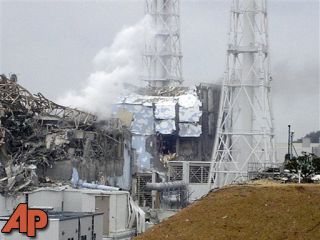
"On 11 March 2011 an earthquake categorised as 9.0 MW on the moment magnitude scale occurred at 14:46 Japan Standard Time (JST) off the northeast coast of Japan. Reactors 4, 5 and 6 had been shut down prior to the earthquake for planned maintenance.[19][20] The remaining reactors were shut down automatically after the earthquake, but the subsequent tsunami flooded the plant, knocking out emergency generators needed to run pumps which cool and control the reactors. The flooding and earthquake damage prevented assistance being brought from elsewhere. Over the following days there was evidence of partial nuclear meltdowns in reactors 1, 2 and 3; hydrogen explosions destroyed the upper cladding of the building housing reactors 1 and 3; an explosion damaged reactor 2's containment; and fires broke out due to a fuel leak near a water pump at Unit 4. Due to high radiation levels the workers at the facility had to temporarily evacuate the area for their own safety immediately."
So it appears that most of the damage was caused by the tsunami. Japan has a history of tsunamis that have killed many people and swept away cities over the past 200 years. This should have been taken into account. It wasn't, and now we have this situation. It will be taken into account before more are built.
That some US reactors share the same design should not worry us. The most at-risk plants in the US are going to be those in Florida because most of Florida isn't even 10 feet above sea level. However, the fault lines in the Atlantic are not nearly as active as those in the Pacific, so the likelihood of them being tsunami'd is pretty low.
The US probably wouldn't need to consider the pyramid idea I proposed, but Japan will. And that's if we even continue to use nuclear energy after the plants expire.
-
Did you know that Florida is in danger of bearing the brunt of a Tsunami created by the collapse of one of the Canary Islands? One of the Volcanoes is in danger of SOMEDAY having it's western half sloughing off into the Atlantic ocean, thereby creating a very dangerous tsunami that would travel to the eastern coast of the US.
-
Japanese people will recover: (From Time Magazine)
Koji Haga wasn't just near the tsunami that devastated northern Japan on March 11. He was on top of it. Somehow the fishing-boat captain kept his pitching vessel upright as the churning force of the wave attacked the shore, turning his coastal community of Akaushi into a graveyard of rubble and probably killing upwards of 10,000 people in the country's north. I met him barely 24 hours after he'd returned to the spot where his house once stood. Aside from the roof, which landed not far from his building's foundations, there was nothing recognizable that remained of his home. A few mementos were scattered in the kaleidoscopic wreckage: his waterlogged family albums were lodged in the axle of an upturned car, while his daughter's pink stuffed animal lay facedown in the mud.
Haga ignored most of these keepsakes. His first priority was scooping up sodden rice to take back to his hungry family and neighbors, who had escaped the wave by scrambling to higher ground. Yet even as the fisherman packed the ruined grain into a sack, he displayed the fortitude and generosity that have so defined this devastated region of Japan. Haga was embarrassed that the rice was spoiled, but he invited me to take some. A neighbor had found a bottle of grain alcohol bobbing in a fetid pool. Would I like a fortifying gulp? The next day, Haga would join Akaushi's other survivors to begin the slow clearing and reconstruction of a village virtually wiped off the map. "We'll all try our best to do this together," he said, not a note of pity in his voice. "That's the Japanese way, isn't it?" (See exclusive photos of the devastation in Japan.)
Natural disasters lay bare the best and worst in people, stripping away hubris and artifice. The tragedy in Japan - a 9.0-magnitude earthquake followed by a killer tsunami and compounded by a nuclear accident at a tremor-and-tidal-wave-damaged power plant - brought into relief the remarkable resilience of the Japanese people. Defining a national psyche can be a tricky undertaking. But the dignified stoicism with which the Japanese have faced this tragedy is extraordinary to see.
Japan's resilience, however, is not solely to be explained in terms of some innate psychological trait that its people possess. It is also manifested in the nation's preparedness. As high as the official death toll will climb in the coming days, there is little doubt that the complex tsunami and earthquake early-warning systems that Japan has in place saved tens of thousands of lives. Now as Japan struggles to overcome one of the worst natural disasters in its history - though the earthquake on March 11 was the most severe in modern times, far fewer died than in the Great Kanto Earthquake of 1923 - it will need even more reserves of fortitude to remake a nation that is all too familiar with losing everything and starting anew.
Marooned on the edge of a continent and perched on one of the most seismically active spots on earth, Japan, for all its modern comforts and luxuries, is a country that lives on the brink of disaster. Even its language is a testament to how this sense of precariousness has shaped the national consciousness. I say this as someone who is half Japanese and should know how to articulate a nation's mind-set. But even I find it hard to define gaman, a unique mix of endurance and self-abnegation that practically all people I spoke to in the disaster zone used to describe their situations. Or what about shoganai, which is often translated too simply as "There's nothing you can do"? (See how Japan became a leader in disaster preparation.)
That's not quite right. The fatalism implied in the phrase denotes not just a helplessness at life's vagaries but also a calm determination to overcome what cannot be controlled. Even those who never lived through Japan's last days of privation during World War II know what is required of them as Japanese citizens. "We, the young generation, will unite and work hard to get over this tragedy," says Mamiko Shimizu, a 24-year-old graduate student. "It's now our time to rebuild Japan."
This earthquake and tsunami may turn out to be the costliest natural disaster in history, outpacing even Hurricane Katrina in 2005. The gravity of the situation was underscored when Emperor Akihito appeared on March 16 for his first-ever televised address to say he was "praying for the safety of as many people as possible," a sentiment repeated by a grim-faced Prime Minister Naoto Kan in daily public appearances. Nevertheless, despite the cost and loss of life, Japan's ultra-sophisticated earthquake-and-tsunami-alert system increased the odds for everyone. Survivors I met told versions of the same story. The earthquake unleashed its fury. Then because of radio broadcasts, text messages, sirens, firemen's door-to-door calls and just plain instinct honed by years of disaster drills at school, people from towns and villages along the coast - Japan's population is concentrated in an often narrow coastal plain - immediately fled to higher ground.
Japan is the only country on the planet with an earthquake early-warning system in place. It is also the only one with a truly successful tsunami-alert scheme - 300 earthquake sensors scattered in territorial waters that can predict the likelihood of a tsunami in minutes. Tsunami evacuation routes are posted up and down the coast. When the government says to evacuate, the Japanese people listen.
-
Come on, DH. A Japanese ENGINEER RESIGNED because of what he considered a major design problem with the reactors.
Why the hell would you think I'm a "moron" because I blame the overheating problem at the nuclear energy plant.... due to a design problem?
It's a design flaw with the COOLIING SYSTEM.
Hey, I'm right on this one, dude. At least explain why you think I'm wrong.
Hell, even Vapor is agreeing with me.
Does anybody think the engineer that resigned over cooling system design flaw(s), as he saw it... is a "moron" ?
http://www.reuters.com/article/2011/03/15/us-japan-quake-engineer-idUSTRE72E9H420110315
-
Come on, DH. A Japanese ENGINEER RESIGNED because of what he considered a major design problem with the reactors.
Why the hell would you think I'm a "moron" because I blame the overheating problem at the nuclear energy plant.... due to a design problem?
It's a design flaw with the COOLIING SYSTEM.
Hey, I'm right on this one, dude. At least explain why you think I'm wrong.
Hell, even Vapor is agreeing with me.
Does anybody think the engineer that resigned over cooling system design flaw(s), as he saw it... is a "moron" ?
http://www.reuters.com/article/2011/03/15/us-japan-quake-engineer-idUSTRE72E9H420110315
Come on, DH. A Japanese ENGINEER RESIGNED because of what he considered a major design problem with the reactors.
Why the hell would you think I'm a "moron" because I blame the overheating problem at the nuclear energy plant.... due to a design problem?
It's a design flaw with the COOLIING SYSTEM.
Hey, I'm right on this one, dude. At least explain why you think I'm wrong.
Hell, even Vapor is agreeing with me.
Does anybody think the engineer that resigned over cooling system design flaw(s), as he saw it... is a "moron" ?
http://www.reuters.com/article/2011/03/15/us-japan-quake-engineer-idUSTRE72E9H420110315
Actually Brainiac, it was an American engineer who resigned. Did you read the article you quoted:
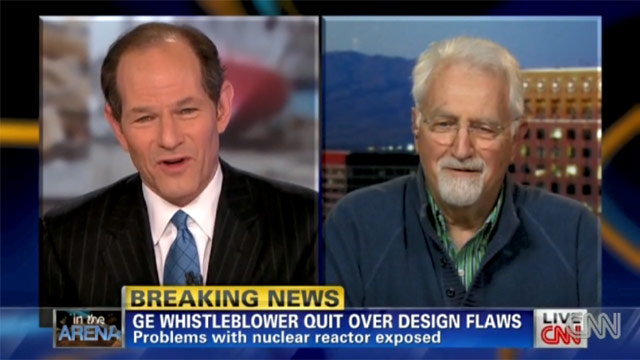
(Reuters) - A General Electric Co engineer said he resigned 35 years ago over concern about the safety of a nuclear reactor design used in the now crippled Fukushima Daiichi plant in Japan.
Dale Bridenbaugh said the "Mark 1" design had "not yet been designed to withstand the loads" that could be experienced in a large-scale accident.
"At the time, I didn't think the utilities were taking things seriously enough," Bridenbaugh, now retired, said in a phone interview. "I felt some of the plants should have been shut down while the analysis was completed, and GE and the utilities didn't want to do that, so I left."
Bridenbaugh said that to the best of his knowledge, the design flaws he had identified were addressed at the Daiichi plant, requiring "a fairly significant expense."
The Aptos, California, resident spoke earlier with ABC News, a unit of Walt Disney Co.
GE in a statement said it has had "40 years of safe operations" of its boiling water reactor Mark 1 technology.
"In 1980 the (Nuclear Regulatory Commission) issued a generic industry order assessing the Mark 1 containment," the Fairfield, Connecticut-based company added. "We responded to this order and issued it to all of our customers."
Following last Friday's 9.0 earthquake and tsunami, the Daiichi plant has suffered several explosions, and is now sending radiation wafting into Tokyo, 150 miles to the south. Authorities are trying to prevent a full meltdown.
Bridenbaugh said that after leaving GE he started a firm to advise state governments on safety issues. Like many, he said he is watching closely as events unfold in Japan.
"I feel sorry for the guys over there trying to handle that thing," he said. "On the other hand you can't say the Fukushima situation is a direct result of the Mark 1 containment. It is a direct result of the earthquake, tsunami and the fact the Mark 1 containment is less forgiving than some of the other reactor versions."
(Reporting by Jonathan Stempel and Lewis Krauskopf in New York; Editing by Gary Hill)
I rest my case. End of discussion.
-
Yes, I did read it. And he was Japanese when he resigned, then changed his name and
immigrated to the U.S.
Idiot.
ROF,L.... @@
-
Yes, I did read it. And he was Japanese when he resigned, then changed his name and
immigrated to the U.S.
Idiot.
ROF,L.... @@
Yes, I did read it. And he was Japanese when he resigned, then changed his name and
immigrated to the U.S.
Idiot.
ROF,L.... @@
I hope you don't expect anyone to believe that horseshit. Quit making up things and pretending them to be true. I'm done with responding to your delusional posts.
-
Yes, I did read it. And he was Japanese when he resigned, then changed his name and
immigrated to the U.S.
Idiot.
ROF,L.... @@
Yes, I did read it. And he was Japanese when he resigned, then changed his name and
immigrated to the U.S.
Idiot.
ROF,L.... @@
I'mnot sure why it would matter if this guy was Japanese or not, but that's a pretty bold claim, Cal.
Looks can be deceiving, but a quick glance suggests that he is most likely not ethnically Japanese.
-
-
Ahh royal Stewart and clan Marshall hunting tartans.
WSS
-
I'mnot sure why it would matter if this guy was Japanese or not, but that's a pretty bold claim, Cal. Tupa
*************************
Well, of course I was being facetious about that nonsense - in the other article, I hadn't noticed that the guy was American or Japanese, I just
went and found another article on the subject.
The silly point is, like you said, it doesn't matter if he was American or not. He was an engineer with them, and he resigned,
for reasons which prove my point. DH just gets nasty like this sometimes. I don't know why... @@



Hello! It looks like you're interested in this conversation, but you don't have an account yet.
Getting fed up of having to scroll through the same posts each visit? When you register for an account, you'll always come back to exactly where you were before, and choose to be notified of new replies (either via email, or push notification). You'll also be able to save bookmarks and upvote posts to show your appreciation to other community members.
With your input, this post could be even better 💗
Register Login