
Science says experts configure man made global warming to fit what they want it to fit
-
About 3 minutes
oh wow master came down hard on you huh? usually it only takes 20 or less seconds to disprove one of cals imbecile claims/narratives narratives. Good job out of you taking one for the team like that. ?
usually it only takes 20 or less seconds to disprove one of cals imbecile claims/narratives narratives.
Let's get busy then.
-
Well you better go visit Glacier National Park before it's renamed Never Winter National Seashore.????️
What purpose would that serve?
What purpose would that serve?
Truth in advertising. The glaciers there are are down by 39% on average in overall size in the past 50 years.
-
Thank you President Trump! MAGA!
-
-
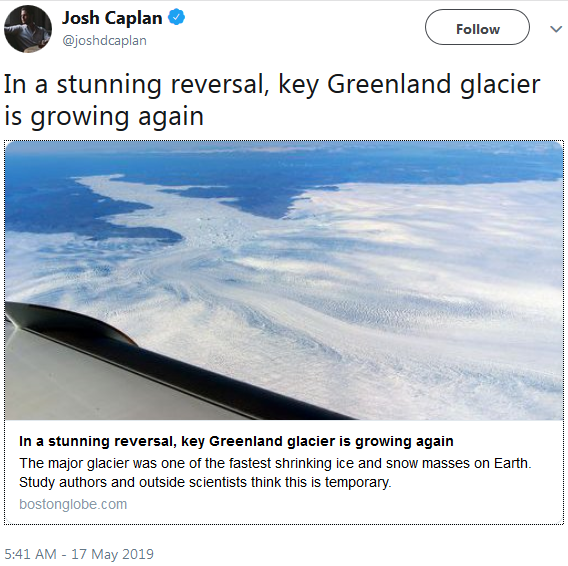
just research....it isnt hard...
water has kept coming, according to data from NASA's Oceans Melting Greenland (OMG) mission and other sources.
In a new paper, Khazendar and his team have identified the cause - and, yes, it is only temporary.
The team traced the current using observations and a NASA-developed ocean modelling system to fill in the gaps in the data.
The cooling began in the North Atlantic Ocean, 966 kilometres (600 miles) south of the glacier, triggered by a climate pattern called the North Atlantic Oscillation (NAO): every five to 20 years, atmospheric pressure at sea level fluctuates, ultimately resulting in either warming or cooling, which is then carried northward by the ocean currents up the southwestern coast of Greenland.
In 2016, the water in this current was cooler by 1.5 degrees Celsius, cooling the Atlantic around Greenland by about 1 degree Celsius; this made its way to the mouth of Jakobshavn, allowing the ice to thicken.
Seems like such a tiny increment for such a big effect, doesn't it? Even the researchers were surprised.
"We didn't think the ocean could be that important," OMG principal investigator Josh Willis of the Jet Propulsion Laboratory told National Geographic.
But, inevitably, the pendulum will swing back, and the glacier will shrink again.
Meanwhile, the rest of Greenland's ice sheet is still receding; and, even if this slight growth were to continue, it couldn't possibly make up for the intense losses experienced so far.
-
wait - texsag actually referenced a link to the subject he's making. hot freakin willy nillies !
but he's still wrong on his basic premise, as always...?
Key Greenland glacier growing again after shrinking for years, NASA ...
Mar 25, 2019 - A major Greenland glacier that was one of the fastest shrinking ice and ... temperature is a bigger player in glacier retreats and advances than ... -
yep. woody and texsag - wrong on "mmgw"
Climate shock: 90 percent of the world's glaciers are GROWING | PSI Intl
Nov 26, 2016 - “That is what is SUPPOSED to happen when there is global warming,” says @Smaulgld. “Glaciers get bigger unless they melt -that's global ... -
pick a source. Here's another one:
Big U-turn: Key melting Greenland glacier is growing again - Phys.org
Mar 25, 2019 - A major Greenland glacier that was one of the fastest shrinking ice and snow masses on Earth is growing again, a new NASA study finds. -
What purpose would that serve?
Truth in advertising. The glaciers there are are down by 39% on average in overall size in the past 50 years.
Truth in advertising. The glaciers there are are down by 39% on average in overall size in the past 50 years.
I post a vid explaining that if we stopped all CO2 emissions nothing would change for 2000yrs.
You respond by suggesting I should go visit some glaciers.
I asked you what good that would do.
and you reply with this.
Are you out of your mind?
-
just research....it isnt hard...
water has kept coming, according to data from NASA's Oceans Melting Greenland (OMG) mission and other sources.
In a new paper, Khazendar and his team have identified the cause - and, yes, it is only temporary.
The team traced the current using observations and a NASA-developed ocean modelling system to fill in the gaps in the data.
The cooling began in the North Atlantic Ocean, 966 kilometres (600 miles) south of the glacier, triggered by a climate pattern called the North Atlantic Oscillation (NAO): every five to 20 years, atmospheric pressure at sea level fluctuates, ultimately resulting in either warming or cooling, which is then carried northward by the ocean currents up the southwestern coast of Greenland.
In 2016, the water in this current was cooler by 1.5 degrees Celsius, cooling the Atlantic around Greenland by about 1 degree Celsius; this made its way to the mouth of Jakobshavn, allowing the ice to thicken.
Seems like such a tiny increment for such a big effect, doesn't it? Even the researchers were surprised.
"We didn't think the ocean could be that important," OMG principal investigator Josh Willis of the Jet Propulsion Laboratory told National Geographic.
But, inevitably, the pendulum will swing back, and the glacier will shrink again.
Meanwhile, the rest of Greenland's ice sheet is still receding; and, even if this slight growth were to continue, it couldn't possibly make up for the intense losses experienced so far.
just research....it isnt hard...
water has kept coming, according to data from NASA's Oceans Melting Greenland (OMG) mission and other sources.
In a new paper, Khazendar and his team have identified the cause - and, yes, it is only temporary.
The team traced the current using observations and a NASA-developed ocean modelling system to fill in the gaps in the data.
The cooling began in the North Atlantic Ocean, 966 kilometres (600 miles) south of the glacier, triggered by a climate pattern called the North Atlantic Oscillation (NAO): every five to 20 years, atmospheric pressure at sea level fluctuates, ultimately resulting in either warming or cooling, which is then carried northward by the ocean currents up the southwestern coast of Greenland.
In 2016, the water in this current was cooler by 1.5 degrees Celsius, cooling the Atlantic around Greenland by about 1 degree Celsius; this made its way to the mouth of Jakobshavn, allowing the ice to thicken.
Seems like such a tiny increment for such a big effect, doesn't it? Even the researchers were surprised.
"We didn't think the ocean could be that important," OMG principal investigator Josh Willis of the Jet Propulsion Laboratory told National Geographic.
But, inevitably, the pendulum will swing back, and the glacier will shrink again.
Meanwhile, the rest of Greenland's ice sheet is still receding; and, even if this slight growth were to continue, it couldn't possibly make up for the intense losses experienced so far.
^^^^^
-
Truth in advertising. The glaciers there are are down by 39% on average in overall size in the past 50 years.
I post a vid explaining that if we stopped all CO2 emissions nothing would change for 2000yrs.
You respond by suggesting I should go visit some glaciers.
I asked you what good that would do.
and you reply with this.
Are you out of your mind?
I post a vid explaining that if we stopped all CO2 emissions nothing would change for 2000yrs.
You respond by suggesting I should go visit some glaciers.
I asked you what good that would do.
and you reply with this.
Are you out of your mind?
Texsag never quits his nonsense. Weird, outlandish claims right out of somewhere crazy.
-
just research....it isnt hard...
water has kept coming, according to data from NASA's Oceans Melting Greenland (OMG) mission and other sources.
In a new paper, Khazendar and his team have identified the cause - and, yes, it is only temporary.
The team traced the current using observations and a NASA-developed ocean modelling system to fill in the gaps in the data.
The cooling began in the North Atlantic Ocean, 966 kilometres (600 miles) south of the glacier, triggered by a climate pattern called the North Atlantic Oscillation (NAO): every five to 20 years, atmospheric pressure at sea level fluctuates, ultimately resulting in either warming or cooling, which is then carried northward by the ocean currents up the southwestern coast of Greenland.
In 2016, the water in this current was cooler by 1.5 degrees Celsius, cooling the Atlantic around Greenland by about 1 degree Celsius; this made its way to the mouth of Jakobshavn, allowing the ice to thicken.
Seems like such a tiny increment for such a big effect, doesn't it? Even the researchers were surprised.
"We didn't think the ocean could be that important," OMG principal investigator Josh Willis of the Jet Propulsion Laboratory told National Geographic.
But, inevitably, the pendulum will swing back, and the glacier will shrink again.
Meanwhile, the rest of Greenland's ice sheet is still receding; and, even if this slight growth were to continue, it couldn't possibly make up for the intense losses experienced so far.
just research....it isnt hard...
water has kept coming, according to data from NASA's Oceans Melting Greenland (OMG) mission and other sources.
The cooling began in the North Atlantic Ocean, 966 kilometres (600 miles) south of the glacier, triggered by a climate pattern called the North Atlantic Oscillation (NAO): every five to 20 years, atmospheric pressure at sea level fluctuates, ultimately resulting in either warming or cooling, which is then carried northward by the ocean currents up the southwestern coast of Greenland.
"We didn't think the ocean could be that important," OMG principal investigator Josh Willis of the Jet Propulsion Laboratory told National Geographic.
But, inevitably, the pendulum will swing back, and the glacier will shrink again.Meanwhile, the rest of Greenland's ice sheet is still receding; and, even if this slight growth were to continue, it couldn't possibly make up for the intense losses experienced so far.

-
Truth in advertising. The glaciers there are are down by 39% on average in overall size in the past 50 years.
I post a vid explaining that if we stopped all CO2 emissions nothing would change for 2000yrs.
You respond by suggesting I should go visit some glaciers.
I asked you what good that would do.
and you reply with this.
Are you out of your mind?
I post a vid explaining that if we stopped all CO2 emissions nothing would change for 2000yrs.
You respond by suggesting I should go visit some glaciers.
I asked you what good that would do.
and you reply with this.
Are you out of your mind?
No your initial response was "screw that" which is different from the closing statement in the video which was "stop digging". So if "screw that" is your position, then go visit the receding glaciers now before they're gone. Or work on the CO2 gobbling technology that he suggested might speed up a reversal if done soon enough.
-
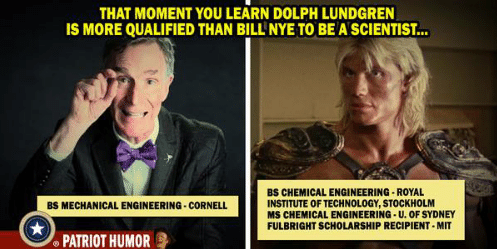
So you don't think a Cornell educated mechanical engineer had to take a few science classes along the way as part of the curriculum and is also smart enough to be self taught as well? Very interesting.
-
So you don't think a Cornell educated mechanical engineer had to take a few science classes along the way as part of the curriculum and is also smart enough to be self taught as well? Very interesting.
Just think...neither of them are a climatologist.
Two things that will define you: Your determination when you have nothing. Your attitude when you have everything. - Mike McCartney -
I post a vid explaining that if we stopped all CO2 emissions nothing would change for 2000yrs.
You respond by suggesting I should go visit some glaciers.
I asked you what good that would do.
and you reply with this.
Are you out of your mind?
No your initial response was "screw that" which is different from the closing statement in the video which was "stop digging". So if "screw that" is your position, then go visit the receding glaciers now before they're gone. Or work on the CO2 gobbling technology that he suggested might speed up a reversal if done soon enough.
No your initial response was "screw that" which is different from the closing statement in the video which was "stop digging". So if "screw that" is your position, then go visit the receding glaciers now before they're gone. Or work on the CO2 gobbling technology that he suggested might speed up a reversal if done soon enough.
OK..got it. Thanx
-
So you don't think a Cornell educated mechanical engineer had to take a few science classes along the way as part of the curriculum and is also smart enough to be self taught as well? Very interesting.
Just think...neither of them are a climatologist.
Just think...neither of them are a climatologist.
no but nye understands the scientific process and knows when its being properly followed.
-
Just think...neither of them are a climatologist.
no but nye understands the scientific process and knows when its being properly followed.
no but nye understands the scientific process and knows when its being properly followed.
Then he should understand that bias (climategate) should not be inserted into the scientific process.






Hello! It looks like you're interested in this conversation, but you don't have an account yet.
Getting fed up of having to scroll through the same posts each visit? When you register for an account, you'll always come back to exactly where you were before, and choose to be notified of new replies (either via email, or push notification). You'll also be able to save bookmarks and upvote posts to show your appreciation to other community members.
With your input, this post could be even better 💗
Register Login