
Not on board with this one...
-
Jeez, you really are a pathetic lil TWAT aren't ya. ?
Our musical works to date http://www.arielsatticmusic.com/ -
He's either that petty and that big of a thin skinned baby that this is all an actual tirade of his in response to twitter being mean to him
or this is all just some big distraction from COVID, some other issue, etc
If anyone on this board can justify Trump's response and actions to this twitter thing I'd love to hear it
He's either that petty and that big of a thin skinned baby that this is all an actual tirade of his in response to twitter being mean to him
or this is all just some big distraction from COVID, some other issue, etc
If anyone on this board can justify Trump's response and actions to this twitter thing I'd love to hear it
Actually, I do find myself in agreement with Trump on this one. Here's why:
The issue boils down to whether or not social media companies like Google, Twitter, Facebook, YouTube, etc. are considered to be "platforms" or "publishers", and whether or not said companies are liable for the content of their users.
Back in the early days of the internet, some people tried to sue message boards and other online social media companies for the opinions posted on there by their users. In response, Congress passed 47 U.S. Code § 230: Protection for private blocking and screening of offensive material. This statue laid out protections for social media sites against litigation for what their users posted. The most important part of the statue, and the one that is at the heart of this executive orders, follows:
(c) Protection for “Good Samaritan” blocking and screening of offensive material
(1) Treatment of publisher or speaker
- No provider or user of an interactive computer service shall be treated as the publisher or speaker of any information provided by another information content provider.
(2) Civil liability. No provider or user of an interactive computer service shall be held liable on account of—
- (A) any action voluntarily taken in good faith to restrict access to or availability of material that the provider or user considers to be obscene, lewd, lascivious, filthy, excessively violent, harassing, or otherwise objectionable, whether or not such material is constitutionally protected; or
- (B) any action taken to enable or make available to information content providers or others the technical means to restrict access to material described in paragraph (1).
Basically, what this states is that as long as social media companies make good faith efforts in restricting speech that is unreasonably "obscene, lewd, lascivious, filthy, excessively violent, harassing, or otherwise objectionable", they are considered "platforms" by law and are protected against lawsuits for the content on their website. Publishers, on the other hand, are open to lawsuits for the content that they publish because they actively edit and curate the content they put out that either exceeds or is outside the scope of Section 230 - (C) 2. For example, papers like the NYT, WaPo, NYPost, etc. and news companies like ABC, NBC, CBS, FOX, CNN, etc. are considered publishers because they actively curate the content that they print or put on the TV, and make a profit while doing so, so they are open to lawsuits for what they put out.
What the Trump administration is alleging by this executive order - and I tend to agree with them on this point - is that platforms like Twitter, Google and Facebook are actively censoring users and content, mostly from conservatives and conservative viewpoints, outside of the scope laid out by Section 230. It has been demonstrated numerous times that these companies are actively censoring and editing out conservative viewpoints by practices like shadow banning, demonetizing, deletion and outright banning of certain users or user-generated content. This, theoretically, exceeds the scope of a speech "platform" and falls within the realm of being a "publisher". If so, that opens up Twitter, Facebook, Google, YouTube, etc, to billions of dollars worth of lawsuits about the content on their sites.
So the Trump administration, by creating this executive order, is backing these companies into the proverbial corner and forcing them to make a choice. Are they platforms? If so, they have to cease censorship practices against conservatives and viewpoints that they themselves may not necessarily agree with. Or, they can declare themselves as publishers, in which case they are free to continue to censor and edit their content however they see fit, but become legally liable for the content they provide on their sites.
Here is an article from 2018 that does a good job at describing the whole "platform or publisher" concept, and a video from journalist Tim Pool that also does a good job at going over the implications of Trump's executive order:
"That which can be asserted without evidence can also be dismissed without evidence”. - Christopher Hitchens "The universe is under no obligation to make sense to you". - Neil deGrasse Tyson -
He's either that petty and that big of a thin skinned baby that this is all an actual tirade of his in response to twitter being mean to him
or this is all just some big distraction from COVID, some other issue, etc
If anyone on this board can justify Trump's response and actions to this twitter thing I'd love to hear it
Actually, I do find myself in agreement with Trump on this one. Here's why:
The issue boils down to whether or not social media companies like Google, Twitter, Facebook, YouTube, etc. are considered to be "platforms" or "publishers", and whether or not said companies are liable for the content of their users.
Back in the early days of the internet, some people tried to sue message boards and other online social media companies for the opinions posted on there by their users. In response, Congress passed 47 U.S. Code § 230: Protection for private blocking and screening of offensive material. This statue laid out protections for social media sites against litigation for what their users posted. The most important part of the statue, and the one that is at the heart of this executive orders, follows:
(c) Protection for “Good Samaritan” blocking and screening of offensive material
(1) Treatment of publisher or speaker
- No provider or user of an interactive computer service shall be treated as the publisher or speaker of any information provided by another information content provider.
(2) Civil liability. No provider or user of an interactive computer service shall be held liable on account of—
- (A) any action voluntarily taken in good faith to restrict access to or availability of material that the provider or user considers to be obscene, lewd, lascivious, filthy, excessively violent, harassing, or otherwise objectionable, whether or not such material is constitutionally protected; or
- (B) any action taken to enable or make available to information content providers or others the technical means to restrict access to material described in paragraph (1).
Basically, what this states is that as long as social media companies make good faith efforts in restricting speech that is unreasonably "obscene, lewd, lascivious, filthy, excessively violent, harassing, or otherwise objectionable", they are considered "platforms" by law and are protected against lawsuits for the content on their website. Publishers, on the other hand, are open to lawsuits for the content that they publish because they actively edit and curate the content they put out that either exceeds or is outside the scope of Section 230 - (C) 2. For example, papers like the NYT, WaPo, NYPost, etc. and news companies like ABC, NBC, CBS, FOX, CNN, etc. are considered publishers because they actively curate the content that they print or put on the TV, and make a profit while doing so, so they are open to lawsuits for what they put out.
What the Trump administration is alleging by this executive order - and I tend to agree with them on this point - is that platforms like Twitter, Google and Facebook are actively censoring users and content, mostly from conservatives and conservative viewpoints, outside of the scope laid out by Section 230. It has been demonstrated numerous times that these companies are actively censoring and editing out conservative viewpoints by practices like shadow banning, demonetizing, deletion and outright banning of certain users or user-generated content. This, theoretically, exceeds the scope of a speech "platform" and falls within the realm of being a "publisher". If so, that opens up Twitter, Facebook, Google, YouTube, etc, to billions of dollars worth of lawsuits about the content on their sites.
So the Trump administration, by creating this executive order, is backing these companies into the proverbial corner and forcing them to make a choice. Are they platforms? If so, they have to cease censorship practices against conservatives and viewpoints that they themselves may not necessarily agree with. Or, they can declare themselves as publishers, in which case they are free to continue to censor and edit their content however they see fit, but become legally liable for the content they provide on their sites.
Here is an article from 2018 that does a good job at describing the whole "platform or publisher" concept, and a video from journalist Tim Pool that also does a good job at going over the implications of Trump's executive order:
Actually, I do find myself in agreement with Trump on this one. Here's why:
The issue boils down to whether or not social media companies like Google, Twitter, Facebook, YouTube, etc. are considered to be "platforms" or "publishers", and whether or not said companies are liable for the content of their users.
Back in the early days of the internet, some people tried to sue message boards and other online social media companies for the opinions posted on there by their users. In response, Congress passed 47 U.S. Code § 230: Protection for private blocking and screening of offensive material. This statue laid out protections for social media sites against litigation for what their users posted. The most important part of the statue, and the one that is at the heart of this executive orders, follows:
(c) Protection for “Good Samaritan” blocking and screening of offensive material
(1) Treatment of publisher or speaker
- No provider or user of an interactive computer service shall be treated as the publisher or speaker of any information provided by another information content provider.
(2) Civil liability. No provider or user of an interactive computer service shall be held liable on account of—
- (A) any action voluntarily taken in good faith to restrict access to or availability of material that the provider or user considers to be obscene, lewd, lascivious, filthy, excessively violent, harassing, or otherwise objectionable, whether or not such material is constitutionally protected; or
- (B) any action taken to enable or make available to information content providers or others the technical means to restrict access to material described in paragraph (1).
Basically, what this states is that as long as social media companies make good faith efforts in restricting speech that is unreasonably "obscene, lewd, lascivious, filthy, excessively violent, harassing, or otherwise objectionable", they are considered "platforms" by law and are protected against lawsuits for the content on their website. Publishers, on the other hand, are open to lawsuits for the content that they publish because they actively edit and curate the content they put out that either exceeds or is outside the scope of Section 230 - (C) 2. For example, papers like the NYT, WaPo, NYPost, etc. and news companies like ABC, NBC, CBS, FOX, CNN, etc. are considered publishers because they actively curate the content that they print or put on the TV, and make a profit while doing so, so they are open to lawsuits for what they put out.
What the Trump administration is alleging by this executive order - and I tend to agree with them on this point - is that platforms like Twitter, Google and Facebook are actively censoring users and content, mostly from conservatives and conservative viewpoints, outside of the scope laid out by Section 230. It has been demonstrated numerous times that these companies are actively censoring and editing out conservative viewpoints by practices like shadow banning, demonetizing, deletion and outright banning of certain users or user-generated content. This, theoretically, exceeds the scope of a speech "platform" and falls within the realm of being a "publisher". If so, that opens up Twitter, Facebook, Google, YouTube, etc, to billions of dollars worth of lawsuits about the content on their sites.
So the Trump administration, by creating this executive order, is backing these companies into the proverbial corner and forcing them to make a choice. Are they platforms? If so, they have to cease censorship practices against conservatives and viewpoints that they themselves may not necessarily agree with. Or, they can declare themselves as publishers, in which case they are free to continue to censor and edit their content however they see fit, but become legally liable for the content they provide on their sites.
OTOH- more simply- you can take it as Trump is claiming he can publish outright lies, and his millions of Twitter followers can do their own fact checking (which they won't) ..... And we can start with his BS Lamb voted for Pelosi. There's plenty of other crap. If Trump wasn't the President- I suspect he'd have been kicked off of Twitter long ago- just based on personal attacks with zero basis in fact- other than he doesn't like them....
And if they become liable- they can sue Trump for posting BS- it cuts both ways.... But- but I'm the President- you can't do that. Whatever- King Donald.
-
Weapoizing the office for personal vendetta quite blatantly... Is never a good idea.
Yes, Cal... Obama and the IRS blah blah blah.
-
Weapoizing the office for personal vendetta quite blatantly... Is never a good idea.
Yes, Cal... Obama and the IRS blah blah blah.
Weapoizing the office for personal vendetta quite blatantly... Is never a good idea.
Yes, Cal... Obama and the IRS blah blah blah.
But it was cool then right? It's just that everybody switches hats depending on who's in the White House. That being said...
I think it's probably a bad idea. As I said often I would advise him to handle the opposition in different ways at different times.
But regardless of your love or hatred for Trump ask yourselves if social media has any responsibility whatsoever just because so many more Americans get their news from that they ever did before? Should they be held to any kind of standard? I mean you can't really deny that the major newspapers and networks have all picked sides.
WSS
-
I’m certainly glad Jack Dorsey hired a Head of Integrity that’s “unbiased” to police Twitterville.
 Two things that will define you: Your determination when you have nothing. Your attitude when you have everything. - Mike McCartney
 -
He's either that petty and that big of a thin skinned baby that this is all an actual tirade of his in response to twitter being mean to him
or this is all just some big distraction from COVID, some other issue, etc
If anyone on this board can justify Trump's response and actions to this twitter thing I'd love to hear it
Actually, I do find myself in agreement with Trump on this one. Here's why:
The issue boils down to whether or not social media companies like Google, Twitter, Facebook, YouTube, etc. are considered to be "platforms" or "publishers", and whether or not said companies are liable for the content of their users.
Back in the early days of the internet, some people tried to sue message boards and other online social media companies for the opinions posted on there by their users. In response, Congress passed 47 U.S. Code § 230: Protection for private blocking and screening of offensive material. This statue laid out protections for social media sites against litigation for what their users posted. The most important part of the statue, and the one that is at the heart of this executive orders, follows:
(c) Protection for “Good Samaritan” blocking and screening of offensive material
(1) Treatment of publisher or speaker
- No provider or user of an interactive computer service shall be treated as the publisher or speaker of any information provided by another information content provider.
(2) Civil liability. No provider or user of an interactive computer service shall be held liable on account of—
- (A) any action voluntarily taken in good faith to restrict access to or availability of material that the provider or user considers to be obscene, lewd, lascivious, filthy, excessively violent, harassing, or otherwise objectionable, whether or not such material is constitutionally protected; or
- (B) any action taken to enable or make available to information content providers or others the technical means to restrict access to material described in paragraph (1).
Basically, what this states is that as long as social media companies make good faith efforts in restricting speech that is unreasonably "obscene, lewd, lascivious, filthy, excessively violent, harassing, or otherwise objectionable", they are considered "platforms" by law and are protected against lawsuits for the content on their website. Publishers, on the other hand, are open to lawsuits for the content that they publish because they actively edit and curate the content they put out that either exceeds or is outside the scope of Section 230 - (C) 2. For example, papers like the NYT, WaPo, NYPost, etc. and news companies like ABC, NBC, CBS, FOX, CNN, etc. are considered publishers because they actively curate the content that they print or put on the TV, and make a profit while doing so, so they are open to lawsuits for what they put out.
What the Trump administration is alleging by this executive order - and I tend to agree with them on this point - is that platforms like Twitter, Google and Facebook are actively censoring users and content, mostly from conservatives and conservative viewpoints, outside of the scope laid out by Section 230. It has been demonstrated numerous times that these companies are actively censoring and editing out conservative viewpoints by practices like shadow banning, demonetizing, deletion and outright banning of certain users or user-generated content. This, theoretically, exceeds the scope of a speech "platform" and falls within the realm of being a "publisher". If so, that opens up Twitter, Facebook, Google, YouTube, etc, to billions of dollars worth of lawsuits about the content on their sites.
So the Trump administration, by creating this executive order, is backing these companies into the proverbial corner and forcing them to make a choice. Are they platforms? If so, they have to cease censorship practices against conservatives and viewpoints that they themselves may not necessarily agree with. Or, they can declare themselves as publishers, in which case they are free to continue to censor and edit their content however they see fit, but become legally liable for the content they provide on their sites.
Here is an article from 2018 that does a good job at describing the whole "platform or publisher" concept, and a video from journalist Tim Pool that also does a good job at going over the implications of Trump's executive order:
Actually, I do find myself in agreement with Trump on this one. Here's why:
The issue boils down to whether or not social media companies like Google, Twitter, Facebook, YouTube, etc. are considered to be "platforms" or "publishers", and whether or not said companies are liable for the content of their users.
Back in the early days of the internet, some people tried to sue message boards and other online social media companies for the opinions posted on there by their users. In response, Congress passed 47 U.S. Code § 230: Protection for private blocking and screening of offensive material. This statue laid out protections for social media sites against litigation for what their users posted. The most important part of the statue, and the one that is at the heart of this executive orders, follows:
(c) Protection for “Good Samaritan” blocking and screening of offensive material
(1) Treatment of publisher or speaker
- No provider or user of an interactive computer service shall be treated as the publisher or speaker of any information provided by another information content provider.
(2) Civil liability. No provider or user of an interactive computer service shall be held liable on account of—
- (A) any action voluntarily taken in good faith to restrict access to or availability of material that the provider or user considers to be obscene, lewd, lascivious, filthy, excessively violent, harassing, or otherwise objectionable, whether or not such material is constitutionally protected; or
- (B) any action taken to enable or make available to information content providers or others the technical means to restrict access to material described in paragraph (1).
Basically, what this states is that as long as social media companies make good faith efforts in restricting speech that is unreasonably "obscene, lewd, lascivious, filthy, excessively violent, harassing, or otherwise objectionable", they are considered "platforms" by law and are protected against lawsuits for the content on their website. Publishers, on the other hand, are open to lawsuits for the content that they publish because they actively edit and curate the content they put out that either exceeds or is outside the scope of Section 230 - (C) 2. For example, papers like the NYT, WaPo, NYPost, etc. and news companies like ABC, NBC, CBS, FOX, CNN, etc. are considered publishers because they actively curate the content that they print or put on the TV, and make a profit while doing so, so they are open to lawsuits for what they put out.
What the Trump administration is alleging by this executive order - and I tend to agree with them on this point - is that platforms like Twitter, Google and Facebook are actively censoring users and content, mostly from conservatives and conservative viewpoints, outside of the scope laid out by Section 230. It has been demonstrated numerous times that these companies are actively censoring and editing out conservative viewpoints by practices like shadow banning, demonetizing, deletion and outright banning of certain users or user-generated content. This, theoretically, exceeds the scope of a speech "platform" and falls within the realm of being a "publisher". If so, that opens up Twitter, Facebook, Google, YouTube, etc, to billions of dollars worth of lawsuits about the content on their sites.
So the Trump administration, by creating this executive order, is backing these companies into the proverbial corner and forcing them to make a choice. Are they platforms? If so, they have to cease censorship practices against conservatives and viewpoints that they themselves may not necessarily agree with. Or, they can declare themselves as publishers, in which case they are free to continue to censor and edit their content however they see fit, but become legally liable for the content they provide on their sites.
Here is an article from 2018 that does a good job at describing the whole "platform or publisher" concept, and a video from journalist Tim Pool that also does a good job at going over the implications of Trump's executive order:
Sorry, I just haven't seen sufficient evidence yet that Twitter is actively "censoring" conservative viewpoints just because they're conservative. Most of the time when this comes up it turns out that user said something homophobic (or similar) and that led to the actions.
Plus, nothing is stopping these people from using another platform to post their content.
Also, Trump isn't even being censored. The content is still there.
And is it "censoring a conservative viewpoint" if that viewpoint is an outright lie?
As Tia said I think he's using the office for his own vendetta.
If anything this opens the door to them having to fact check EVERY public figure on Twitter now. But, again, they're their own company. If they wanted to actually censor every post talking about mass shootings could they not just do that? Couldn't users just go to another platform? Maybe I'm misunderstanding something but I thought the law above is more about the responsibility they hold when something unlawful is posted, and not necessarily what they allow to be posted overall.
Ja.brill Peppers - Cleveland Brown OldBrownsFan, on 02 Jun 2017 - 5:09PM said: "No you are not the work of the devil but you are deceived by the devil." Who's got it better than us? Nooooobody! -
I’m certainly glad Jack Dorsey hired a Head of Integrity that’s “unbiased” to police Twitterville.
I’m certainly glad Jack Dorsey hired a Head of Integrity that’s “unbiased” to police Twitterville.
Go to another social media site then?
Go create Conservatwitter and use that.
Ja.brill Peppers - Cleveland Brown OldBrownsFan, on 02 Jun 2017 - 5:09PM said: "No you are not the work of the devil but you are deceived by the devil." Who's got it better than us? Nooooobody! -

-
I’m certainly glad Jack Dorsey hired a Head of Integrity that’s “unbiased” to police Twitterville.
Go to another social media site then?
Go create Conservatwitter and use that.
Go to another social media site then?
Go create Conservatwitter and use that.
That’s not the point.
Is Twitter a Social Media website, or does it want to be a Publisher?
It can’t drive on both sides of the road.
If you think Conservatives aren’t being censored on Twitter, you’re delusional.
Two things that will define you: Your determination when you have nothing. Your attitude when you have everything. - Mike McCartney -
Go to another social media site then?
Go create Conservatwitter and use that.
That’s not the point.
Is Twitter a Social Media website, or does it want to be a Publisher?
It can’t drive on both sides of the road.
If you think Conservatives aren’t being censored on Twitter, you’re delusional.
That’s not the point.
Is Twitter a Social Media website, or does it want to be a Publisher?
It can’t drive on both sides of the road.
If you think Conservatives aren’t being censored on Twitter, you’re delusional.
Wasn't Woody just complaining that half the Twitter accounts are Russian Bots?
WSS
-
That’s not the point.
Is Twitter a Social Media website, or does it want to be a Publisher?
It can’t drive on both sides of the road.
If you think Conservatives aren’t being censored on Twitter, you’re delusional.
Wasn't Woody just complaining that half the Twitter accounts are Russian Bots?
WSS
Wasn't Woody just complaining that half the Twitter accounts are Russian Bots?
WSS
I'm sorry you're unable to keep up
-
Go to another social media site then?
Go create Conservatwitter and use that.
That’s not the point.
Is Twitter a Social Media website, or does it want to be a Publisher?
It can’t drive on both sides of the road.
If you think Conservatives aren’t being censored on Twitter, you’re delusional.
That’s not the point.
Is Twitter a Social Media website, or does it want to be a Publisher?
It can’t drive on both sides of the road.
If you think Conservatives aren’t being censored on Twitter, you’re delusional.
I've looked at basically every instance of Twitter "censorship" that has been posted on this board. Many of them are basically "gays are sinners!" type posts. I see no problem in taking down those posts.
Maybe I'm misunderstanding the law posted above, but it seems more about protecting the site from what users might post. If Twitter wants to delete posts then why can't they? Other social media sites exist. As long as they aren't discriminating based on sex, race, sexual orientation, etc then shouldn't they be allowed?
-
Wasn't Woody just complaining that half the Twitter accounts are Russian Bots?
WSS
I'm sorry you're unable to keep up
I'm sorry you're unable to keep up
I will take a page from Cal's book --Woodpecker translation: "Why yes, as a matter of fact I did. I must have forgotten, sorry. Russia Russia Bots Bots"
?
WSS
www.westsidesteve.com www.myspace.com/westsidestevemusic www.cdbaby.com/artist/westsidestevesimmons -
I'm sorry you're unable to keep up
I will take a page from Cal's book --Woodpecker translation: "Why yes, as a matter of fact I did. I must have forgotten, sorry. Russia Russia Bots Bots"
?
WSS
I will take a page from Cal's book --Woodpecker translation: "Why yes, as a matter of fact I did. I must have forgotten, sorry. Russia Russia Bots Bots"
?
WSS
I assumed you read at a higher grade level than that
-
oh, go shove your stinking feathers, greta woodpecka.

-
I would hope any leader would welcome their constituents fact checking their points to reinforce all the truth that’s being disseminated
-
Actually, I do find myself in agreement with Trump on this one. Here's why:
The issue boils down to whether or not social media companies like Google, Twitter, Facebook, YouTube, etc. are considered to be "platforms" or "publishers", and whether or not said companies are liable for the content of their users.
Back in the early days of the internet, some people tried to sue message boards and other online social media companies for the opinions posted on there by their users. In response, Congress passed 47 U.S. Code § 230: Protection for private blocking and screening of offensive material. This statue laid out protections for social media sites against litigation for what their users posted. The most important part of the statue, and the one that is at the heart of this executive orders, follows:
(c) Protection for “Good Samaritan” blocking and screening of offensive material
(1) Treatment of publisher or speaker
- No provider or user of an interactive computer service shall be treated as the publisher or speaker of any information provided by another information content provider.
(2) Civil liability. No provider or user of an interactive computer service shall be held liable on account of—
- (A) any action voluntarily taken in good faith to restrict access to or availability of material that the provider or user considers to be obscene, lewd, lascivious, filthy, excessively violent, harassing, or otherwise objectionable, whether or not such material is constitutionally protected; or
- (B) any action taken to enable or make available to information content providers or others the technical means to restrict access to material described in paragraph (1).
Basically, what this states is that as long as social media companies make good faith efforts in restricting speech that is unreasonably "obscene, lewd, lascivious, filthy, excessively violent, harassing, or otherwise objectionable", they are considered "platforms" by law and are protected against lawsuits for the content on their website. Publishers, on the other hand, are open to lawsuits for the content that they publish because they actively edit and curate the content they put out that either exceeds or is outside the scope of Section 230 - (C) 2. For example, papers like the NYT, WaPo, NYPost, etc. and news companies like ABC, NBC, CBS, FOX, CNN, etc. are considered publishers because they actively curate the content that they print or put on the TV, and make a profit while doing so, so they are open to lawsuits for what they put out.
What the Trump administration is alleging by this executive order - and I tend to agree with them on this point - is that platforms like Twitter, Google and Facebook are actively censoring users and content, mostly from conservatives and conservative viewpoints, outside of the scope laid out by Section 230. It has been demonstrated numerous times that these companies are actively censoring and editing out conservative viewpoints by practices like shadow banning, demonetizing, deletion and outright banning of certain users or user-generated content. This, theoretically, exceeds the scope of a speech "platform" and falls within the realm of being a "publisher". If so, that opens up Twitter, Facebook, Google, YouTube, etc, to billions of dollars worth of lawsuits about the content on their sites.
So the Trump administration, by creating this executive order, is backing these companies into the proverbial corner and forcing them to make a choice. Are they platforms? If so, they have to cease censorship practices against conservatives and viewpoints that they themselves may not necessarily agree with. Or, they can declare themselves as publishers, in which case they are free to continue to censor and edit their content however they see fit, but become legally liable for the content they provide on their sites.
Here is an article from 2018 that does a good job at describing the whole "platform or publisher" concept, and a video from journalist Tim Pool that also does a good job at going over the implications of Trump's executive order:
Sorry, I just haven't seen sufficient evidence yet that Twitter is actively "censoring" conservative viewpoints just because they're conservative. Most of the time when this comes up it turns out that user said something homophobic (or similar) and that led to the actions.
Plus, nothing is stopping these people from using another platform to post their content.
Also, Trump isn't even being censored. The content is still there.
And is it "censoring a conservative viewpoint" if that viewpoint is an outright lie?
As Tia said I think he's using the office for his own vendetta.
If anything this opens the door to them having to fact check EVERY public figure on Twitter now. But, again, they're their own company. If they wanted to actually censor every post talking about mass shootings could they not just do that? Couldn't users just go to another platform? Maybe I'm misunderstanding something but I thought the law above is more about the responsibility they hold when something unlawful is posted, and not necessarily what they allow to be posted overall.
Sorry, I just haven't seen sufficient evidence yet that Twitter is actively "censoring" conservative viewpoints just because they're conservative. Most of the time when this comes up it turns out that user said something homophobic (or similar) and that led to the actions.
You never will because you don't want to.
James Woods was censored. You honestly never heard about that?
Twitter employees have been found guilty conservative censorship attempts before. In November 2018, Twitter suspended Marine veteran and conservative commentator Jesse Kelly’s account, but refused to explain why. After online backlash, Twitter reinstated Kelly’s account.
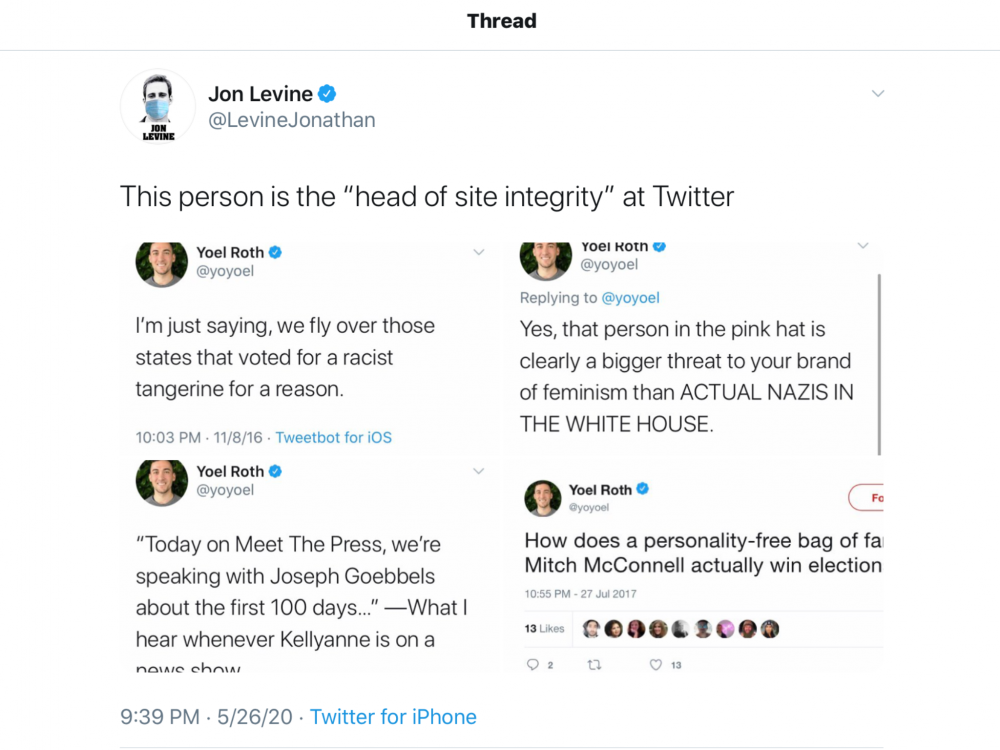
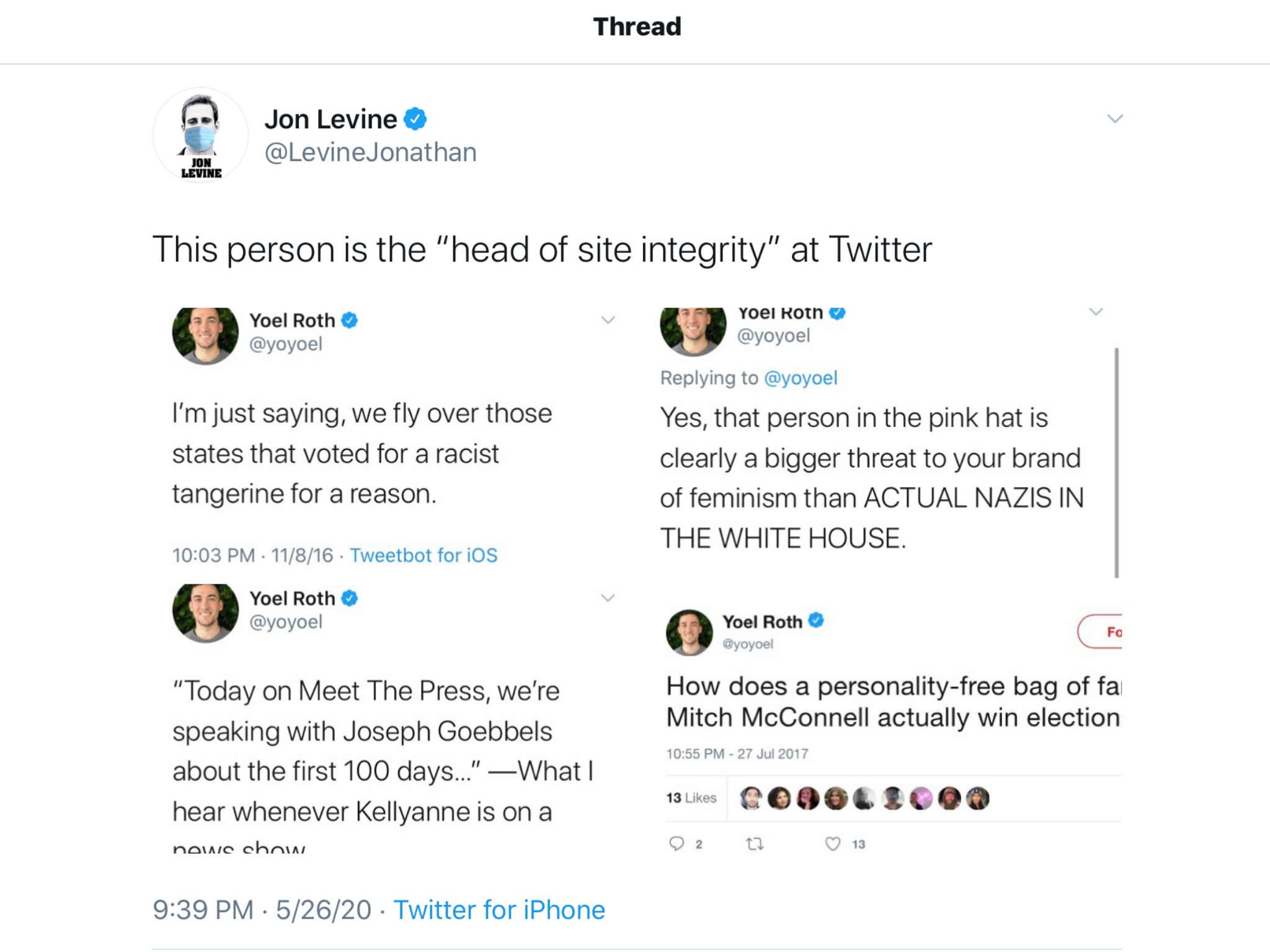
So Twitter names this anti-Trump guy Yoel Roth as Twitter’s Head of Site Integrity who has Tweeted posts such as:
“I’m just saying, we fly over those states that voter for a racist tangerine for a reason,” Roth wrote the night of the 2016 election.
Roth also called Senate Majority Leader Mitch McConnell a “bag of farts” in one tweet, and expressed fear over “actual nazis in the White House” in another.
Quite a display of site integrity there eh?
Earlier in 2018, Project Veritas obtained undercover footage of Twitter employees boasting about using their positions to quietly block certain users’ posts from being seen. “One strategy is to shadow ban so you have ultimate control,” said a former Twitter software engineer in the clip.
In testimony before Congress, Twitter CEO Jack Dorsey insisted that “Twitter does not use political ideology to make any decisions, whether related to ranking content on our service or how we enforce our rules.” Yet, when asked by podcaster Sam Harris about Twitter’s suspension of certain accounts, Dorsey claimed, “I don’t believe that we can afford to take a neutral stance anymore,” according to the Daily Wire
-
Sorry, I just haven't seen sufficient evidence yet that Twitter is actively "censoring" conservative viewpoints just because they're conservative. Most of the time when this comes up it turns out that user said something homophobic (or similar) and that led to the actions.
You never will because you don't want to.
James Woods was censored. You honestly never heard about that?
Twitter employees have been found guilty conservative censorship attempts before. In November 2018, Twitter suspended Marine veteran and conservative commentator Jesse Kelly’s account, but refused to explain why. After online backlash, Twitter reinstated Kelly’s account.
So Twitter names this anti-Trump guy Yoel Roth as Twitter’s Head of Site Integrity who has Tweeted posts such as:
“I’m just saying, we fly over those states that voter for a racist tangerine for a reason,” Roth wrote the night of the 2016 election.
Roth also called Senate Majority Leader Mitch McConnell a “bag of farts” in one tweet, and expressed fear over “actual nazis in the White House” in another.
Quite a display of site integrity there eh?
Earlier in 2018, Project Veritas obtained undercover footage of Twitter employees boasting about using their positions to quietly block certain users’ posts from being seen. “One strategy is to shadow ban so you have ultimate control,” said a former Twitter software engineer in the clip.
In testimony before Congress, Twitter CEO Jack Dorsey insisted that “Twitter does not use political ideology to make any decisions, whether related to ranking content on our service or how we enforce our rules.” Yet, when asked by podcaster Sam Harris about Twitter’s suspension of certain accounts, Dorsey claimed, “I don’t believe that we can afford to take a neutral stance anymore,” according to the Daily Wire
You never will because you don't want to.
James Woods was censored. You honestly never heard about that?
Twitter employees have been found guilty conservative censorship attempts before. In November 2018, Twitter suspended Marine veteran and conservative commentator Jesse Kelly’s account, but refused to explain why. After online backlash, Twitter reinstated Kelly’s account.
So Twitter names this anti-Trump guy Yoel Roth as Twitter’s Head of Site Integrity who has Tweeted posts such as:
“I’m just saying, we fly over those states that voter for a racist tangerine for a reason,” Roth wrote the night of the 2016 election.
Roth also called Senate Majority Leader Mitch McConnell a “bag of farts” in one tweet, and expressed fear over “actual nazis in the White House” in another.
Quite a display of site integrity there eh?
Earlier in 2018, Project Veritas obtained undercover footage of Twitter employees boasting about using their positions to quietly block certain users’ posts from being seen. “One strategy is to shadow ban so you have ultimate control,” said a former Twitter software engineer in the clip.
In testimony before Congress, Twitter CEO Jack Dorsey insisted that “Twitter does not use political ideology to make any decisions, whether related to ranking content on our service or how we enforce our rules.” Yet, when asked by podcaster Sam Harris about Twitter’s suspension of certain accounts, Dorsey claimed, “I don’t believe that we can afford to take a neutral stance anymore,” according to the Daily Wire
Supposed "censorship" attempts get posted on here all of the time. Most of those fall along the lines I previously mentioned.
Alex Jones getting banned doesn't make me think Twitter is going out of their way to ban conservatives.
Project Veritas has been proven to doctor footage so forgive me if I don't put any stock into what their "investigation" finds.
Again though, I don't see how Twitter DOESN'T have the ability to do this. This falls within their guidelines for moderation and doesn't make them a publisher. Trump and his followers are free to use another social media platform. Trump's petty vendetta leading to him trying to take out Section 230 is only going to make it worse. Twitter isn't violating the First Amendment. They aren't censoring him.




Hello! It looks like you're interested in this conversation, but you don't have an account yet.
Getting fed up of having to scroll through the same posts each visit? When you register for an account, you'll always come back to exactly where you were before, and choose to be notified of new replies (either via email, or push notification). You'll also be able to save bookmarks and upvote posts to show your appreciation to other community members.
With your input, this post could be even better 💗
Register Login