
Cue Up the Twilight Zone Theme. Baker spots UFO
-
Me and Orion are both astronomers....
Calling me an astronomer is an insult to astronomers. ? I'm just a mild enthusiast. I have an 8" equatorial that's set up in my enclosed back porch...but it hardly ever carries itself outside.
 The constellation Orion is heading west now at night. Spring's a Comin'.
Calling me an astronomer is an insult to astronomers. ? I'm just a mild enthusiast. I have an 8" equatorial that's set up in my enclosed back porch...but it hardly ever carries itself outside.
The constellation Orion is heading west now at night. Spring's a Comin'.
Me too... I just don't own a telescope yet.. I'm a space junkie...
-
I am going to use this to augment the Survey thread:
Have you ever seen what you believe to be a UFO?
I have not, not that I recall.
I am going to use this to augment the Survey thread:
Have you ever seen what you believe to be a UFO?
I have not, not that I recall.
I've seen weird things in the sky, that seem to move deliberately, then change direction, abruptly. If there are no aliens, how did mankind advance so far in the last 100 years or so, compared to the thousands of years of existence? One word...Roswell.
-
well, I've always be an outdoorsman/kid. Back in the sixties, on the farm, I'd go out and watch the stars at night sometimes, waiting for shooting stars. One night, there was a bright "star" moving across the sky, but about 3? times faster than any satellite I've ever seen, and far faster than the space station moves across the sky. I was watching it, moving fast, on a crystal clear dark night, and about the middle of the sky, it made a freaking 90 degree angle, and started fading out, like a ufo going away from earth.
Never saw anything like that again. 90 degrees? what the....so I give the Mayfields all the respect for what they saw.
You just never know.
As far as constellations... all I need to know is that the front lip of the big dipper, bottom to top, points toward North.
-
Me and Orion are both astronomers.... the bug bear to interstellar travel is this nasty thing called the speed of light. Only way to get from point A to point B in our galaxy is hope wormholes exist. Fer instance- even IF you could build a spaceship capable of travelling at the speed of light- (that's 186,000 miles per second, you can get to the Moon in a second and change) it would still take you 4 years to get to our nearest neighboring star, Alpha Centauri.
I always love to point out this reduction in scale example. Shrink the universe down to- the Sun is a dot, and the Earth is an atom sized speck orbiting it one inch away. On that scale Alpha Centauri is 4 miles away. Our nearest neighbor Andromeda Galaxy would be 10 times more distant than the Moon.
I had also read that there are suns so big.. it takes centuries even millenia to make one single orbit around it... I find that fascinating.. And really puts you in perspective to what we really are in terms of scale.. It makes me wonder if there is some microbial lifeform with intelligence equal or greater than ours... Thats mind numbing when you think of the scope of our universe...
I had also read that there are suns so big.. it takes centuries even millenia to make one single orbit around it... I find that fascinating.. And really puts you in perspective to what we really are in terms of scale.. It makes me wonder if there is some microbial lifeform with intelligence equal or greater than ours... Thats mind numbing when you think of the scope of our universe...
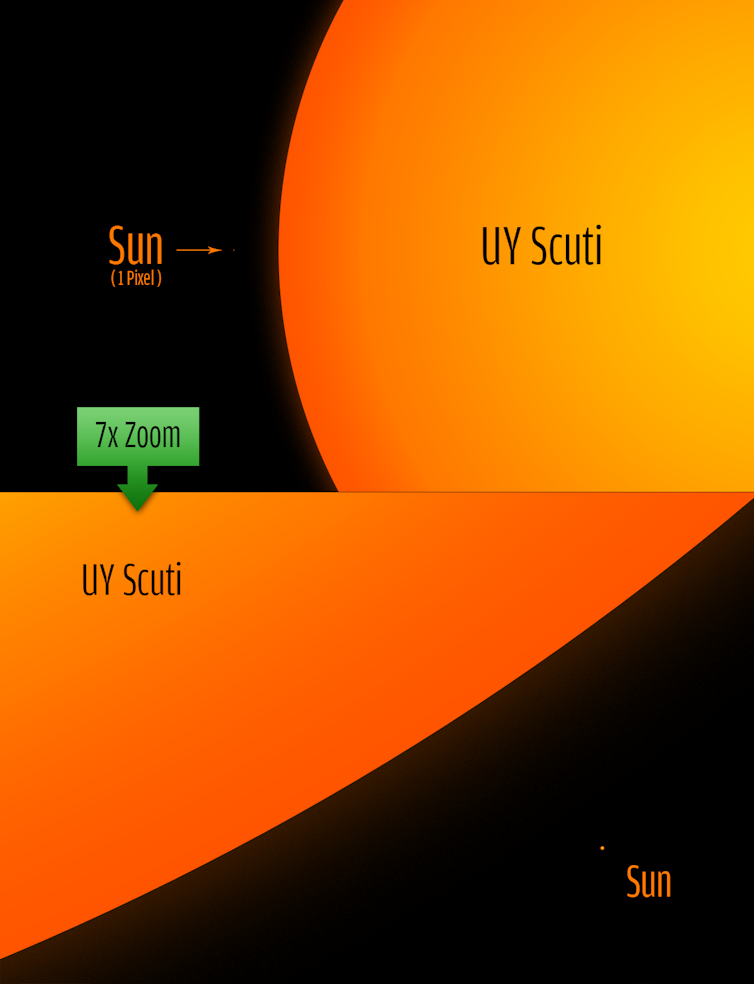
I knew off of the top of my head many stars are so large, Saturn's orbit would fit very comfortably inside them. Here's an image of the largest star we know about. In the dim constellation Scutum, 20 degrees north of Sagittarius.
Me too... I just don't own a telescope yet.. I'm a space junkie...
As to telescopes I actually own- an old 6" f\10 reflector I built 50 years ago. And a Meade 4" Schmidt-Cassegrain- the biggest 'scope that will fit in an overhead bin of an airplane. Handy when you go on solar eclipse trips. But you rapidly get spoiled when you have access to the local astronomy club's 16" reflector, or head out to star parties at dark sky sites where guys who are really into it haul their 24" and larger telescopes there on trailers. Jupiter was so bright looking through one of those 24" scopes, it almost hurt your eyes to look at it.
PS- it's a waste of money having one of those big scopes, unless you live somewhere way out in the country. With the ever increasing light pollution and sky glow, looking for- as I like to call them "the dim fuzzies" is like trying to spot a polar bear in a blizzard.
-
well, I've always be an outdoorsman/kid. Back in the sixties, on the farm, I'd go out and watch the stars at night sometimes, waiting for shooting stars. One night, there was a bright "star" moving across the sky, but about 3? times faster than any satellite I've ever seen, and far faster than the space station moves across the sky. I was watching it, moving fast, on a crystal clear dark night, and about the middle of the sky, it made a freaking 90 degree angle, and started fading out, like a ufo going away from earth.
Never saw anything like that again. 90 degrees? what the....so I give the Mayfields all the respect for what they saw.
You just never know.
As far as constellations... all I need to know is that the front lip of the big dipper, bottom to top, points toward North.
all I need to know is that the front lip of the big dipper, bottom to top, points toward North.
...towards True north. Or Celestial north. (the two stars farthest from the 'handle', follow the arc to Polaris)
A compass points to magnetic north which is to the left, or west, of true north. Magnetic north is a bit of a moving target due to molten material movement down inside the earth.
-
all I need to know is that the front lip of the big dipper, bottom to top, points toward North.
...towards True north. Or Celestial north. (the two stars farthest from the 'handle', follow the arc to Polaris)
A compass points to magnetic north which is to the left, or west, of true north. Magnetic north is a bit of a moving target due to molten material movement down inside the earth.
...towards True north. Or Celestial north. (the two stars farthest from the 'handle', follow the arc to Polaris)
A compass points to magnetic north which is to the left, or west, of true north. Magnetic north is a bit of a moving target due to molten material movement down inside the earth.
close enough to perfect for me! Thanks
-
...towards True north. Or Celestial north. (the two stars farthest from the 'handle', follow the arc to Polaris)
A compass points to magnetic north which is to the left, or west, of true north. Magnetic north is a bit of a moving target due to molten material movement down inside the earth.
close enough to perfect for me! Thanks
close enough to perfect for me! Thanks
Yup. If you're reading a map you're using true north. The stars are better than the compass. If you know how to use them. I'd wind up at the north pole going in circles.
-
-
well, I've always be an outdoorsman/kid. Back in the sixties, on the farm, I'd go out and watch the stars at night sometimes, waiting for shooting stars. One night, there was a bright "star" moving across the sky, but about 3? times faster than any satellite I've ever seen, and far faster than the space station moves across the sky. I was watching it, moving fast, on a crystal clear dark night, and about the middle of the sky, it made a freaking 90 degree angle, and started fading out, like a ufo going away from earth.
Never saw anything like that again. 90 degrees? what the....so I give the Mayfields all the respect for what they saw.
You just never know.
As far as constellations... all I need to know is that the front lip of the big dipper, bottom to top, points toward North.
well, I've always be an outdoorsman/kid. Back in the sixties, on the farm, I'd go out and watch the stars at night sometimes, waiting for shooting stars.
As far as constellations... all I need to know is that the front lip of the big dipper, bottom to top, points toward North.
In "point" of fact they aim directly at Polaris, the North Star. Of course if it's cloudy I take out my trusty multi-decade old turn of the 19th century brass cased compass.?
-
well, I've always be an outdoorsman/kid. Back in the sixties, on the farm, I'd go out and watch the stars at night sometimes, waiting for shooting stars.
As far as constellations... all I need to know is that the front lip of the big dipper, bottom to top, points toward North.
In "point" of fact they aim directly at Polaris, the North Star. Of course if it's cloudy I take out my trusty multi-decade old turn of the 19th century brass cased compass.?
In "point" of fact they aim directly at Polaris, the North Star. Of course if it's cloudy I take out my trusty multi-decade old turn of the 19th century brass cased compass.?
More trivia.
Well if it's a clear night- at least in Ohio, I can always orient myself. OTOH, we're living in a time where Polaris is (pretty close, not exactly) our "North Star". Wasn't always- or will be the case. The Earth, because of the gravitational drag on the us from the Moon wobbles like a top that's slowing down. It takes 24,000 years to complete one wobble. (Um, more accurately- the Tropic of Cancer and Tropic of Capricorn should now be renamed the Tropic of Gemini and Tropic of Sagittarius. ) Stars like Thuban in the constellation Draco, or Vega in Lyra will be "North Stars"- eventually. FWIW, currently there's no "South Star". The very dim 5th magnitude star Sigma Octans is as close as you get.
Now if you go way north- or way south, your perspective changes dramatically. The one time I was in Alaska when it was dark enough to see stars- really disorienting. Those stars should be way up there- but they weren't. My bucket list thing is to get south of the equator to see the sky (and Orion) flipped upside down. Tahiti at 17 degrees south works.
PS- as a kid - I thought I wanted to be a professional Astronomer. Several problems. First, you have to be a crack mathematician. Second, you need at least a Doctorate, and job opportunities are extremely limited. Third, guys were researching stuff at the time like Chandrasekhar's Limit, orbital mechanics (Grandpa gave me a magazine that had the equations on how we got the Mariner probe to Venus in 1962) , and theoretical astrophysics have zero interest to me.
-
In "point" of fact they aim directly at Polaris, the North Star. Of course if it's cloudy I take out my trusty multi-decade old turn of the 19th century brass cased compass.?
More trivia.
Well if it's a clear night- at least in Ohio, I can always orient myself. OTOH, we're living in a time where Polaris is (pretty close, not exactly) our "North Star". Wasn't always- or will be the case. The Earth, because of the gravitational drag on the us from the Moon wobbles like a top that's slowing down. It takes 24,000 years to complete one wobble. (Um, more accurately- the Tropic of Cancer and Tropic of Capricorn should now be renamed the Tropic of Gemini and Tropic of Sagittarius. ) Stars like Thuban in the constellation Draco, or Vega in Lyra will be "North Stars"- eventually. FWIW, currently there's no "South Star". The very dim 5th magnitude star Sigma Octans is as close as you get.
Now if you go way north- or way south, your perspective changes dramatically. The one time I was in Alaska when it was dark enough to see stars- really disorienting. Those stars should be way up there- but they weren't. My bucket list thing is to get south of the equator to see the sky (and Orion) flipped upside down. Tahiti at 17 degrees south works.
PS- as a kid - I thought I wanted to be a professional Astronomer. Several problems. First, you have to be a crack mathematician. Second, you need at least a Doctorate, and job opportunities are extremely limited. Third, guys were researching stuff at the time like Chandrasekhar's Limit, orbital mechanics (Grandpa gave me a magazine that had the equations on how we got the Mariner probe to Venus in 1962) , and theoretical astrophysics have zero interest to me.
More trivia.
Well if it's a clear night- at least in Ohio, I can always orient myself. OTOH, we're living in a time where Polaris is (pretty close, not exactly) our "North Star". Wasn't always- or will be the case. The Earth, because of the gravitational drag on the us from the Moon wobbles like a top that's slowing down. It takes 24,000 years to complete one wobble. (Um, more accurately- the Tropic of Cancer and Tropic of Capricorn should now be renamed the Tropic of Gemini and Tropic of Sagittarius. ) Stars like Thuban in the constellation Draco, or Vega in Lyra will be "North Stars"- eventually. FWIW, currently there's no "South Star". The very dim 5th magnitude star Sigma Octans is as close as you get.
Now if you go way north- or way south, your perspective changes dramatically. The one time I was in Alaska when it was dark enough to see stars- really disorienting. Those stars should be way up there- but they weren't. My bucket list thing is to get south of the equator to see the sky (and Orion) flipped upside down. Tahiti at 17 degrees south works.
PS- as a kid - I thought I wanted to be a professional Astronomer. Several problems. First, you have to be a crack mathematician. Second, you need at least a Doctorate, and job opportunities are extremely limited. Third, guys were researching stuff at the time like Chandrasekhar's Limit, orbital mechanics (Grandpa gave me a magazine that had the equations on how we got the Mariner probe to Venus in 1962) , and theoretical astrophysics have zero interest to me.
And on my bucket list is to see the Southern Cross. Got my "pioneering" compass all set to go. Damn this COVID crap.?
-
In "point" of fact they aim directly at Polaris, the North Star. Of course if it's cloudy I take out my trusty multi-decade old turn of the 19th century brass cased compass.?
More trivia.
Well if it's a clear night- at least in Ohio, I can always orient myself. OTOH, we're living in a time where Polaris is (pretty close, not exactly) our "North Star". Wasn't always- or will be the case. The Earth, because of the gravitational drag on the us from the Moon wobbles like a top that's slowing down. It takes 24,000 years to complete one wobble. (Um, more accurately- the Tropic of Cancer and Tropic of Capricorn should now be renamed the Tropic of Gemini and Tropic of Sagittarius. ) Stars like Thuban in the constellation Draco, or Vega in Lyra will be "North Stars"- eventually. FWIW, currently there's no "South Star". The very dim 5th magnitude star Sigma Octans is as close as you get.
Now if you go way north- or way south, your perspective changes dramatically. The one time I was in Alaska when it was dark enough to see stars- really disorienting. Those stars should be way up there- but they weren't. My bucket list thing is to get south of the equator to see the sky (and Orion) flipped upside down. Tahiti at 17 degrees south works.
PS- as a kid - I thought I wanted to be a professional Astronomer. Several problems. First, you have to be a crack mathematician. Second, you need at least a Doctorate, and job opportunities are extremely limited. Third, guys were researching stuff at the time like Chandrasekhar's Limit, orbital mechanics (Grandpa gave me a magazine that had the equations on how we got the Mariner probe to Venus in 1962) , and theoretical astrophysics have zero interest to me.
-
More trivia.
Well if it's a clear night- at least in Ohio, I can always orient myself. OTOH, we're living in a time where Polaris is (pretty close, not exactly) our "North Star". Wasn't always- or will be the case. The Earth, because of the gravitational drag on the us from the Moon wobbles like a top that's slowing down. It takes 24,000 years to complete one wobble. (Um, more accurately- the Tropic of Cancer and Tropic of Capricorn should now be renamed the Tropic of Gemini and Tropic of Sagittarius. ) Stars like Thuban in the constellation Draco, or Vega in Lyra will be "North Stars"- eventually. FWIW, currently there's no "South Star". The very dim 5th magnitude star Sigma Octans is as close as you get.
Now if you go way north- or way south, your perspective changes dramatically. The one time I was in Alaska when it was dark enough to see stars- really disorienting. Those stars should be way up there- but they weren't. My bucket list thing is to get south of the equator to see the sky (and Orion) flipped upside down. Tahiti at 17 degrees south works.
PS- as a kid - I thought I wanted to be a professional Astronomer. Several problems. First, you have to be a crack mathematician. Second, you need at least a Doctorate, and job opportunities are extremely limited. Third, guys were researching stuff at the time like Chandrasekhar's Limit, orbital mechanics (Grandpa gave me a magazine that had the equations on how we got the Mariner probe to Venus in 1962) , and theoretical astrophysics have zero interest to me.
And on my bucket list is to see the Southern Cross. Got my "pioneering" compass all set to go. Damn this COVID crap.?
And on my bucket list is to see the Southern Cross. Got my "pioneering" compass all set to go. Damn this COVID crap.?
Well I can say I've seen it. I'd almost say prepare to be disappointed. Theoretically- it clears the southern horizon in Key West, but you need to go far farther south for a better look. Like I did for a total solar eclipse in Curacao back in 1998. It's bright, but it's tiny. Use the two pointer stars in the Big Dipper for scale. Surprisingly, west of it there's an asterism called the False Cross that's bigger, and almost as bright.
-
I can't read it all, but I'm just gonna say one theory that I have. With the number of UFOs that are sighted in the US, I wouldn't be surprised if they were related to some aircraft by the Air Force or NASA or something like that.
The US has the best aviation on Earth because it guarantees a supremacy in many conflicts, so I wouldn't be surprised if there were secret aircrafts or spacecrafts (talking about drones, special satellites or stuff like that) that are sighted by people on the ground.
Plus it was in Texas, right? Aren't there Houston and other NASA related bases?
Btw, I took my usual break from the NFL so that's why I only commented on this topic. I usually read topic titles lately.
-
Look, the military literally came out and said we need help cause we have a confirmed case of a UFO. It's not crazy to think other people are seeing them.
Also, that Cowherd clip might literally be the dumbest thing that man has ever said.
-
Baker used to get hummers from skanks in the parking lot of Cheesecake Factories, now he's seeing UFOs.
Safe to say he never will have a boring offseason. Can't wait to see what happens next offseason.
-
-
Nice try... From the comments...
"Aside from the fact that there are no known ways to either contract existing spacetime or create new spacetime on demand, so the propulsion technique is entirely imaginary, hey, why not? I can imagine a sparkly yellow unicorn dancing in orbit around Mars, too - which is just as probable as this propulsive system."
Just a modified wormhole theory Gipper... Other than far beyond anything we can currently produce- it takes an unbelievable amount of energy to accelerate an object to quantum speeds. FWIW, the best we can currently do- 150,000 mph- we're well short of the roughly 3,600X faster we'd need to go- just to get to the speed of light. The other obvious thing- assuming Einstein is right- when you accelerate an object to above light speed- time moves backwards. For a kicks and giggles thought. Let's assume a spacecraft moving at double the speed of light. We get to Alpha Centauri in two years- that's 1\2 the time it took light to get to Earth. We're now living (relative to Earth)- two years in the past.
So is the speed of light the speed limit of our Universe? That will be a question for generations in our far distant future to answer.
-
Baker used to get hummers from skanks in the parking lot of Cheesecake Factories, now he's seeing UFOs.
Safe to say he never will have a boring offseason. Can't wait to see what happens next offseason.
Baker used to get hummers from skanks in the parking lot of Cheesecake Factories, now he's seeing UFOs.
Safe to say he never will have a boring offseason. Can't wait to see what happens next offseason.
Until I see him rolling up $20s on a rubber swan in a Vegas pool with a half-filled bottle of Jack floating nearby, he ain't got off-season game.?
-
Nice try... From the comments...
"Aside from the fact that there are no known ways to either contract existing spacetime or create new spacetime on demand, so the propulsion technique is entirely imaginary, hey, why not? I can imagine a sparkly yellow unicorn dancing in orbit around Mars, too - which is just as probable as this propulsive system."
Just a modified wormhole theory Gipper... Other than far beyond anything we can currently produce- it takes an unbelievable amount of energy to accelerate an object to quantum speeds. FWIW, the best we can currently do- 150,000 mph- we're well short of the roughly 3,600X faster we'd need to go- just to get to the speed of light. The other obvious thing- assuming Einstein is right- when you accelerate an object to above light speed- time moves backwards. For a kicks and giggles thought. Let's assume a spacecraft moving at double the speed of light. We get to Alpha Centauri in two years- that's 1\2 the time it took light to get to Earth. We're now living (relative to Earth)- two years in the past.
So is the speed of light the speed limit of our Universe? That will be a question for generations in our far distant future to answer.
Nice try... From the comments...
"Aside from the fact that there are no known ways to either contract existing spacetime or create new spacetime on demand, so the propulsion technique is entirely imaginary, hey, why not? I can imagine a sparkly yellow unicorn dancing in orbit around Mars, too - which is just as probable as this propulsive system."
Just a modified wormhole theory Gipper... Other than far beyond anything we can currently produce- it takes an unbelievable amount of energy to accelerate an object to quantum speeds. FWIW, the best we can currently do- 150,000 mph- we're well short of the roughly 3,600X faster we'd need to go- just to get to the speed of light. The other obvious thing- assuming Einstein is right- when you accelerate an object to above light speed- time moves backwards. For a kicks and giggles thought. Let's assume a spacecraft moving at double the speed of light. We get to Alpha Centauri in two years- that's 1\2 the time it took light to get to Earth. We're now living (relative to Earth)- two years in the past.
So is the speed of light the speed limit of our Universe? That will be a question for generations in our far distant future to answer.
What about the "wormhole" theory? I see it in science fiction all the time....but what is the supposed theory behind it. Stargate?
As, as a Dune fan, there is the concept of "Folding Space". Is that too just a modified wormhole theory? Whatever that is













Hello! It looks like you're interested in this conversation, but you don't have an account yet.
Getting fed up of having to scroll through the same posts each visit? When you register for an account, you'll always come back to exactly where you were before, and choose to be notified of new replies (either via email, or push notification). You'll also be able to save bookmarks and upvote posts to show your appreciation to other community members.
With your input, this post could be even better 💗
Register Login