
The Downstream Effects of Sanctioning Russia into the Stone Age
-
I will borrow a horse and buggy and wear a wide brimmed black hat and grow a beard before
I ever buy an electric car. Hell will freeze over first.
It will never happen. Never as in, you betcha not going to.
-
Part II: The Rest of the Russian Economy
There are three major types of fertilizer, derived from nitrogen, phosphate, or potash. Ammonia (NH3) is a byproduct of the refinement of LNG. Russia, with all their natural gas and ammonia, also happens to be the world's #1 exporter of nitrogen-based fertilizers. They are the #1 exporter of potash-based fertilizers too. Hey Cal, if you're still farming, could you give me a quick rundown of how much fertilizer cost in 2021 compared to 2020? Then could you take a wild guess at how much you think it will cost for this year's growing season?
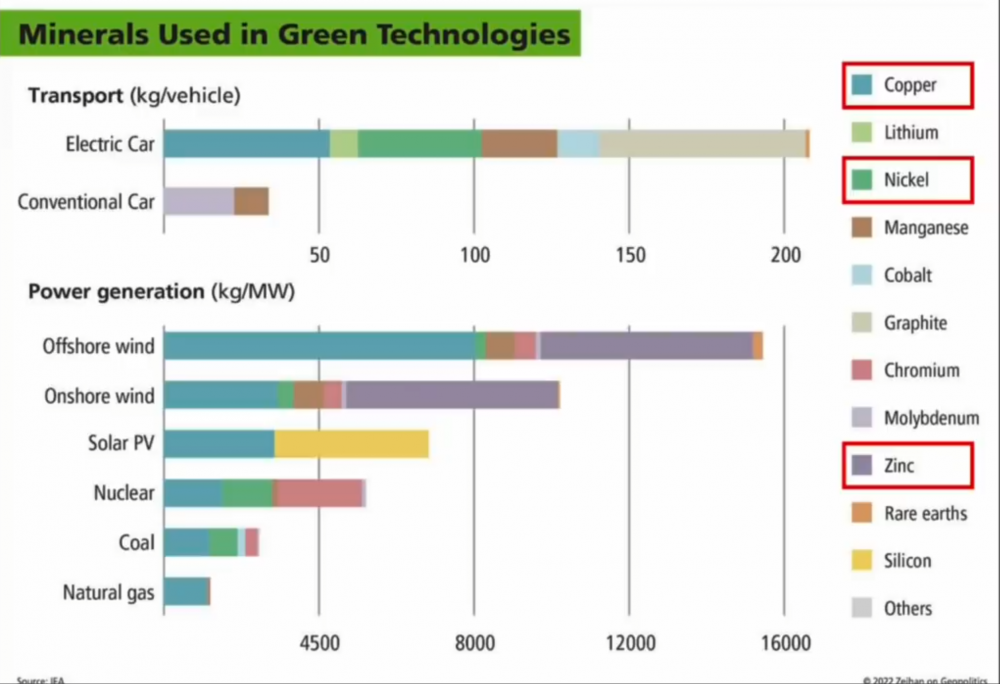
Metals and ores... Iron and low-quality steel. Russia is the #1 exporter. Nickel ore, #1 exporter. Finished nickel, #1 exporter. You can't make stainless steel without nickel, which has anti-corrosive properties. Most surgical plates and screws are alloys with nickel in them for their anti-corrosive and hardness properties. Some lasers utilize crystals that are doped with nickel. Geniuses like the press secretary and Pete Buttigieg have suggested that we need to transition to electric cars so that states like Russia can't hold us hostage with the oil. Well, that'd be fine, except for the fact that Tesla's car batteries require almost 50kg of nickel.
Wheat. Russia is a top 5 grain producer. Most of their export goes to the Middle East. The last time there were disruptions to this trade, it happened to correlate to the Arab Spring. Ukraine is a top 10 grain exporter. Now we're going to strain their ability to move that? Expect food conflicts to pop up abroad and/or much of the Middle East to change alignment from US to Russian/Chinese influence (as we are already starting to see). Now is a good time to grow some wheat, I think.
Platinum. Catalytic converters. Any piece of modern electronics. Hope you got your graphics cards and latest iphone. Russia is a top 3 producer of platinum.
This is the course we are now committed to by enacting these sanctions. Again, really glad I live in the US and not anywhere else with all of this looming.
Excellent stuff, Vapor ! Thanks !
Excellent stuff, Vapor ! Thanks !
Cal, could you answer my questions about fertilizer prices? I want to know how much you paid in 2020, how much you paid in 2021, and how much you think you'll pay this year.
Great info. My follow up question would be Russia's "market size", and not necessarily their rank. They could be #1 nickel exporter, but if 40 countries are major players in the space, then the impact may be overstated just by stating that Russia is the biggest.
I don't know that to be true, it's just what I would ask for next to better understand the impact.
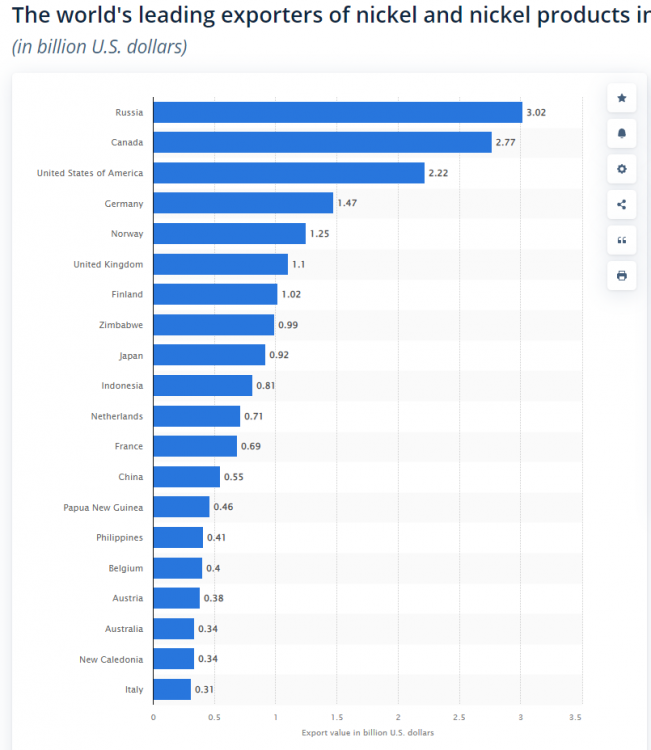
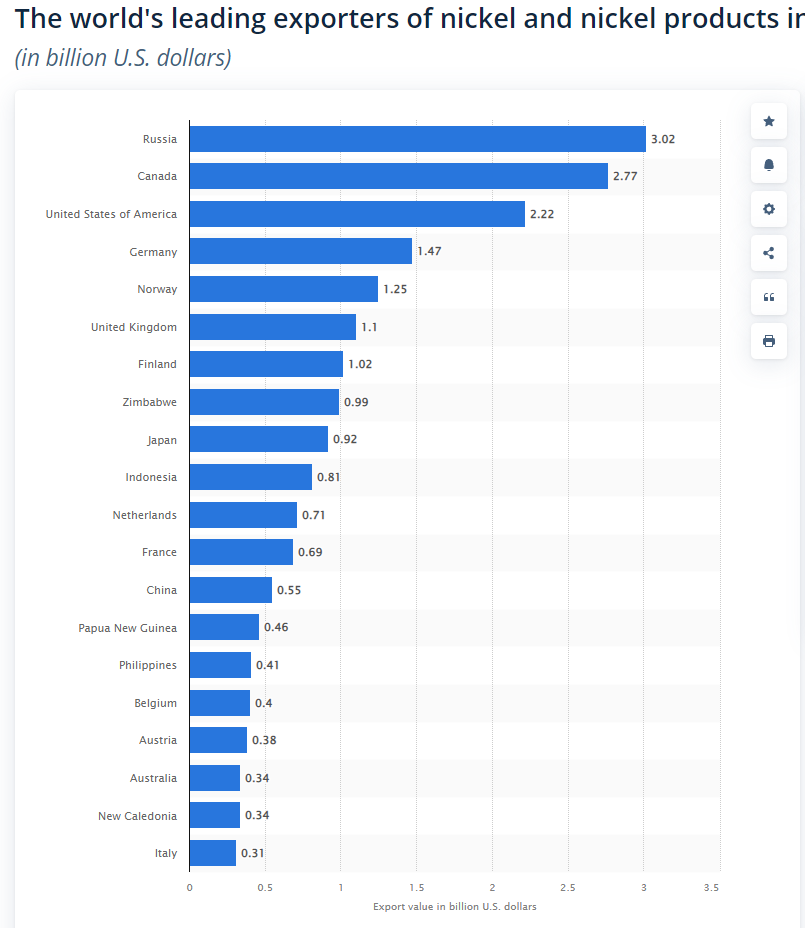
Below is sourced from statista. data is from 2020. I have read estimates that range from 7-15% range for their market share of all nickel products. When you look at refined nickel products, such as the stuff that goes into EV batteries, they have somewhere between 15-25% of the market. Of the countries below, Indonesia has the biggest reserves, which we will expect them to tap. However, I won't wager a guess at how long it would take to increase that production.
Again, great post. Thanks for the info
I agree that Russia's actions will drive change in the oil industry. I would argue that there should be "inorganic" reasons to drive that change instead of waiting for something like this. Oil companies are massively profitable and their main concern is improving that profit, not adequately supplying a critical product to the economy. If investing in more efficient equipment, or acting on those 9000 permits, doesn't financially make sense then it won't be done. I'd argue something the crucial shouldn't be left to the market and executives.
Yes, there is bloat in govt orgs. Tons of waste. No doubt. You're saying profits will provide incentives to seek efficiency, but in your same post you show how they're not getting more efficient with shale. If it doesn't benefit then to increase output or efficiency then they have no reason to do that, because their only driving forces are profits and shareholders, not the greater good. Instead we're waiting for outside forces, organic or otherwise, to change their calculus.
Right, but again, if this is the direction to think we should go then what are you going to do to drive us there? It doesn't make sense for large energy companies or it would be happening by now. Do you wait and hope the math changes, or do you use government intervention to force their hand?
Woody, you need to define what "the greater good" is. I would argue that the US government and the oil super majors have more or less been on the same page since the cold war, as they've had an overlap of interests. From the oil tycoon perspective, the more oil that is efficiently flowing across the globe, the higher the profits. From the US government's perspective, the more oil that flows, the more valuable the petrodollar, and that acts as a further support for American hegemony. If I had to guess at what your definition of greater good is, it would be the economic improvement and well-being of less industrialized countries, which would also overlap with what the US order and the oil super majors have done to this point. We might actually see the government forcing their hand, and while it would be better for the average Joe American, it certainly won't be for the greater good of the world.
If any of you geezers could weigh in on what politics were like during the oil crisis of the 70s, I'd be happy to listen. Does now feel comparable to the 70s?
(And that's with us just avoiding getting into EVs)
That's part III
-
just an opinion
MAGA included the dream bringing the industries back to America
that had been lost to say China, Russia for the sole purpose of protecting us (US) from such forewarned
foreign strategies that could blindside us at will?
I dont know, but Id be willing to bet that the voices in the past that said our national interests were at risk,
were systematically DROWNED out by those who are NOW in charge politically and what is currently in play?
the worst of which can be left up to our imagination.
-
Excellent stuff, Vapor ! Thanks !
Cal, could you answer my questions about fertilizer prices? I want to know how much you paid in 2020, how much you paid in 2021, and how much you think you'll pay this year.
Great info. My follow up question would be Russia's "market size", and not necessarily their rank. They could be #1 nickel exporter, but if 40 countries are major players in the space, then the impact may be overstated just by stating that Russia is the biggest.
I don't know that to be true, it's just what I would ask for next to better understand the impact.
Below is sourced from statista. data is from 2020. I have read estimates that range from 7-15% range for their market share of all nickel products. When you look at refined nickel products, such as the stuff that goes into EV batteries, they have somewhere between 15-25% of the market. Of the countries below, Indonesia has the biggest reserves, which we will expect them to tap. However, I won't wager a guess at how long it would take to increase that production.
Again, great post. Thanks for the info
I agree that Russia's actions will drive change in the oil industry. I would argue that there should be "inorganic" reasons to drive that change instead of waiting for something like this. Oil companies are massively profitable and their main concern is improving that profit, not adequately supplying a critical product to the economy. If investing in more efficient equipment, or acting on those 9000 permits, doesn't financially make sense then it won't be done. I'd argue something the crucial shouldn't be left to the market and executives.
Yes, there is bloat in govt orgs. Tons of waste. No doubt. You're saying profits will provide incentives to seek efficiency, but in your same post you show how they're not getting more efficient with shale. If it doesn't benefit then to increase output or efficiency then they have no reason to do that, because their only driving forces are profits and shareholders, not the greater good. Instead we're waiting for outside forces, organic or otherwise, to change their calculus.
Right, but again, if this is the direction to think we should go then what are you going to do to drive us there? It doesn't make sense for large energy companies or it would be happening by now. Do you wait and hope the math changes, or do you use government intervention to force their hand?
Woody, you need to define what "the greater good" is. I would argue that the US government and the oil super majors have more or less been on the same page since the cold war, as they've had an overlap of interests. From the oil tycoon perspective, the more oil that is efficiently flowing across the globe, the higher the profits. From the US government's perspective, the more oil that flows, the more valuable the petrodollar, and that acts as a further support for American hegemony. If I had to guess at what your definition of greater good is, it would be the economic improvement and well-being of less industrialized countries, which would also overlap with what the US order and the oil super majors have done to this point. We might actually see the government forcing their hand, and while it would be better for the average Joe American, it certainly won't be for the greater good of the world.
If any of you geezers could weigh in on what politics were like during the oil crisis of the 70s, I'd be happy to listen. Does now feel comparable to the 70s?
(And that's with us just avoiding getting into EVs)
That's part III
Cal, could you answer my questions about fertilizer prices? I want to know how much you paid in 2020, how much you paid in 2021, and how much you think you'll pay this year.
well, it depends - I don't know where the paper work is, but regular fertilizers have dramatically increased...
from 2020 to 2021, corn fertilizer (corn needs a LOT of nitrogen) - the price increased about 50%. Over just one acre, that's a lot.
I don't do soybeans anymore - I have refused to use roundup for years now, but a farmer friend that does - says soybean fertilizer has gone up about 25% during the above time frame. Soybeans don't need all that nitrogen.
If you need to add potash fertilizer, I had to phone a friend - that went up about 38% he said.
Consider the hundreds of lbs per acre, for a farmer that does many acres, his own and neighbors' large fields ...
(most farmers try to farm as many acres as possible to increase their profit margin) the cost is dramatic. Add to the cost of gas/diesel fuel, etc....
food prices are not going to be friendly soon. I may grow a survival food field this year. lol.
buckwheat, sweet corn, and other things.
Some farmers have gone organic - at least unofficially, like me - and the fertilizer costs is far higher. To qualify for official organic status, that takes bucks and time.
It seems that food prices are going to go way up, I fear - so many people not as well off as a lot of us - are going to
struggle. When inflation upsets the apple cart of profitability - that doesn't bode well for farmers who have a 350,000 used combine - a 125,000 tractor, fertilizer sprayers, $8,000 planters (we used to have one of those - and we bought it USED).....
people don't know the relatively small profitability margin farmers deal with. maintenance costs, fuel costs, fertilizer costs, and farmers pay rent to other land owners to farm their land, etc etc....
prices are going up and it could be worse than some folks can imagine.
I just bought a pressure canner/cooker - and have been dyhydrating fruits and unfrozen vegetables. Vegetables and meats must be pressure canned.
Folks need to consider that costs will go up for the farmer, for the moving of farmer's crops to buyers, for buyers to process and bag, for transporting to distribution warehouses, for delivery to stores, .... it doesn't take much mismanagement and stupid mmgw and endless money printing for prices to explode.
We have been working a good bit on self-sustainability to a degree. I want to put in a fish pond.
A big farmer friend is concerned, but has to keep on keeping on, he said. I had him cut and bale hay off our field, and gave him the
big round bales - for his cattle. He's a friend. Oh, last year, he bought fertilizer wholesale from the producing plant. The plant has now shut down, and he will have to buy fertizlier retail. That is a very bad sign.
-
and seed. When we planted soybeans - it cost about a thousand bucks for our bigger field back then...
Expect Higher Seed Corn Prices This Fall | Hoosier Ag Today
The first is that generally during higher expected revenue periods seed corn costs tend to rise. We saw rising revenues in 2020, and expect this to continue into 2021 and this would lead us to believe seed cost will rise in 2022." The ag economist expects seed corn costs to increase by $6 to $10 per acre. -
Thanks for sharing, cal.
-
Thanks for sharing, cal.
Thanks for sharing, cal.
Ironically, I just saw a while ago, that fertilizer and seed prices are expected to go up
by triple digit percentages.
-
Part III: The Impact on Future Technologies
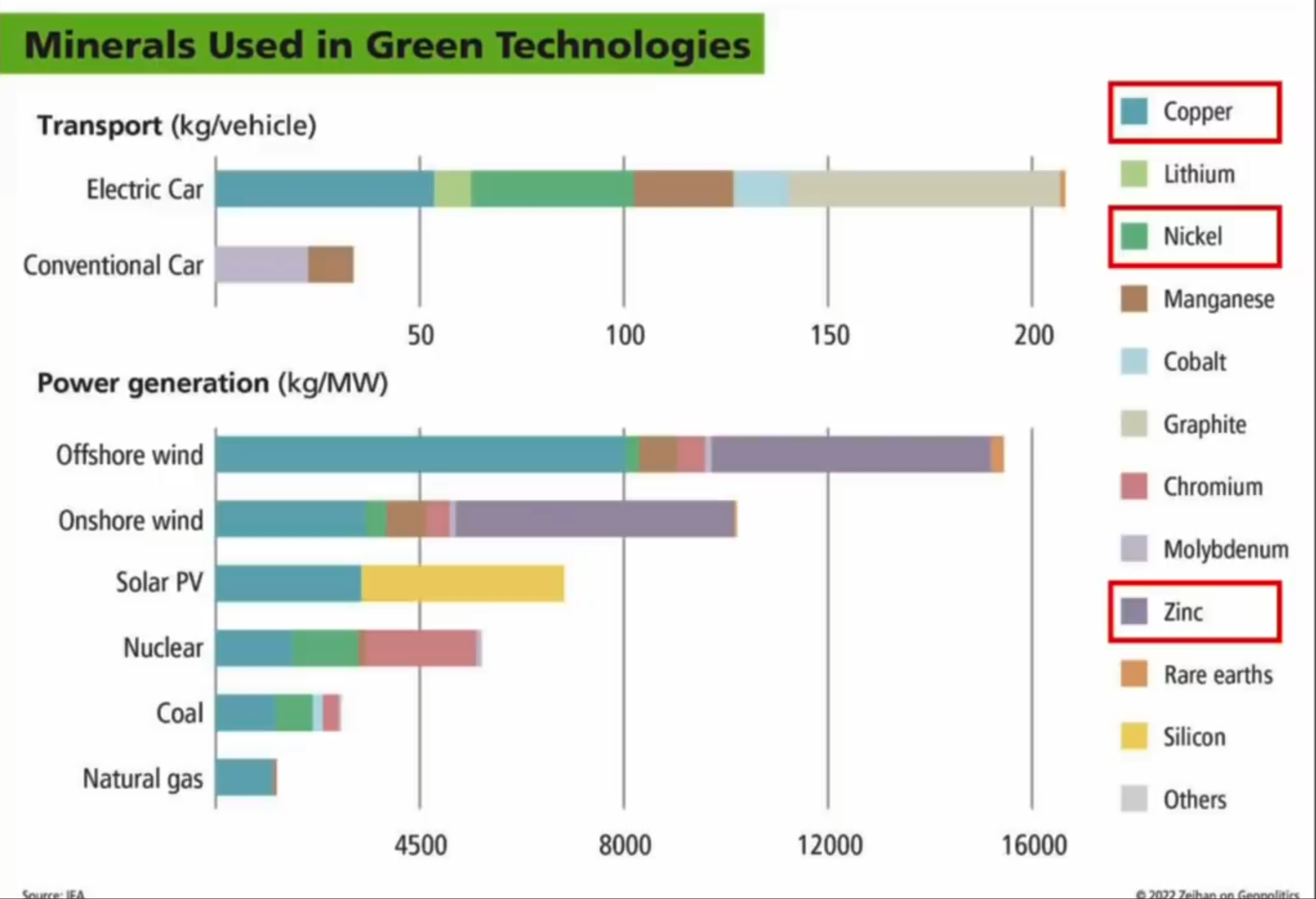
I've seen a lot of people positing that this conflict will open the floodgates on green tech. I think that it will actually have the opposite effect. Russia is a top 5 exporter of nickel, steel, and aluminum. You need nickel for resistance to corrosion. You need steel for basically everything. You need aluminum to make it strong, but light. Wind turbines, nuclear reactors, EVs - their production is going to be even more cost-prohibitive than it is now.
Below is an interesting graphic from Peter Zeihan's upcoming book. You can see that you need a lot less metal mass per vehicle or per megawatt generated versus fossil fuel infrastructure. It's not a good time to go green.
Source: Zeihan on Geopolitics
-
Makes me happy that I invested in copper a couple of years ago.
-
Thanks for sharing, cal.
Ironically, I just saw a while ago, that fertilizer and seed prices are expected to go up
by triple digit percentages.
Ironically, I just saw a while ago, that fertilizer and seed prices are expected to go up
by triple digit percentages.
Well, you know who produces the most shit,, eeerrr, fertilizer
 Our musical works to date http://www.arielsatticmusic.com/
 -
Just saw a few articles claiming that Bidenl threatened the Chinese with sanctions should they become involved. No doubt that will hurt the United States consumer more than it will hurt the Chinese. And let me guess that the EU will still buy Russian oil and gas and Chinese products. So the actual pain will be borne by American citizens. Maybe Biden supporters should go on a hunger strike until Putin surrenders?
WSS
-
@vaportrail what are your thoughts on the thousands of previously approved drilling permits that the oil companies aren't using?
Not to get all socialist here, but maybe something as critical to our economy, and the world's, should be entirely left up to CEOs looking to get the most benefit for their shareholders.
@vaportrail what are your thoughts on the thousands of previously approved drilling permits that the oil companies aren't using?
Not to get all socialist here, but maybe something as critical to our economy, and the world's, should be entirely left up to CEOs looking to get the most benefit for their shareholders.
Not to mention the Keystone Pipeline exists and is operational. Phases 1-3 are going it was Phase 4, Keystone XL, that was cancelled. Phases 1-3 have the capacity to transport 1.3 million barrels per day.
-
If the EU and NATO continue to buy Russian oil and the price of a barrel doubles who is suffering, the Russians or the people that buy the oil?
Seems like a case of "this is going to hurt me more than it's going to hurt you!"
Just wait till we get the bill for the sanctions against China.
WSS
-
My other thought on this topic, in regards to the sources of these metals, is where the current production is compared to where the reserves of these metals are located. It could all be getting mined already and this is a moot point, I don't know. But I am wondering if this is a similar situation to oil and natural gas, where there are more locations where these resources can be extracted, but for various reasons, the companies that do the extraction have deemed those locations not financially viable. Are the more domestic, non-Russian sources of nickel that could be tapped to aid in the production of these modern technologies, but mining companies feel that it is too costly (location, regulations, labor, etc.)? If that is the case, then you either wait for the "free" market to come around and make those mines economically viable (price increases / supply shortages out of Russia) or you direct funding from the govt. to subsidize these efforts and kickstart the process (maybe just but two fewer fighter jets in the defense budget or something...)
Ja.brill Peppers - Cleveland Brown OldBrownsFan, on 02 Jun 2017 - 5:09PM said: "No you are not the work of the devil but you are deceived by the devil." Who's got it better than us? Nooooobody! -
My other thought on this topic, in regards to the sources of these metals, is where the current production is compared to where the reserves of these metals are located. It could all be getting mined already and this is a moot point, I don't know. But I am wondering if this is a similar situation to oil and natural gas, where there are more locations where these resources can be extracted, but for various reasons, the companies that do the extraction have deemed those locations not financially viable. Are the more domestic, non-Russian sources of nickel that could be tapped to aid in the production of these modern technologies, but mining companies feel that it is too costly (location, regulations, labor, etc.)? If that is the case, then you either wait for the "free" market to come around and make those mines economically viable (price increases / supply shortages out of Russia) or you direct funding from the govt. to subsidize these efforts and kickstart the process (maybe just but two fewer fighter jets in the defense budget or something...)
My other thought on this topic, in regards to the sources of these metals, is where the current production is compared to where the reserves of these metals are located. It could all be getting mined already and this is a moot point, I don't know. But I am wondering if this is a similar situation to oil and natural gas, where there are more locations where these resources can be extracted, but for various reasons, the companies that do the extraction have deemed those locations not financially viable. Are the more domestic, non-Russian sources of nickel that could be tapped to aid in the production of these modern technologies, but mining companies feel that it is too costly (location, regulations, labor, etc.)? If that is the case, then you either wait for the "free" market to come around and make those mines economically viable (price increases / supply shortages out of Russia) or you direct funding from the govt. to subsidize these efforts and kickstart the process (maybe just but two fewer fighter jets in the defense budget or something...)

-
My other thought on this topic, in regards to the sources of these metals, is where the current production is compared to where the reserves of these metals are located. It could all be getting mined already and this is a moot point, I don't know. But I am wondering if this is a similar situation to oil and natural gas, where there are more locations where these resources can be extracted, but for various reasons, the companies that do the extraction have deemed those locations not financially viable. Are the more domestic, non-Russian sources of nickel that could be tapped to aid in the production of these modern technologies, but mining companies feel that it is too costly (location, regulations, labor, etc.)? If that is the case, then you either wait for the "free" market to come around and make those mines economically viable (price increases / supply shortages out of Russia) or you direct funding from the govt. to subsidize these efforts and kickstart the process (maybe just but two fewer fighter jets in the defense budget or something...)
My other thought on this topic, in regards to the sources of these metals, is where the current production is compared to where the reserves of these metals are located. It could all be getting mined already and this is a moot point, I don't know. But I am wondering if this is a similar situation to oil and natural gas, where there are more locations where these resources can be extracted, but for various reasons, the companies that do the extraction have deemed those locations not financially viable. Are the more domestic, non-Russian sources of nickel that could be tapped to aid in the production of these modern technologies, but mining companies feel that it is too costly (location, regulations, labor, etc.)? If that is the case, then you either wait for the "free" market to come around and make those mines economically viable (price increases / supply shortages out of Russia) or you direct funding from the govt. to subsidize these efforts and kickstart the process (maybe just but two fewer fighter jets in the defense budget or something...)
I'm all for decreasing US defense spending, but you can't just move it from the DOD budget to the DOE budget and expect that to fix the issue. The people with the highest expertise in these fields are in the private sector. So if the government were to say "Hey, we want to add infrastructure for mining raw metal" you can bet that they'd be contracting out a significant portion of that work - and in my estimation the contractors (oil super majors, large mining companies) would still be running the show. Everything that you're suggesting is happening as we speak, but it's going to be on the order of years, in my opinion before these things can really get running.
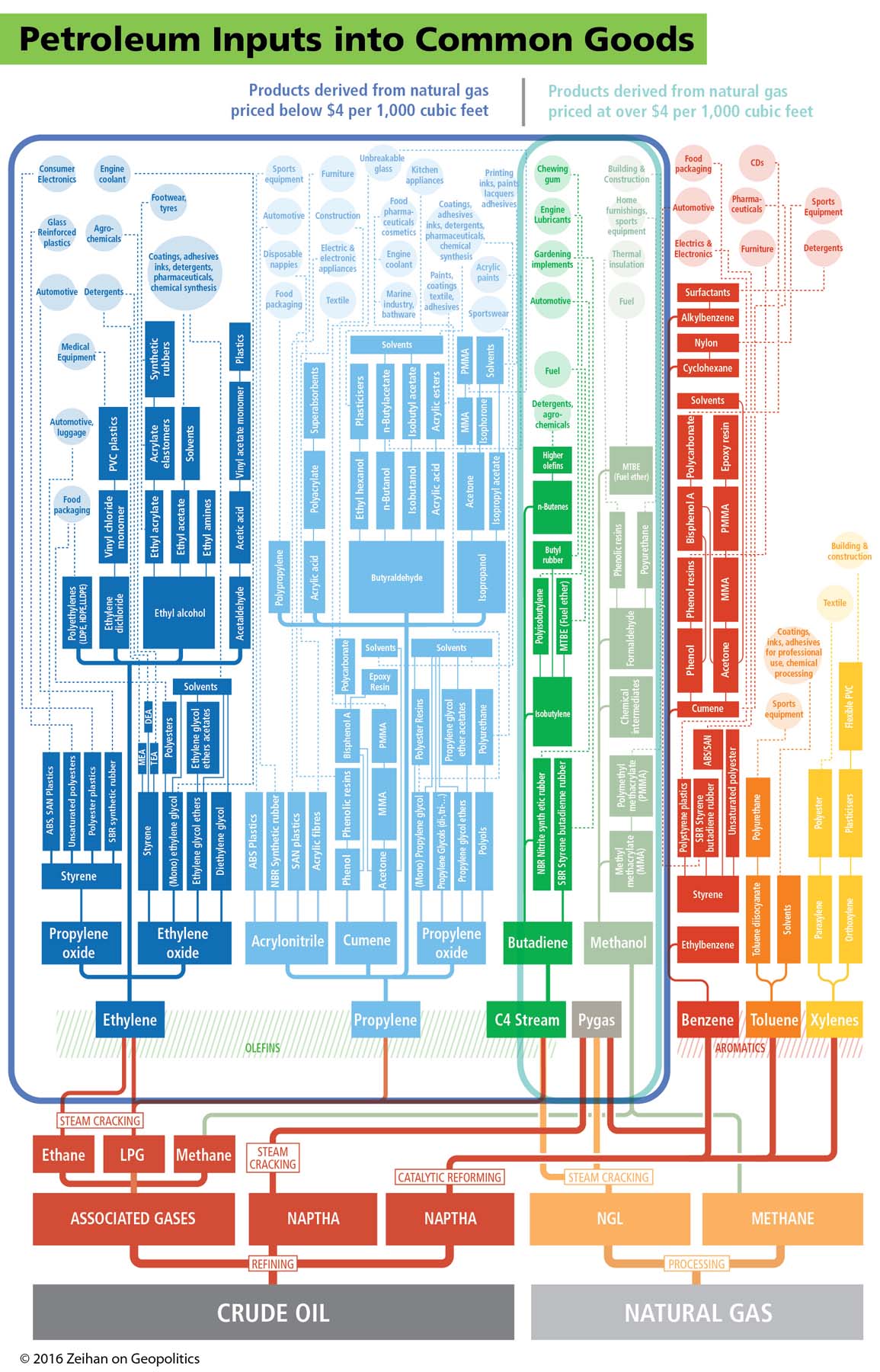
In the case of natural gas, however, Russia owns a product that is inelastic. The image below shows a lot of the end products in petroleum/shale/gas refinement. Source: Zeihan. The biggest story that will dictate the geopolitics of Europe is the G7 commitment to NOT cede to Putin's demand to only accept Rubles for payment for their gas/oil products. Russia's next step may be to shut off the gas. This will squeeze the Europeans, and Russia will be paying close attention to the Germans. If they get squeezed hard enough, then Putin could have the upper hand in negotiations and demand that Germany withdraw from NATO defense commitments. They'll do the same to Turkey, who they also share a pipeline with. If those two countries cave, then every NATO member will be second guessing what this alliance actually means. This is Putin's long game. All of this is going to happen long before the replacement infrastructure is in place.
-
My other thought on this topic, in regards to the sources of these metals, is where the current production is compared to where the reserves of these metals are located. It could all be getting mined already and this is a moot point, I don't know. But I am wondering if this is a similar situation to oil and natural gas, where there are more locations where these resources can be extracted, but for various reasons, the companies that do the extraction have deemed those locations not financially viable. Are the more domestic, non-Russian sources of nickel that could be tapped to aid in the production of these modern technologies, but mining companies feel that it is too costly (location, regulations, labor, etc.)? If that is the case, then you either wait for the "free" market to come around and make those mines economically viable (price increases / supply shortages out of Russia) or you direct funding from the govt. to subsidize these efforts and kickstart the process (maybe just but two fewer fighter jets in the defense budget or something...)
I'm all for decreasing US defense spending, but you can't just move it from the DOD budget to the DOE budget and expect that to fix the issue. The people with the highest expertise in these fields are in the private sector. So if the government were to say "Hey, we want to add infrastructure for mining raw metal" you can bet that they'd be contracting out a significant portion of that work - and in my estimation the contractors (oil super majors, large mining companies) would still be running the show. Everything that you're suggesting is happening as we speak, but it's going to be on the order of years, in my opinion before these things can really get running.
In the case of natural gas, however, Russia owns a product that is inelastic. The image below shows a lot of the end products in petroleum/shale/gas refinement. Source: Zeihan. The biggest story that will dictate the geopolitics of Europe is the G7 commitment to NOT cede to Putin's demand to only accept Rubles for payment for their gas/oil products. Russia's next step may be to shut off the gas. This will squeeze the Europeans, and Russia will be paying close attention to the Germans. If they get squeezed hard enough, then Putin could have the upper hand in negotiations and demand that Germany withdraw from NATO defense commitments. They'll do the same to Turkey, who they also share a pipeline with. If those two countries cave, then every NATO member will be second guessing what this alliance actually means. This is Putin's long game. All of this is going to happen long before the replacement infrastructure is in place.
I'm all for decreasing US defense spending
Sure, let's decrease while Russia and China are in cahoots. Let's spend it on welfare and green energy instead.
-
I'm all for decreasing US defense spending
Sure, let's decrease while Russia and China are in cahoots. Let's spend it on welfare and green energy instead.
Sure, let's decrease while Russia and China are in cahoots. Let's spend it on welfare and green energy instead.
Why don't we do that with social security instead ?
-
Sure, let's decrease while Russia and China are in cahoots. Let's spend it on welfare and green energy instead.
Why don't we do that with social security instead ?
Why don't we do that with social security instead ?
I agree. For anyone retiring after 2050.?
-
Let's talk about the Horn of Africa.
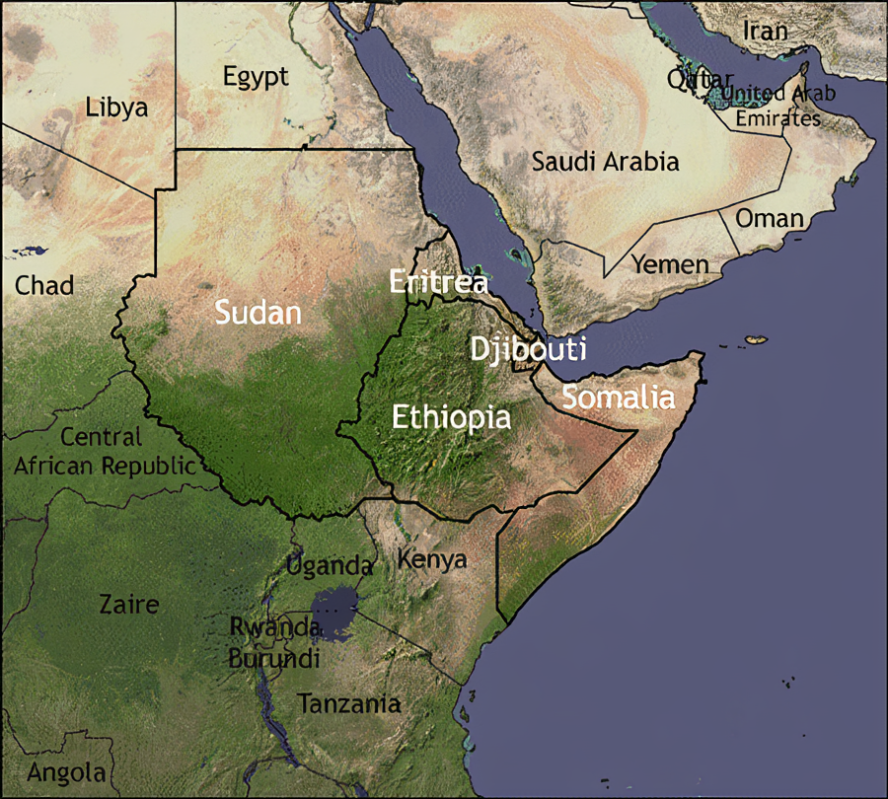
About 150 million people live in the area consisting of Sudan, Eritrea, Djibouti, Ethiopia, and Somalia. These folks haven't exactly been dealt a good hand, and life over there is about to get significantly harder.

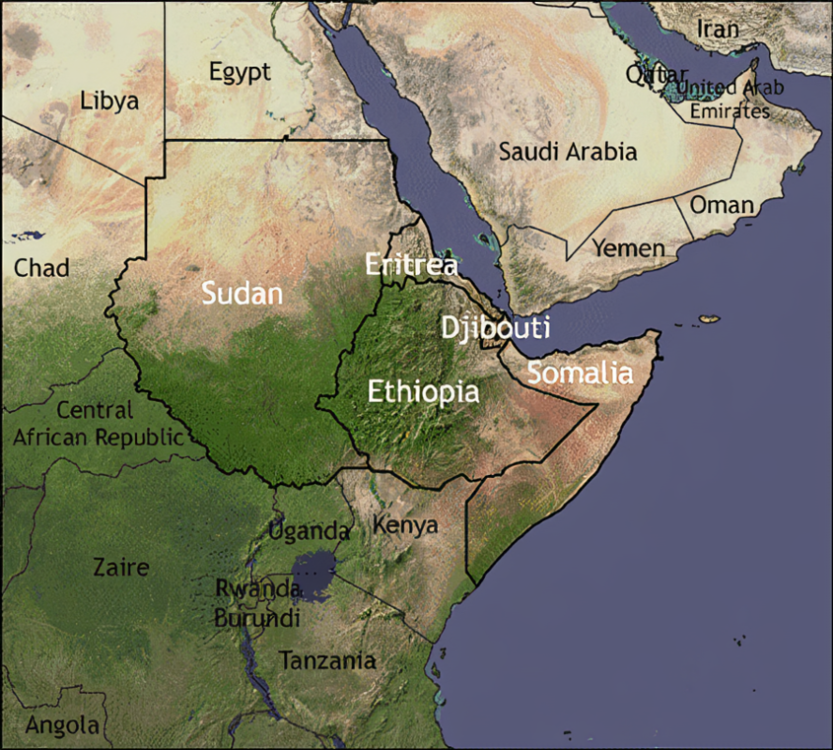
Looking at the map, you can see that the western areas of the horn are forested, and as you go further north into Sudan and Egypt, it turns to desert. This region is a powder keg of water and food conflicts, and they're about to get triply squeezed.
The Grand Ethiopian Renaissance Dam
The Nile River is the largest source of freshwater for much of the region and beyond, and you can see it dividing Egypt and flowing through Sudan. One of the major tributaries that feeds the Nile is the Blue Nile. This river runs through the greenest part of Ethiopia and flows into Sudan. Ethiopia has started a major engineering project called the Grand Ethiopian Renaissance Dam.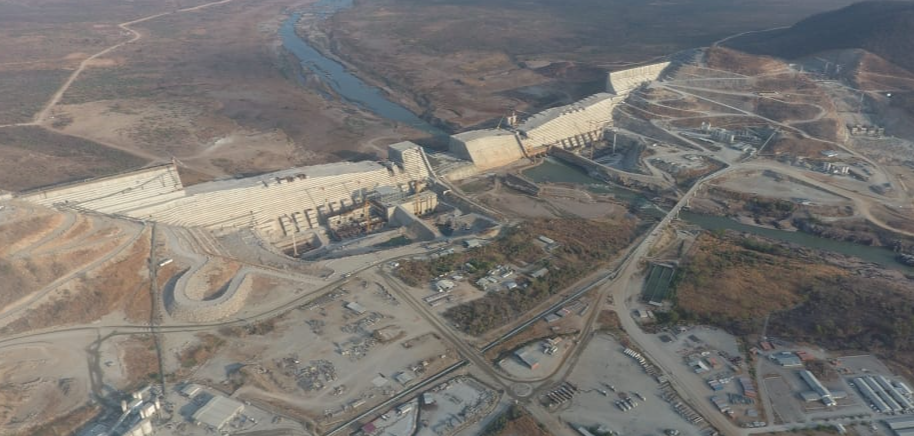
This dam was built on the Blue Nile. It will affect the 13 countries in the Nile River basin and the 300 million people living there. Damming this river has been a contentious issue for Egypt and Ethiopia for about 100 years. In July of last year, the Ethiopians said to hell with what the Egyptians and Sudanese want, and they started filling it. It is expected to take 4-6 years until the filling is complete. 90% of Egypt's water supply comes from the Nile. 30% of the country's working population is in Nile-based agriculture. The looming water crisis is an existential threat to both countries, and diplomatic compromises have been scarce.
The Ukranian Conflict
I've talked at length about how most of the surplus grain from Ukraine and Russia goes to Africa. 80% of Egypt's wheat imports came from the two countries. They've secured some exports from India to make up for the supply disruption. 60% of Sudan's imported wheat was from Russia and Ukraine. In Ethiopia, 45% of their imported wheat is from Russia and Ukraine. These countries aren't particularly wealthy to begin with, and here is what has happened to the price of wheat over the last 5 years.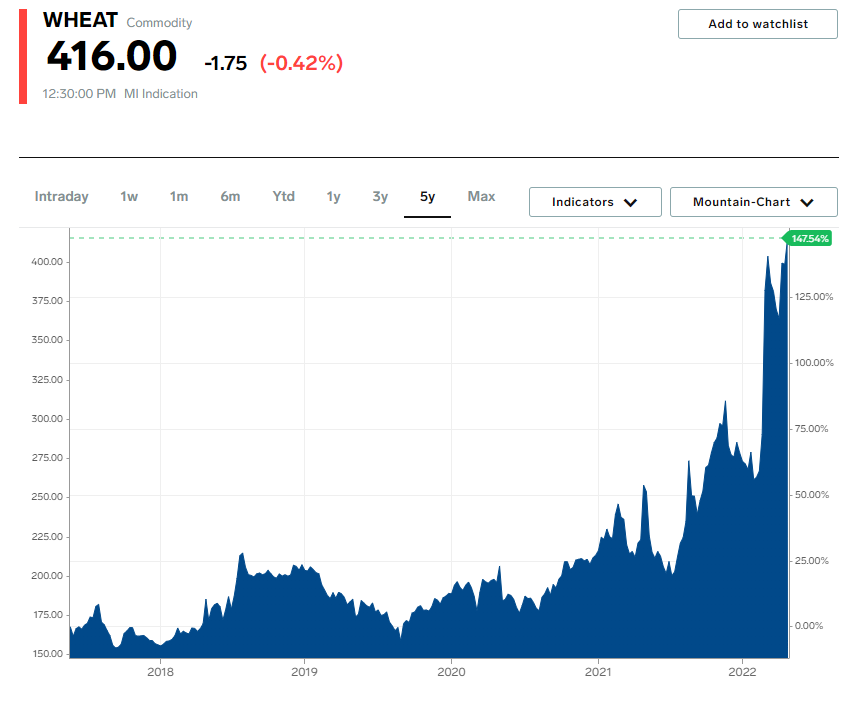
Historic Drought
The Horn is currently experiencing the worst drought in about 40 years. When a similar drought hit Ethiopia in the 80s, approximately 1 million people died. The UN has called for donations, and the world community has pledged $1.4 billion dollars.So, what does this have to do with anything?
There will be refugees. Some will flee to Kenya. The Middle Eastern countries might take a small number. Turkey has historically taken a bunch from Syria/Iraq, but the conflict in Syria would be a barrier for refugees. I would bet that many of them try to take a trip across the Mediterranean where Europe is already struggling to take in refugees from Ukraine. Look at the response to current riots in Sweden over some troll burning a Koran, for example. More Europeans are starting to question if taking in massive amounts of refugees from a different culture is worth the clashes that follow. Even in France, where Macron just won his election, the nationalist party candidate Marine Le Pen increased her vote share by 10% compared to the election in 2017.
As of last year, analysts suggested that proxy conflicts over the Grand Ethiopian Renaissance Dam were likely. An open war between Egypt and Ethiopia was considered to be highly unlikely. Now that the region is dealing with all 3 of these issues at the same time, the probability of an open war increases. If this were to happen, Egypt would likely target the dam. Ethiopia would target the Suez Canal. Remember how big a deal it was when the Evergreen container ship got stuck there for a week? Remember all the delays that caused? This would be considerably worse, as container ships and barges would be avoiding the area completely instead of waiting nearby for it to reopen. This is a major shipping route for LNG and oil from the Middle East to Europe, who already lacks the resolve to stop buying Russian fossil fuels and is funding the Ukrainian invasion. It's also the most direct route for getting Russian oil to China.
Obviously, I can't predict the future, but I am certainly starting to get concerned about things snowballing. On the one hand, you have Russian aggression galvanizing the rest of Europe into sanctioning them into the stone age. On the other, these sanctions are about to amplify the European refugee and energy crises. It will be interesting to see how it plays out, but when you have people like Boris Johnson shouting that the sanctions will continue even if Russia ceases hostilities, it doesn't really give Putin a reason to stop.









Hello! It looks like you're interested in this conversation, but you don't have an account yet.
Getting fed up of having to scroll through the same posts each visit? When you register for an account, you'll always come back to exactly where you were before, and choose to be notified of new replies (either via email, or push notification). You'll also be able to save bookmarks and upvote posts to show your appreciation to other community members.
With your input, this post could be even better 💗
Register Login