
Your Opinion On Student Loan Forgiveness
-
Okay we can pretend there's never been a conversation here about people with certain levels of formal education and how they vote or earn or brag about the reputation of the institution of learning they attend.
By the way as you absolutely know I never paint anything as only. So you're the guy being disingenuous here, again.
And the fact that things do happen underscores my point. Silly degrees are certainly a big part of it. Valid degrees for people who have absolutely no work ethic nor any aptitude to do that job even if they did finish the degree is another. Getting a degree in a field or too many people are going for that same degree, communications or marketing for example, is another. The kid that takes guitar lessons and still sucks for whatever reason doesn't get his money back. The kid who takes guitar lessons and becomes really really good but can't get a gig doesn't get his money back. The kid who takes guitar lessons and plays pretty well then finds out that playing in a band isn't all that lucrative doesn't get his money back.
But as far as free shit, like with the commonplace high school diploma if k - 16 is run the same way, which I guarantee it will be, that associates degree won't be worth much anyway.
(Just and aside the three people I know of that defaulted went for law enforcement social work and fashion design)
By the way 24% of those who graduate from law schools aren't even practicing law.
WSS
The last guy on here, and maybe only, to brag about how much he makes was Axe
I'm commenting on how you phrased your first post. Being a college student just doesn't make people feel superior. The institution plays a role, for sure, and so does the individual. I also would confuse arrogance and pride. But again, this is you framing your argument in a certain way.
Even in your response above, you move to admitting people with "valid" degrees may get screwed by student loans too, but then immediately insinuate those individuals have no work ethic or aptitude. Once again, there are plenty of younger people that got "real" degrees, in fields of high demand, that are good at their jobs and still have to deal with the shackles of student loan debt. You can't just say this is only for lazy people, or people who picked bad degrees, or whatever... whatever you come up with to frame the argument in a way you can blame the student, absolving you from thinking there is a problem that even needs solved.
A college degree doesn't lose its value in the workforce just because students don't have to go into crippling debt to get it... the value is in the curriculum and the work that was put in to graduate (plus all of the other stuff, like alumni networks, career resources, school prestige, experiences, etc)
I graduated with an engineering degree and I won't be doing engineering soon. Careers are fluid.
But I'm saying you do the same schtick with your "free shit" rants. The people voting for progressive policies are just lazy and want free stuff, blah blah blah. Doesn't work as well when someone like me votes for those policies, which provide me no direct benefit, and raise my taxes. But you're framing it a certain way on purpose.
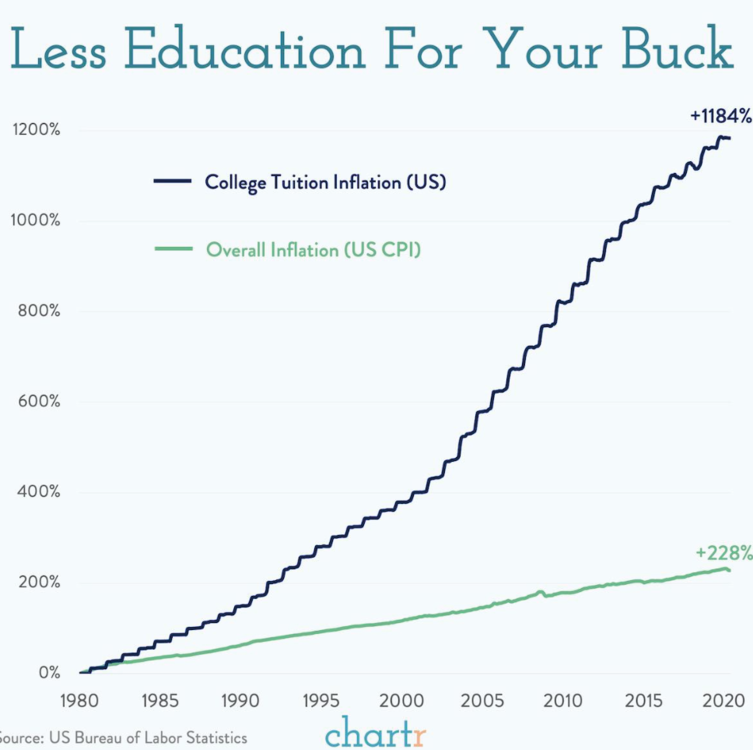
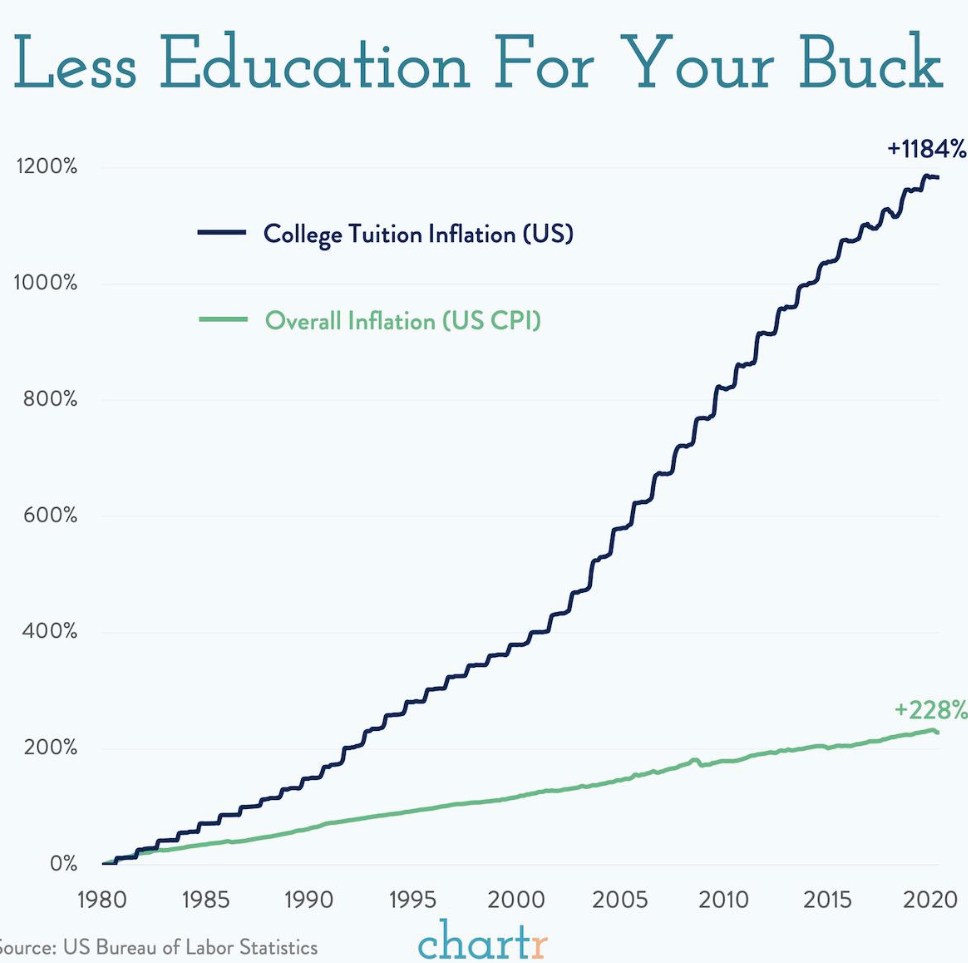
As D Bone touched on in the post after yours, the issue is the rising costs of tuition. Far far far outpacing damn near anything else.
I graduated with an engineering degree and I won't be doing engineering soon.
-
I don't think anybody probably has a complaint with lowering the a p r.
WSS
-
Okay we can pretend there's never been a conversation here about people with certain levels of formal education and how they vote or earn or brag about the reputation of the institution of learning they attend.
By the way as you absolutely know I never paint anything as only. So you're the guy being disingenuous here, again.
And the fact that things do happen underscores my point. Silly degrees are certainly a big part of it. Valid degrees for people who have absolutely no work ethic nor any aptitude to do that job even if they did finish the degree is another. Getting a degree in a field or too many people are going for that same degree, communications or marketing for example, is another. The kid that takes guitar lessons and still sucks for whatever reason doesn't get his money back. The kid who takes guitar lessons and becomes really really good but can't get a gig doesn't get his money back. The kid who takes guitar lessons and plays pretty well then finds out that playing in a band isn't all that lucrative doesn't get his money back.
But as far as free shit, like with the commonplace high school diploma if k - 16 is run the same way, which I guarantee it will be, that associates degree won't be worth much anyway.
(Just and aside the three people I know of that defaulted went for law enforcement social work and fashion design)
By the way 24% of those who graduate from law schools aren't even practicing law.
WSS
The last guy on here, and maybe only, to brag about how much he makes was Axe
I'm commenting on how you phrased your first post. Being a college student just doesn't make people feel superior. The institution plays a role, for sure, and so does the individual. I also would confuse arrogance and pride. But again, this is you framing your argument in a certain way.
Even in your response above, you move to admitting people with "valid" degrees may get screwed by student loans too, but then immediately insinuate those individuals have no work ethic or aptitude. Once again, there are plenty of younger people that got "real" degrees, in fields of high demand, that are good at their jobs and still have to deal with the shackles of student loan debt. You can't just say this is only for lazy people, or people who picked bad degrees, or whatever... whatever you come up with to frame the argument in a way you can blame the student, absolving you from thinking there is a problem that even needs solved.
A college degree doesn't lose its value in the workforce just because students don't have to go into crippling debt to get it... the value is in the curriculum and the work that was put in to graduate (plus all of the other stuff, like alumni networks, career resources, school prestige, experiences, etc)
I graduated with an engineering degree and I won't be doing engineering soon. Careers are fluid.
But I'm saying you do the same schtick with your "free shit" rants. The people voting for progressive policies are just lazy and want free stuff, blah blah blah. Doesn't work as well when someone like me votes for those policies, which provide me no direct benefit, and raise my taxes. But you're framing it a certain way on purpose.
As D Bone touched on in the post after yours, the issue is the rising costs of tuition. Far far far outpacing damn near anything else.
The last guy on here, and maybe only, to brag about how much he makes was Axe
I'm commenting on how you phrased your first post. Being a college student just doesn't make people feel superior. The institution plays a role, for sure, and so does the individual. I also would confuse arrogance and pride. But again, this is you framing your argument in a certain way.
Even in your response above, you move to admitting people with "valid" degrees may get screwed by student loans too, but then immediately insinuate those individuals have no work ethic or aptitude. Once again, there are plenty of younger people that got "real" degrees, in fields of high demand, that are good at their jobs and still have to deal with the shackles of student loan debt. You can't just say this is only for lazy people, or people who picked bad degrees, or whatever... whatever you come up with to frame the argument in a way you can blame the student, absolving you from thinking there is a problem that even needs solved.
A college degree doesn't lose its value in the workforce just because students don't have to go into crippling debt to get it... the value is in the curriculum and the work that was put in to graduate (plus all of the other stuff, like alumni networks, career resources, school prestige, experiences, etc)
I graduated with an engineering degree and I won't be doing engineering soon. Careers are fluid.
But I'm saying you do the same schtick with your "free shit" rants. The people voting for progressive policies are just lazy and want free stuff, blah blah blah. Doesn't work as well when someone like me votes for those policies, which provide me no direct benefit, and raise my taxes. But you're framing it a certain way on purpose.
As D Bone touched on in the post after yours, the issue is the rising costs of tuition. Far far far outpacing damn near anything else.
1 I don't remember Axe saying anything of the sort.
2 it is my way of framing it because I think it's true. College students have a tendency to be condescending little snots. And looking down their noses at people in trailer parks who work low-paying jobs.
3 don't be silly I've never denied there are differing values to degrees. Still people with work ethic are more successful. More successful than someone that got a social promotion high school diploma. It will be the same deal with 4 more years is free with absolutely no reason to work hard or not work hard. Especially, if you know this happens, the government has to pay your rent and food while you are in college. And the institutions of Higher Learning which really are businesses will find some way for dimwits to pass a class or two to keep the government-run money pouring in. And no doubt s*** happens. If there are too many marketing majors the demand goes down. But if everybody has an associate's or bachelor's degree and something then those degrees won't mean anything. Then the government has to pay for Masters and doctorates. As far as prestige? Then the deadbeats will be crying but they have to have a degree Stanford or Yale or Harvard and that Cleveland State just doesn't cut the mustard.
4 back to the previous reply. High schools find a way to pass people. If college is now paid for by the government colleges will find a way to pass people. And if it's free school Prestige no longer plays A Part.
5 whether or not you will still be Engineering in a few years you still got that job with your degree. You probably wouldn't have gotten that with a degree in clarinet.
6 And I will continue to rant about free shit because the demand from you people will never end. It will never be enough. Not for the 'poor' people or for the politicians pretend to want to help them or the liberal guilty White people who enjoy wringing their hands and feeling superior to those of us who think poor people are by and large a combination of stupid lazy and unlucky. But that's really another subject. I can't help it if the marketing plan of the Institutes of Higher Learning has been successful in making their product overpriced. People make bad or unlucky decisions about Investments all the time.
WSS
-
So most of the time I guess I like Elon Musk pretty well. I just saw a blurb supposedly from him which does make sense. This is a paraphrase: an 18 year old can't take out a $10,000 business loan but he can take out a $100,000 student loan and that's the problem. Or a problem.
(I may have added that he's also not seen as having his shit together well enough to be trusted with a beer or a pack of cigarettes.)
WSS
-
I have six figures in student loan debt and the means to pay it back. If Uncle Sam insists the taxpayer subsidize it, I'm not so dogmatic that I'd turn it down. The boomers got their education and homes cheap; they also got that social security teat. Now, homes and tuition are the highest they've ever been. Social Security won't be there when I need it. Why shouldn't I be selfish here?
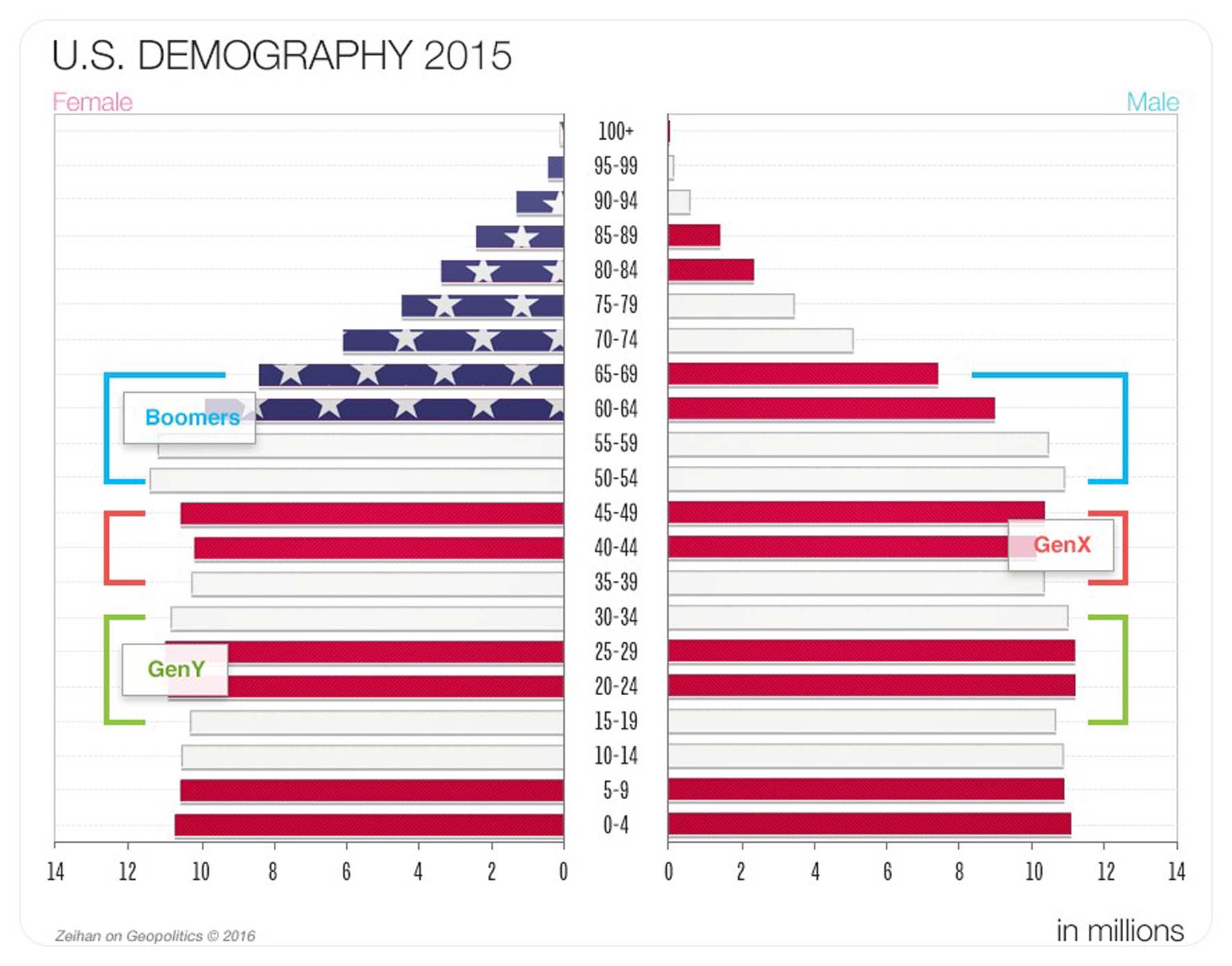
The demographics of the country dictate that complete student loan forgiveness is a matter of when and not a matter of if. Millennials are the biggest generation since the boomers. It will be paid off at the expense of Generation X, who will not have the votes to overcome the never-ending debt constituency. College isn't getting any cheaper, and I'd expect the zoomers will be siding with their parents over their grandparents on this issue.
College is a racket.
-
Boomers got homes cheap? In the 70's and 80's a interest on a home loan was in the teens. You had to make a lot of money to afford a home then. Education costs were on par with now when you take in disposable income. Sorry.
-
I think I was 27 when I bought my first home, a bungalow and a up and down duplex on the same lot. Sure it was a dump but the interest rate was 9 and a half percent. It seems around that time I was thinking to myself if I could just make two hundred and fifty bucks a week forever things would be sweet.
Minor in secondary Ed which, had I decided to do that, probably would have kept me employed as a teacher. (fortunately I chose a different career path one of the few I could find that was even easier haha) Don't know what a state college costs to get a degree in teaching.
As to Vapors statement I agree. Even if I am opposed to most forms of free s*** I would probably accept it if they threw some my way, but I'd be a little bit embarrassed.
WSS
-
Boomers got homes cheap? In the 70's and 80's a interest on a home loan was in the teens. You had to make a lot of money to afford a home then. Education costs were on par with now when you take in disposable income. Sorry.
Boomers got homes cheap? In the 70's and 80's a interest on a home loan was in the teens. You had to make a lot of money to afford a home then. Education costs were on par with now when you take in disposable income. Sorry.
Do you have any data to back up that assertion? Cuz this data from the US Bureau of Labor Statistics says otherwise.
-
Look up the housing interest rates.
1970s
Thanks to Freddie Mac, there’s solid data available for 30-year fixed-rate mortgage rates beginning in 1971.
Rates in 1971 were in the mid-7% range, and they moved up steadily until they were at 9.19% in 1974. They briefly dipped down into the mid- to high-8% range before climbing to 11.20% in 1979. This was during a period of high inflation that hit its peak early in the next decade.
1980s
In both the 1970s and 1980s, the United States was pushed into a recession caused by an oil embargo against the country. The Organization of the Petroleum Exporting Countries (OPEC) instituted the embargo. One of the effects of this was hyperinflation, which meant that the price of goods and services rose extremely fast.
To counteract hyperinflation, the Federal Reserve raised short-term interest rates. This made money in savings accounts worth more. On the other hand, all interest rates rose, so the cost of borrowing money increased, too.
Interest rates reached their highest point in modern history in 1981 when the annual average was 16.63%, according to the Freddie Mac data. Fixed rates declined from there, but they finished the decade around 10%. The 1980s were an expensive time to borrow money.
1990s
In the 1990s, inflation started to calm down a little bit. The average mortgage rate in 1990 was 10.13%, but it slowly fell, finally dipping below 7% to come in at 6.94% in 1998.
According to a paper published by the Economic Policy Institute, one big reason for the economic growth and declining inflation seen later in the decade was the arrival of the internet in the mainstream consciousness. The increased investment in research and development of new technologies spurred a ton of economic growth.
2000s
Mortgage rates steadily declined from 8.05% in 2000 to the high-5% range in 2003. However, it wasn’t all milk and honey in this decade.
The housing crash happened in part because property values declined steeply until they hit their lowest point in 2008. This left many homeowners owing more on their homes than the property was worth. To provide some relief and to stimulate the economy, the Federal Reserve cut interest rates to make borrowing money cheaper.
Short-term rates, or the rates at which financial institutions borrow money, ended up being slashed to the point where they were at or near 0. This made it extremely cheap for banks to borrow funds so they could keep mortgage rates low.
As a result of this change, mortgage rates fell almost a full percentage point, averaging 5.04% in 2009.
2010s
Riding the wave of low bank borrowing costs, mortgage rates entered the new decade around 4.69%. They continued to fall steadily and were in the mid-3% range by 2012. In 2013, rates went up to 3.98%. A big reason for this was that the bond market panicked a little bit when the Federal Reserve said it would stop buying as many bonds.
When there are fewer buyers available, the yields on mortgage bonds have to go up to attract purchasers. This also causes mortgage rates to rise. Rates went up to 4.17% in 2014. In 2015, mortgage rates fell back to 3.85% as the market calmed down.
Although they were a little higher to end the year, rates in 2016 averaged 3.65%. With global turmoil, investors flocked to the safety of the U.S. bond market to guarantee the steadiness of their investments.
Rates began to rise after the 2016 presidential election. They reached their peak at the end of 2018/start of 2019. Rates on a 30-year fixed rate mortgage (FRM) ran between 3.95% on the low end and 5.34% on the high.
Take the first step toward the right mortgage.
2020-2021
Rates declined throughout 2019. When January 2020 came around, the average rate for a 30-year fixed was about 3.7%.
Then COVID-19 hit the United States. In response, the Federal Reserve dropped the federal funds rate to between 0 – 0.25%. This caused other short-term and long-term rates to drop.
This move was made to encourage borrowing on home loans, as well as other loans. It also led to a large increase in refinance and mortgage applications. By December, Freddie Mac reported an average mortgage rate for a 30-year FRM sitting at 2.68%.
Mortgage rates then hovered within the same range for the first half of 2021. The June rate increased slightly to 2.98%. Since then, rates have started to edge upward. As of October 21, Freddie Mac reported an average mortgage rate for 30-year FRM of 3.09%. Mortgage rate forecasts predict a continued increase by year’s end, which some attribute to inflation driven by temporary supply-chain issues. That could make 2021 – 2022 a good time to consider refinancing.
-
I did not know interest rates ran that high for housing way back when. I'd like to see if the end cost of a home is comparable after being adjusted for inflation. For the current rates, they're back up to 5%. I locked in at 3.2 before it got crazy, but the house would have sold for 75% what I paid if I had the opportunity to buy it pre-pandemic.
-
I did not know interest rates ran that high for housing way back when. I'd like to see if the end cost of a home is comparable after being adjusted for inflation. For the current rates, they're back up to 5%. I locked in at 3.2 before it got crazy, but the house would have sold for 75% what I paid if I had the opportunity to buy it pre-pandemic.
I did not know interest rates ran that high for housing way back when. I'd like to see if the end cost of a home is comparable after being adjusted for inflation. For the current rates, they're back up to 5%. I locked in at 3.2 before it got crazy, but the house would have sold for 75% what I paid if I had the opportunity to buy it pre-pandemic.
"Historical Mortgage Rates: Averages and Trends from the 1970s to 2019 - ValuePenguin" https://www.valuepenguin.com/mortgages/historical-mortgage-rates
-
I bought my 1st house in 1990 when I was just 23 years old. I paid $114,990 for it and my one and only approved loan option had a $101,000 lending limit to a 1st time home buyer and my interest rate was 12%. I had to come in with over $18K of cash to close and my payments were just over $1,200 per month - of '90s money.
Boy was my house cheap..... I was so very privileged.
-
The house I bought 5 years ago was $250k And now the Zillow estimate is over $330k... Crazy
No idea house the housing market compares now vs back then, but I know for a fact college is much, much more expensive
Ja.brill Peppers - Cleveland Brown OldBrownsFan, on 02 Jun 2017 - 5:09PM said: "No you are not the work of the devil but you are deceived by the devil." Who's got it better than us? Nooooobody! -
The house I bought 5 years ago was $250k And now the Zillow estimate is over $330k... Crazy
No idea house the housing market compares now vs back then, but I know for a fact college is much, much more expensive
The house I bought 5 years ago was $250k And now the Zillow estimate is over $330k... Crazy
No idea house the housing market compares now vs back then, but I know for a fact college is much, much more expensive
My dad oh, may he rest in peace, told me years ago he remembers Grandpa wondering if he'd ever be able to make eight $22 a month house payment.
WSS
-
The house I bought 5 years ago was $250k And now the Zillow estimate is over $330k... Crazy
No idea house the housing market compares now vs back then, but I know for a fact college is much, much more expensive
The house I bought 5 years ago was $250k And now the Zillow estimate is over $330k... Crazy
No idea house the housing market compares now vs back then, but I know for a fact college is much, much more expensive
-
I think if you take out student loans, as with any loan, you should have to pay them back.
The interest rates on student loans should be very low thoughBut having buyers remorse, because you got a degree that costs $80,000. And that degree, is in a field that you can’t get a job to pay it back, is your own stupid fault
"And they don't really know even what they're talkin' about And I can't imagine what empty heads can achieve." -
there seems to be a whole subculture of refusal to accept responsibility for one's actions - as in, no consequences because it is "not fair".
There is legislation now, not passed yet, that would allow abortions up to 7 days AFTER BIRTH. To them, a red line is just another line to eventually cross. It was 28 days, I heard, but they changed it to only 7 days.
Student loans - permissible mob crime in big democrat cities. open borders. dangerous criminals let in again and again and ....again...
getting degrees in nonsense "fields" that dont' yeild good jobs, or any job. drug traffic - they are release from facing consequences....
but it gets a lot of votes to the leftwing marxists who perpetuate it - and on and on the madness goes.
It won't end soon, and will get far worse before it ever does end.
-
I think if you take out student loans, as with any loan, you should have to pay them back.
The interest rates on student loans should be very low thoughBut having buyers remorse, because you got a degree that costs $80,000. And that degree, is in a field that you can’t get a job to pay it back, is your own stupid fault
I think if you take out student loans, as with any loan, you should have to pay them back.
The interest rates on student loans should be very low thoughBut having buyers remorse, because you got a degree that costs $80,000. And that degree, is in a field that you can’t get a job to pay it back, is your own stupid fault
Student loans are the symptom
Hyper inflated college costs are the disease
You provide some level of student loan forgiveness for those suffering now and then you reform college tuition.
Easy for people to say "just pay it off. Don't sign something you can't pay off. Blah blah blah". But going to college is basically required for most careers. Yes, people should consider trades, but you still need a lot of people going to college.
Ja.brill Peppers - Cleveland Brown OldBrownsFan, on 02 Jun 2017 - 5:09PM said: "No you are not the work of the devil but you are deceived by the devil." Who's got it better than us? Nooooobody! -
they should still be responsible for their decisions. Go to school at home? in state? save money?
or, go to a party school on the beach in californica or Florida?
if gullible feeeeelllllings students choose smartly, they would not GO to those expensive schools....
those colleges would not charge so much to go to college. They would not throw money around like it was leaves in a forest.
So many students decide they want to go away to college- be on their "own".
ok, then they are responsible by themselves and their not smart decisions based on their feelings.







Hello! It looks like you're interested in this conversation, but you don't have an account yet.
Getting fed up of having to scroll through the same posts each visit? When you register for an account, you'll always come back to exactly where you were before, and choose to be notified of new replies (either via email, or push notification). You'll also be able to save bookmarks and upvote posts to show your appreciation to other community members.
With your input, this post could be even better 💗
Register Login