
I got yer mmgw proof of bs right here
-
The Polar Ice Cap EffectAs long as the continent of Antarctica exists at the southern pole of our planet we probably will be repeatedly pulled back into glacial ice ages. This occurs because ice caps, which cannot attain great thickness over open ocean, can and do achieve great thickness over a polar continent-- like Antarctica. Antarctica used to be located near the equator, but over geologic time has moved by continental drift to its present location at the south pole. Once established, continental polar ice caps act like huge cold sinks, taking over the climate and growing bigger during periods of reduced solar output. Part of the problem with shaking off the effects of an ice age is once ice caps are established, they cause solar radiation to be reflected back into space, which acts to perpetuate global cooling. This increases the size of ice caps which results in reflection of even more radiation, resulting in more cooling, and so on.Continental polar ice caps seem to play a particularly important role in ice ages when the arrangement of continental land masses restrict the free global circulation of equatorial ocean currents. This is the case with the continents today, as it was during the Carboniferous Ice Age when the supercontinent Pangea stretched from pole to pole 300 million years ago.Stopping Climate ChangePutting things in perspective, geologists tell us our present warm climate is a mere blip in the history of an otherwise cold Earth. Frigid Ice Age temperatures have been the rule, not the exception, for the last couple of million years. This kind of world is not totally inhospitable, but not a very fun place to live, unless you are a polar bear.Some say we are "nearing the end of our minor interglacial period" , and may in fact be on the brink of another Ice Age. If this is true, the last thing we should be doing is limiting carbon dioxide emissions into the atmosphere, just in case they may have a positive effect in sustaining present temperatures. The smart money, however, is betting that there is some momentum left in our present warming cycle. Environmental advocates agree: resulting in a shift of tactics from the "global cooling" scare of the 1970s to the "global warming" threat of the 1980s and 1990s.Now, as we begin the 21st century the terminology is morphing toward"climate change," whereby no matter the direction of temperature trends-- up or down-- the headlines can universally blame humans while avoiding the necessity of switching buzz-words with the periodicity of solar cycles. Such tactics may, however, backfire as peoples' common sensibilities are at last pushed over the brink.Global climate cycles of warming and cooling have been a natural phenomena for hundreds of thousands of years, and it is unlikely that these cycles of dramatic climate change will stop anytime soon. We currently enjoy a warm Earth. Can we count on a warm Earth forever? The answer is most likely... no.Since the climate has always been changing and will likely continue of its own accord to change in the future, instead of crippling the U.S. economy in order to achieve small reductions in global warming effects due to manmade additions to atmospheric carbon dioxide, our resources may be better spent making preparations to adapt to global cooling and global warming, and the inevitable consequences of fluctuating ocean levels, temperatures, and precipitation that accompany climatic change.Supporting this view is British scientist Jane Francis, who maintains:" What we are seeing really is just another interglacial phase within our big icehouse climate." Dismissing political calls for a global effort to reverse climate change, she said, " It's really farcical because the climate has been changing constantly... What we should do is be more aware of the fact that it is changing and that we should be ready to adapt to the change."THIS PAGE BY:Monte HiebThis site last updated October 5, 2007PreviousTable of Contents...EMAIL COMMENTS TO: [email protected]References(1) A scientific Discussion of Climate Change, Sallie Baliunas, Ph.D., Harvard- Smithsonian Center for Astrophysics and Willie Soon, Ph.D., Harvard- Smithsonian Center for Astrophysics.(2) The Effects of Proposals for Greenhouse Gas Emission Reduction; Testimony of Dr. Patrick J. Michaels, Professor of Environmental Sciences, University of Virginia, before the Subcommittee on Energy and Environment of the Committee on Science, United States House of Representatives(3) Statement Concerning Global Warming-- Presented to the Senate Committee on Environmental and Public Works, June 10, 1997, by Dr. Richard S. Lindzen, Massachusetts Institute of Technology(4) Excerpts from,"Our Global Future: Climate Change", Remarks by Under Secretary for Global affairs, T. Wirth, 15 September 1997. Site maintained by The Globe - Climate Change Campaign(5) Testimony of John R. Christy to the Committee on Environmental and Public Works, Department of Atmospheric Science and Earth System Science Laboratory, University of Alabama in Huntsville, July 10, 1997.(6) The Carbon Dioxide Thermometer and the Cause of Global Warming; Nigel Calder,-- Presented at a seminar SPRU (Science and Technology Policy Research), University of Sussex, Brighton, England, October 6, 1998.(7) Variation in cosmic ray flux and global cloud coverage: a missing link in solar-climate relationships; H. Svensmark and E. Friis-Christiansen, Journal of Atmospheric and Solar- Terrestrial Physics, vol. 59, pp. 1225 - 1232 (1997).(8) First International Conference on Global Warming and the Next Ice Age; Dalhousie University, Halifax, Nova Scotia, sponsored by the Canadian Meteorological and Oceanographic Society and the American Meteorological Society, August 21-24, 2001.(9) Ice Core Studies Prove CO2 Is Not the Powerful Climate Driver Climate Alarmists Make It Out to Be; CO2 Science;Volume 6, Number 26: 25 June 2003; http://www.co2science.org/articles/V6/N26/EDIT.phpAdditional ReadingUnderstanding Common Climate Claims: Dr. Richard S. Lindzen; Draft paper to appear in the Proceedings of the 2005 Erice Meeting of the World Federation of Scientists on Global Emergencies.Geological Constraints on Global Climate Variability: Dr. Lee C. Gerhard-- A variety of natural climate drivers constantly change our climate. A slide format presentation. 8.5 MB.Thoughts of Global Warming: "The bottom line is that climatic change is a given. It is inescapable, it happens. There is no reason to be very concerned about it or spend bazillions of dollars to try and even things out.NOAA Paleoclimatology: An educational trip through earths distant and recent past. Also contains useful information and illustrations relating to the causes of climate change.Cracking the Ice Age: From the PBS website-- NOVA online presents a brief tour of the causes of global warming.Little Ice Age (Solar Influence - Temperature): From the online magazine, "CO2 Science."Solar Variability and Climate Change: by Willie Soon, January 10, 2000Earth's Fidgeting Climate: NASA Science News "It may surprise many people that science cannot deliver an unqualified, unanimous answer about something as important as climate change"
-
Yep. Woodypeckerhead is the butt of the board.
Read the truth:
http://www.globalwarmingclassroom.info/Lesson1_graphs.htm

-
Remember that thread I posted about the tactics of science denialists? You follow it exactly...
-
No proof, just sissy, cowardly denial of science. too bad. you rank poorly on
the human being meter, woodpecker.
-
Lol... I'm the denier. Classic
-
*sigh*
That article/website screams "scientifically accurate" BTW.
It looks like a simple case of cherry picking data. I'm at work right now though. Maybe some one else can debunk you ...again
*sigh*
That article/website screams "scientifically accurate" BTW.
It looks like a simple case of cherry picking data. I'm at work right now though. Maybe some one else can debunk you ...again
then how about this?
The scandal of fiddled global warming data
The US has actually been cooling since the Thirties, the hottest decade on record
-
-
Biased liberal nonsense...
Everyone knows NASA is a liberal group!
(If someone here says that, I'll laugh my ass off.)
-
Global warming is fake because it's getting colder in the USA. Good to know. I guess the fact that the whole world is getting warmer is irrelevant? I followed the link offered by your website - I was pleasantly surprised that one was provided - to the underlying data from NOAA. Indeed, in the last 14 years, the average US temperature has shown a gentle decline, in contrast to the previous 14 years. But this is GLOBAL warming - we need to take in to account things beyond the borders of the 48 states. Yes, things do exist beyond your borders.
FUN FACTS about CARBON DIOXIDE
Science time. Carbon dioxide is a necessary gas for life on this planet. If there were no carbon dioxide, the plants wouldn't be able to produce oxygen for us - but this wouldn't be a concern considering the planet would be an ice ball. We can observe the effect produced by the greenhouse gasses - of which carbon dioxide is one - by the fact that we have a relatively temperate climate.
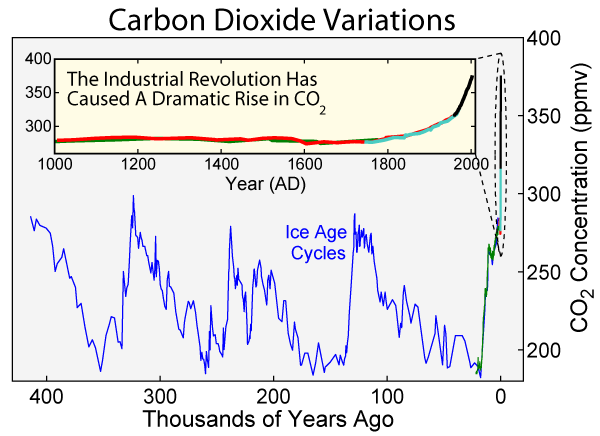
There have been ice-ages before, and there will be in the future. That's not the issue. CO2 levels have been relatively cyclical over the history of our planet, ranging from ~200 - 275 parts per million by volume (ppmv) (see chart), and we should, according to that cycle, be seeing a decrease in CO2 around the current time. As it stands, we're currently sitting around 400ppmv.
The portion of CO2 attributable to humans every year is pretty small, we can all agree. However, when you consider what the world is capable of dealing with, absorbing and turning back in to oxygen, that few million tonnes becomes a much bigger issue because it can't be absorbed.
-
All that proves, Chris, is that weather fluctuates on it's own.
Since the beginning of our planet's plant and animal life.
Like some experts I have quoted... they say the mmgw is a political and financial gambit.
-
You posted an article claiming that since the temperature in the US has shown a decline over 15 years, that global warming was a hoax; I explained that since the warming is *global* the temperature of the US is not the absolute indicator of whether global warming is happening or not.
You posted some 'Fun facts about carbon dioxide'; I gave you a scientific rebuttal of the points it tried to make.
So now you're saying that *I'm* not proving anything?
-
Speaking of fun facts I remember one of the guys on the left a year ago giving me that same statistic after I said that minor and unilateral changes by the United States couldn't make a difference. He said yes over the last 15 years the temperatures actually gone down!
WSS
-
Just found this, although the accent is terrible...
-
I just want to point out one thing to the alarmists. Notice that he has changed the premise when he mentions that one out of four Americans are skeptical and think that the effect of global warming may be exaggerated. Then he goes on to say that one out of four people deny man-made global warming exists at all which was not the question. One out of four believe set the reports are exaggerated. Do you, Chris or woody, believe that it's possible that many of these reports might be exaggerated? And we are talking about the predictions of long-term and short term damage. They have always been exaggerated up to now and I don't see any reason to think that will change.
That disingenuous style of reporting is what allows the skeptics to get a foothold. You guys really should try to understand that.
W
www.westsidesteve.com www.myspace.com/westsidestevemusic www.cdbaby.com/artist/westsidestevesimmons -
speaking of the accent where do you suppose he's from?
(regionally of course)
WSS
-
He's from Birmingham. I lived there for 4 years while at university - I used to love the place, but having moved to London, any time I go back there it seems to small.
To the point, yes, it's over the top journalism. But it does pretty much sum up how I feel about deniers, along with all those debates where it's represented as a 1-vs-1 opinion joust, where scientific views are split down the middle.
-
Oh, and, Bill Nye is cool

-
He's from Birmingham. I lived there for 4 years while at university - I used to love the place, but having moved to London, any time I go back there it seems to small.
To the point, yes, it's over the top journalism. But it does pretty much sum up how I feel about deniers, along with all those debates where it's represented as a 1-vs-1 opinion joust, where scientific views are split down the middle.
I'm just saying you've changed the debate. The point, to me, is not whether or not global warming exists or whether or not man has an effect. I'm sure both are true. How much damage will it cause, how soon will it happen, how much is directly related to mankind and how to solve it have often been exaggerated.He's from Birmingham. I lived there for 4 years while at university - I used to love the place, but having moved to London, any time I go back there it seems to small.
To the point, yes, it's over the top journalism. But it does pretty much sum up how I feel about deniers, along with all those debates where it's represented as a 1-vs-1 opinion joust, where scientific views are split down the middle.
WSS
-
There's no debate that it's happening, there's no debate that we're causing it to at least some degree. There should be debate about what we can do to stop it, followed by the adoption of policies putting those ideas in to plan as quickly as feasible.
-
There's no debate that it's happening, there's no debate that we're causing it to at least some degree. There should be debate about what we can do to stop it, followed by the adoption of policies putting those ideas in to plan as quickly as feasible.
There's no debate that it's happening, there's no debate that we're causing it to at least some degree.
And as long as you include the qualifier "at least to some degree" we have a consensus.
WSS


Hello! It looks like you're interested in this conversation, but you don't have an account yet.
Getting fed up of having to scroll through the same posts each visit? When you register for an account, you'll always come back to exactly where you were before, and choose to be notified of new replies (either via email, or push notification). You'll also be able to save bookmarks and upvote posts to show your appreciation to other community members.
With your input, this post could be even better 💗
Register Login