
What receiver do we go after in draft/FA?
-
as a wvu fan I say kevin white he hasn't gotten into trouble and improved a lot this yr
-
T. Smith and R. Cobb.
Smith with the deep routes and Cobb with all the underneath stuff.
Ya, that would be hot.
Now, all we need is a QB.
-
.. or not have a true #1.
What has been said that gives any indication Farmer values WRs high enough to spend a 1?
What about last season indicated that a #1 was important to our offense?
Step 1: Resign Austin
Step 2: Sign Shorts
Step 3: see what value falls to us in the draft.
.. or not have a true #1.
What has been said that gives any indication Farmer values WRs high enough to spend a 1?
What about last season indicated that a #1 was important to our offense?
Step 1: Resign Austin
Step 2: Sign Shorts
Step 3: see what value falls to us in the draft.
Looking to last year has nothing to do with this year. Different coordinator, different philosophies.
Shanahan's system didn't place value in a true #1 receiver. Flip comes from a little more of a ground game/vertical attack background.
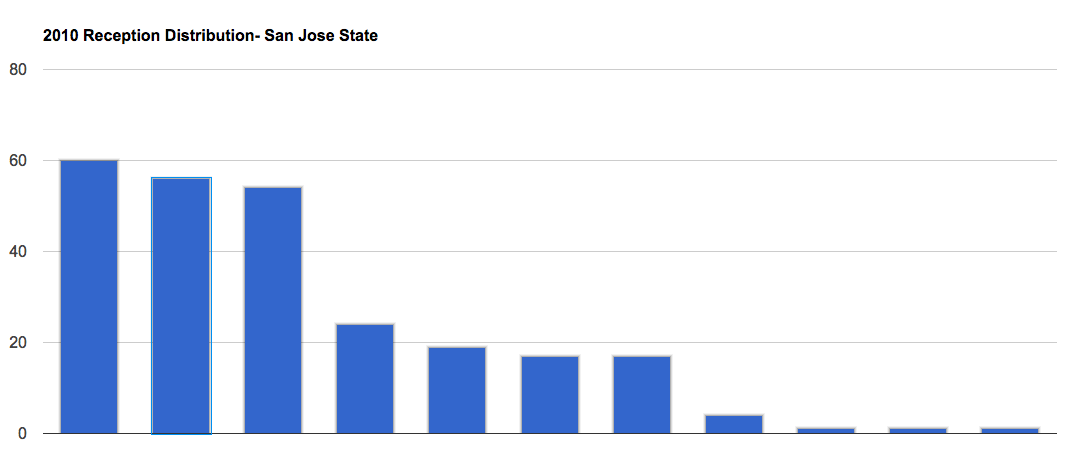
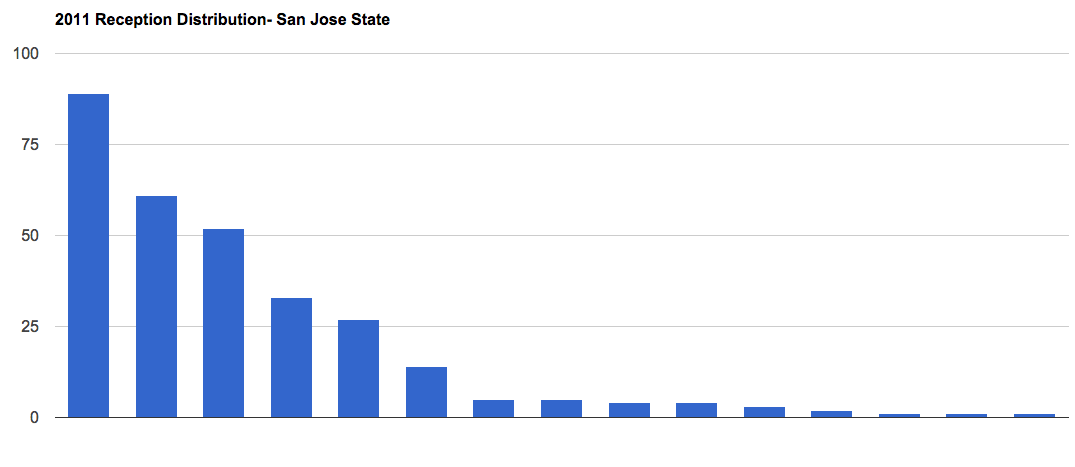
Flip took over for one year as an OC at San Jose State. Under Flip, the San Jose State offense jumped 32 spots in offensive rankings. But what's more interesting is that, in the two years prior to Flip taking over, no WR nabbed more than 60 catches for the year. Then, in Flip's first year, Grigsby hauls in 90 catches for nearly 900 yards.
Obviously, it's hard to gauge exactly how much of that is due to Flip and how much is due to having a solid receiver (Grigsby went on to nab another 90 the following season).
However, it does seem to suggest that there is a solid chance they'll be looking for a more traditional #1, especially with Gordon almost certainly on the way out.
-
Quite possible, TC, but Flip made a point to emphasize a continuation of established WCO/ZBS principles in his intro presser... not to exclusion of any change, but in the "by and large" sense.
"When you have a shared vision it is a lot easier to make unpopular decisions." - Paul DePodesta "When you win, say nothing. When you lose, say less." - Paul Brown Complete 2017 Browns Board Mock: http://thebrownsboard.com/forums/index.php?showtopic=46196 -
Free Agent options: Cecil Shorts, Jeremy Maclin, Michael Crabtree, Torrey Smith, Randall Cobb, Michael Crabtree, Denarious Thomas,
Draft options: Amari Cooper, Devante Parker, Kevin White, Sammy Coates, Justin Hardy, Jaelen Strong, Devin Smith, Ty Montgomery, Nelson Algalor, Rashad Greene...
Who do you want?
Free Agent options: Cecil Shorts, Jeremy Maclin, Michael Crabtree, Torrey Smith, Randall Cobb, Michael Crabtree, Denarious Thomas,
Draft options: Amari Cooper, Devante Parker, Kevin White, Sammy Coates, Justin Hardy, Jaelen Strong, Devin Smith, Ty Montgomery, Nelson Algalor, Rashad Greene...
Who do you want?
i think if any of those fa even hear the word browns by their agents, they will all be fired...no one in their right mind would want to come to this pos organization..me thinks those guys want to win a championship...not be a cellar dweller
-
With Leonard retiring, we need a 2 for 1 like Benjamin. WR,KR and punt returns and they only Qualify if they do not fumble or buff the catch first. A Julian Edelman, best I have seen. Crowder from Duke fits our Small Quick receiver core and can fly on KR and Punt Returns but cannot trust him on fumble issues. Anybody got a Edelman out there, with no turnovers waiting to happen???
-
With Leonard retiring, we need a 2 for 1 like Benjamin. WR,KR and punt returns and they only Qualify if they do not fumble or buff the catch first. A Julian Edelman, best I have seen. Crowder from Duke fits our Small Quick receiver core and can fly on KR and Punt Returns but cannot trust him on fumble issues. Anybody got a Edelman out there, with no turnovers waiting to happen???
With Leonard retiring, we need a 2 for 1 like Benjamin. WR,KR and punt returns and they only Qualify if they do not fumble or buff the catch first. A Julian Edelman, best I have seen. Crowder from Duke fits our Small Quick receiver core and can fly on KR and Punt Returns but cannot trust him on fumble issues. Anybody got a Edelman out there, with no turnovers waiting to happen???
As stated previously-that would be Lockett. He did everything for his team in all of those roles and is damn good at it. That team really counted on him to haul them along.
-
Whatever receiver the Browns pick I hope he has some height.
-
Free Agent options: Cecil Shorts, Jeremy Maclin, Michael Crabtree, Torrey Smith, Randall Cobb, Michael Crabtree, Denarious Thomas,
Draft options: Amari Cooper, Devante Parker, Kevin White, Sammy Coates, Justin Hardy, Jaelen Strong, Devin Smith, Ty Montgomery, Nelson Algalor, Rashad Greene...
Who do you want?
i think if any of those fa even hear the word browns by their agents, they will all be fired...no one in their right mind would want to come to this pos organization..me thinks those guys want to win a championship...not be a cellar dweller
i think if any of those fa even hear the word browns by their agents, they will all be fired...no one in their right mind would want to come to this pos organization..me thinks those guys want to win a championship...not be a cellar dweller
Cecil Shorts is from Cleveland, so maybe he'll want to come home
-
Quite possible, TC, but Flip made a point to emphasize a continuation of established WCO/ZBS principles in his intro presser... not to exclusion of any change, but in the "by and large" sense.
Quite possible, TC, but Flip made a point to emphasize a continuation of established WCO/ZBS principles in his intro presser... not to exclusion of any change, but in the "by and large" sense.
Truth be told, we weren't running a WCO with Shanahan anyway. The core identity of a WCO is "pass to set up the run", which is not what our identity was.
I'm awesome, and I fuck dolphins. Ghoolie 12/2/2012: I have absolutely no skills, training or pride -
Quite possible, TC, but Flip made a point to emphasize a continuation of established WCO/ZBS principles in his intro presser... not to exclusion of any change, but in the "by and large" sense.
Truth be told, we weren't running a WCO with Shanahan anyway. The core identity of a WCO is "pass to set up the run", which is not what our identity was.
Truth be told, we weren't running a WCO with Shanahan anyway. The core identity of a WCO is "pass to set up the run", which is not what our identity was.
Not true at all, case in point - the Broncos teams of the 90's. WCO really identifies with the play language, play concepts, timing, execution and route designs.
It has nothing to do with passing to run. This "pass to run" its a common myth.
edit: I also wouldn't go as far as saying the Browns offense is exclusively anything under Shanny except the underlying common of ZBS. Sure there were plenty of timing routes,
also plenty of option routes for our receivers as well, which isn't necessarily the guiding factor in a timing based offense.
-
Quite possible, TC, but Flip made a point to emphasize a continuation of established WCO/ZBS principles in his intro presser... not to exclusion of any change, but in the "by and large" sense.
Truth be told, we weren't running a WCO with Shanahan anyway. The core identity of a WCO is "pass to set up the run", which is not what our identity was.
Well....my interpretation says you're both right, as the WCO has evolved and changed a lot.....due to the different coaches who have implemented it...
The core identity of a WCO is "pass to set up the run"
With Walsh, it really was originally used in lieu of the run.....IE....lots of screens and dump passes to the backs in normal running situations.....then, the random run out of the blue.....
It has nothing to do with passing to run. This "pass to run" its a common myth.
Modern WCO implements a more traditional run style, but uses 4 receiver sets and lots of motion & shifts.....then liberal use of shorter slant & swing routes....
Meaning, NOW all the receivers are more involved in the short game, when it used to be more about the backs...
So, in principle, the WCO is(and has been) all about quick hitting short plays....mostly via pass.....which set up run opportunities that come randomly and cannot be predicted easily by the D....
-
Well....my interpretation says you're both right, as the WCO has evolved and changed a lot.....due to the different coaches who have implemented it...
The core identity of a WCO is "pass to set up the run"
With Walsh, it really was originally used in lieu of the run.....IE....lots of screens and dump passes to the backs in normal running situations.....then, the random run out of the blue.....
It has nothing to do with passing to run. This "pass to run" its a common myth.
Modern WCO implements a more traditional run style, but uses 4 receiver sets and lots of motion & shifts.....then liberal use of shorter slant & swing routes....
Meaning, NOW all the receivers are more involved in the short game, when it used to be more about the backs...
So, in principle, the WCO is(and has been) all about quick hitting short plays....mostly via pass.....which set up run opportunities that come randomly and cannot be predicted easily by the D....
Well....my interpretation says you're both right, as the WCO has evolved and changed a lot.....due to the different coaches who have implemented it...
With Walsh, it really was originally used in lieu of the run.....IE....lots of screens and dump passes to the backs in normal running situations.....then, the random run out of the blue.....
Modern WCO implements a more traditional run style, but uses 4 receiver sets and lots of motion & shifts.....then liberal use of shorter slant & swing routes....
Meaning, NOW all the receivers are more involved in the short game, when it used to be more about the backs...
So, in principle, the WCO is(and has been) all about quick hitting short plays....mostly via pass.....which set up run opportunities that come randomly and cannot be predicted easily by the D....
Look, man - trying to talk foosball here. Take that shit to the Poli forum!

-
Well....my interpretation says you're both right, as the WCO has evolved and changed a lot.....due to the different coaches who have implemented it...
The core identity of a WCO is "pass to set up the run"
With Walsh, it really was originally used in lieu of the run.....IE....lots of screens and dump passes to the backs in normal running situations.....then, the random run out of the blue.....
It has nothing to do with passing to run. This "pass to run" its a common myth.
Modern WCO implements a more traditional run style, but uses 4 receiver sets and lots of motion & shifts.....then liberal use of shorter slant & swing routes....
Meaning, NOW all the receivers are more involved in the short game, when it used to be more about the backs...
So, in principle, the WCO is(and has been) all about quick hitting short plays....mostly via pass.....which set up run opportunities that come randomly and cannot be predicted easily by the D....
So, in principle, the WCO is(and has been) all about quick hitting short plays... which set up run opportunities that come randomly and cannot be predicted easily by the D....
... with success in the run then setting up intermediate, and deeper, throws off play action.
This captures what I think of when I think "WCO". It was what we saw when Hoyer was effective early and the line was intact.
-
Truth be told, we weren't running a WCO with Shanahan anyway. The core identity of a WCO is "pass to set up the run", which is not what our identity was.
Not true at all, case in point - the Broncos teams of the 90's. WCO really identifies with the play language, play concepts, timing, execution and route designs.
It has nothing to do with passing to run. This "pass to run" its a common myth.
edit: I also wouldn't go as far as saying the Browns offense is exclusively anything under Shanny except the underlying common of ZBS. Sure there were plenty of timing routes,
also plenty of option routes for our receivers as well, which isn't necessarily the guiding factor in a timing based offense.
Not true at all, case in point - the Broncos teams of the 90's. WCO really identifies with the play language, play concepts, timing, execution and route designs.
It has nothing to do with passing to run. This "pass to run" its a common myth.
edit: I also wouldn't go as far as saying the Browns offense is exclusively anything under Shanny except the underlying common of ZBS. Sure there were plenty of timing routes,
also plenty of option routes for our receivers as well, which isn't necessarily the guiding factor in a timing based offense.
That's completely wrong. The "common myth" that you're claiming my description is happens to be closer to the truth than what you described. The West Coast Offense isn't a playcalling system. There is no official "WCO" play calling nomenclature. It is a philosophy of using short to intermediate passes as a supplement and, in some cases, replacement to the running game in order to keep the defense honest.
What you're describing (nomenclature, etc) is the misappropriation of the term, started by our own Bernie Kosar, when WCO was erroneously used to describe the Air Coryell offense.
The Air Coryell offense is a subset of the West Coast Offense. The Air Raid Offense is a subset of the West Coast Offense. But the West Coast Offense in and of itself is a philosophy...not an actual offensive playbook.
The whole "WCO uses long playcall strings" simply stems from the fact that Walsh himself like long playcall strings and that he had a West Coast philosophy. Paul Brown, who invented the WCO, had varying play call strings that changed from year to year.
"In American football, the "West Coast offense" is an offense that places a greater emphasis on passing than on running."
An offensive philosophy in football that utilizes short, high percentage passes as the foundation of a ball-control offense. More of a philosophy on how to conduct a play than a specific formation.
"The 'West Coast Offense' still amounts to nothing more than the total attention to detail and an appreciation for every facet of offensive football and refinement of those things that are needed to provide an environment that allows people to perform at maximum levels of self-actualization"
I'm awesome, and I fuck dolphins. Ghoolie 12/2/2012: I have absolutely no skills, training or pride -
Not true at all, case in point - the Broncos teams of the 90's. WCO really identifies with the play language, play concepts, timing, execution and route designs.
It has nothing to do with passing to run. This "pass to run" its a common myth.
edit: I also wouldn't go as far as saying the Browns offense is exclusively anything under Shanny except the underlying common of ZBS. Sure there were plenty of timing routes,
also plenty of option routes for our receivers as well, which isn't necessarily the guiding factor in a timing based offense.
That's completely wrong. The "common myth" that you're claiming my description is happens to be closer to the truth than what you described. The West Coast Offense isn't a playcalling system. There is no official "WCO" play calling nomenclature. It is a philosophy of using short to intermediate passes as a supplement and, in some cases, replacement to the running game in order to keep the defense honest.
What you're describing (nomenclature, etc) is the misappropriation of the term, started by our own Bernie Kosar, when WCO was erroneously used to describe the Air Coryell offense.
The Air Coryell offense is a subset of the West Coast Offense. The Air Raid Offense is a subset of the West Coast Offense. But the West Coast Offense in and of itself is a philosophy...not an actual offensive playbook.
The whole "WCO uses long playcall strings" simply stems from the fact that Walsh himself like long playcall strings and that he had a West Coast philosophy. Paul Brown, who invented the WCO, had varying play call strings that changed from year to year.
"In American football, the "West Coast offense" is an offense that places a greater emphasis on passing than on running."
An offensive philosophy in football that utilizes short, high percentage passes as the foundation of a ball-control offense. More of a philosophy on how to conduct a play than a specific formation.
"The 'West Coast Offense' still amounts to nothing more than the total attention to detail and an appreciation for every facet of offensive football and refinement of those things that are needed to provide an environment that allows people to perform at maximum levels of self-actualization"
That's completely wrong. The "common myth" that you're claiming my description is happens to be closer to the truth than what you described. The West Coast Offense isn't a playcalling system. There is no official "WCO" play calling nomenclature. It is a philosophy of using short to intermediate passes as a supplement and, in some cases, replacement to the running game in order to keep the defense honest.
What you're describing (timing, nomenclature, route depths, etc) is the misappropriation of the term, started by our own Bernie Kosar, when WCO was erroneously used to describe the Air Coryell offense.
The Air Coryell offense is a subset of the West Coast Offense. The Air Raid Offense is a subset of the West Coast Offense. But the West Coast Offense in and of itself is a philosophy...not an actual offensive playbook.
The whole "WCO uses long playcall strings" simply stems from the fact that Walsh himself like long playcall strings and that he had a West Coast philosophy. Paul Brown, who invented the WCO, had varying play call strings that changed from year to year.
I'm well aware of the philosophy, however the modern WyCo involves play calling nomenclature that's easy to pick up when receivers are tagged. Especially in offenses that are up tempo or no huddle. If you wanted receivers to be tagged outside of a designated number/route tree, that's when a longer play call comes into the picture.
And if I'm wrong in what I'm stating with route depths and such, then why does your second quote say "short, high percentage passes"...? That would kind of prove my point, would it not?
edit: Again, the evolution of the WyCo is that its flexible on run or pass. You can see as mentioned, the modern installment when run sets up pass. Especially for teams that don't have elite receiver talent and need to get their players in more one on one situations.
-
Not true at all, case in point - the Broncos teams of the 90's. WCO really identifies with the play language, play concepts, timing, execution and route designs.
It has nothing to do with passing to run. This "pass to run" its a common myth.
edit: I also wouldn't go as far as saying the Browns offense is exclusively anything under Shanny except the underlying common of ZBS. Sure there were plenty of timing routes,
also plenty of option routes for our receivers as well, which isn't necessarily the guiding factor in a timing based offense.
That's completely wrong. The "common myth" that you're claiming my description is happens to be closer to the truth than what you described. The West Coast Offense isn't a playcalling system. There is no official "WCO" play calling nomenclature. It is a philosophy of using short to intermediate passes as a supplement and, in some cases, replacement to the running game in order to keep the defense honest.
What you're describing (nomenclature, etc) is the misappropriation of the term, started by our own Bernie Kosar, when WCO was erroneously used to describe the Air Coryell offense.
The Air Coryell offense is a subset of the West Coast Offense. The Air Raid Offense is a subset of the West Coast Offense. But the West Coast Offense in and of itself is a philosophy...not an actual offensive playbook.
The whole "WCO uses long playcall strings" simply stems from the fact that Walsh himself like long playcall strings and that he had a West Coast philosophy. Paul Brown, who invented the WCO, had varying play call strings that changed from year to year.
"In American football, the "West Coast offense" is an offense that places a greater emphasis on passing than on running."
An offensive philosophy in football that utilizes short, high percentage passes as the foundation of a ball-control offense. More of a philosophy on how to conduct a play than a specific formation.
"The 'West Coast Offense' still amounts to nothing more than the total attention to detail and an appreciation for every facet of offensive football and refinement of those things that are needed to provide an environment that allows people to perform at maximum levels of self-actualization"
It is a philosophy of using short to intermediate passes as a supplement and, in some cases, replacement to the running game in order to keep the defense honest.
What you're describing (timing, nomenclature, route depths, etc) is the misappropriation of the term, started by our own Bernie Kosar, when WCO was erroneously used to describe the Air Coryell offense.
The Air Coryell offense is a subset of the West Coast Offense. The Air Raid Offense is a subset of the West Coast Offense. But the West Coast Offense in and of itself is a philosophy...not an actual offensive playbook.
The whole "WCO uses long playcall strings" simply stems from the fact that Walsh himself like long playcall strings and that he had a West Coast philosophy. Paul Brown, who invented the WCO, had varying play call strings that changed from year to year.
Yet it's not called the "Ohio River Offense"...
 Too bad... has a nice ring to it.
I know the seeds were sewn in Cinci under Brown, but by all accounts I know his assistant, Bill Walsh was the architect who was restrained by Brown. Not until Walsh took it to SF was the offense fully unleashed and the WCO born.
But, yes... high-percentage passing to supplement the run is to my mind a great, capsule summary of the WCO.
On the other hand... I did not know about Bernie mislabeling "Air Coryell" as WCO.
-
That's completely wrong. The "common myth" that you're claiming my description is happens to be closer to the truth than what you described. The West Coast Offense isn't a playcalling system. There is no official "WCO" play calling nomenclature. It is a philosophy of using short to intermediate passes as a supplement and, in some cases, replacement to the running game in order to keep the defense honest.
What you're describing (timing, nomenclature, route depths, etc) is the misappropriation of the term, started by our own Bernie Kosar, when WCO was erroneously used to describe the Air Coryell offense.
The Air Coryell offense is a subset of the West Coast Offense. The Air Raid Offense is a subset of the West Coast Offense. But the West Coast Offense in and of itself is a philosophy...not an actual offensive playbook.
The whole "WCO uses long playcall strings" simply stems from the fact that Walsh himself like long playcall strings and that he had a West Coast philosophy. Paul Brown, who invented the WCO, had varying play call strings that changed from year to year.
I'm well aware of the philosophy, however the modern WyCo involves play calling nomenclature that's easy to pick up when receivers are tagged. Especially in offenses that are up tempo or no huddle. If you wanted receivers to be tagged outside of a designated number/route tree, that's when a longer play call comes into the picture.
And if I'm wrong in what I'm stating with route depths and such, then why does your second quote say "short, high percentage passes"...? That would kind of prove my point, would it not?
edit: Again, the evolution of the WyCo is that its flexible on run or pass. You can see as mentioned, the modern installment when run sets up pass. Especially for teams that don't have elite receiver talent and need to get their players in more one on one situations.
I'm well aware of the philosophy, however the modern WyCo involves play calling nomenclature that's easy to pick up when receivers are tagged. Especially in offenses that are up tempo or no huddle. If you wanted receivers to be tagged outside of a designated number/route tree, that's when a longer play call comes into the picture.
And if I'm wrong in what I'm stating with route depths and such, then why does your second quote say "short, high percentage passes"...? That would kind of prove my point, would it not?
edit: Again, the evolution of the WyCo is that its flexible on run or pass. You can see as mentioned, the modern installment when run sets up pass. Especially for teams that don't have elite receiver talent and need to get their players in more one on one situations.
I see what you're saying, and I get that there are common names and designations that have been carried over from coach to coach.
You're not wrong about route depths and such. That is what I'm saying. The WCO is the philosophy behind the plays being run, not the play names themselves. Concepts, timing, etc, those are right on.
Brown Right Deuce Jet Flanker Drive can be the same as Horton Belly 361, just depends on the coach.
You were more correct than I gave you credit for, I just saw language and kind of stopped reading.
That's completely wrong. The "common myth" that you're claiming my description is happens to be closer to the truth than what you described. The West Coast Offense isn't a playcalling system. There is no official "WCO" play calling nomenclature. It is a philosophy of using short to intermediate passes as a supplement and, in some cases, replacement to the running game in order to keep the defense honest.
What you're describing (nomenclature, etc) is the misappropriation of the term, started by our own Bernie Kosar, when WCO was erroneously used to describe the Air Coryell offense.
The Air Coryell offense is a subset of the West Coast Offense. The Air Raid Offense is a subset of the West Coast Offense. But the West Coast Offense in and of itself is a philosophy...not an actual offensive playbook.
The whole "WCO uses long playcall strings" simply stems from the fact that Walsh himself like long playcall strings and that he had a West Coast philosophy. Paul Brown, who invented the WCO, had varying play call strings that changed from year to year.
Yet it's not called the "Ohio River Offense"...
Too bad... has a nice ring to it.I know the seeds were sewn in Cinci under Brown, but by all accounts I know his assistant, Bill Walsh was the architect who was restrained by Brown. Not until Walsh took it to SF was the offense fully unleashed and the WCO born.
But, yes... high-percentage passing to supplement the run is to my mind a great, capsule summary of the WCO.
On the other hand... I did not know about Bernie mislabeling "Air Coryell" as WCO.
Yep. When he played with Dallas, if I'm not mistaken.
-
I'm well aware of the philosophy, however the modern WyCo involves play calling nomenclature that's easy to pick up when receivers are tagged. Especially in offenses that are up tempo or no huddle. If you wanted receivers to be tagged outside of a designated number/route tree, that's when a longer play call comes into the picture.
And if I'm wrong in what I'm stating with route depths and such, then why does your second quote say "short, high percentage passes"...? That would kind of prove my point, would it not?
edit: Again, the evolution of the WyCo is that its flexible on run or pass. You can see as mentioned, the modern installment when run sets up pass. Especially for teams that don't have elite receiver talent and need to get their players in more one on one situations.
I see what you're saying, and I get that there are common names and designations that have been carried over from coach to coach.
You're not wrong about route depths and such. That is what I'm saying. The WCO is the philosophy behind the plays being run, not the play names themselves. Concepts, timing, etc, those are right on.
Brown Right Deuce Jet Flanker Drive can be the same as Horton Belly 361, just depends on the coach.
You were more correct than I gave you credit for, I just saw language and kind of stopped reading.
That's completely wrong. The "common myth" that you're claiming my description is happens to be closer to the truth than what you described. The West Coast Offense isn't a playcalling system. There is no official "WCO" play calling nomenclature. It is a philosophy of using short to intermediate passes as a supplement and, in some cases, replacement to the running game in order to keep the defense honest.
What you're describing (nomenclature, etc) is the misappropriation of the term, started by our own Bernie Kosar, when WCO was erroneously used to describe the Air Coryell offense.
The Air Coryell offense is a subset of the West Coast Offense. The Air Raid Offense is a subset of the West Coast Offense. But the West Coast Offense in and of itself is a philosophy...not an actual offensive playbook.
The whole "WCO uses long playcall strings" simply stems from the fact that Walsh himself like long playcall strings and that he had a West Coast philosophy. Paul Brown, who invented the WCO, had varying play call strings that changed from year to year.
Yet it's not called the "Ohio River Offense"...
Too bad... has a nice ring to it.I know the seeds were sewn in Cinci under Brown, but by all accounts I know his assistant, Bill Walsh was the architect who was restrained by Brown. Not until Walsh took it to SF was the offense fully unleashed and the WCO born.
But, yes... high-percentage passing to supplement the run is to my mind a great, capsule summary of the WCO.
On the other hand... I did not know about Bernie mislabeling "Air Coryell" as WCO.
Yep. When he played with Dallas, if I'm not mistaken.
I see what you're saying, and I get that there are common names and designations that have been carried over from coach to coach.
You're not wrong about route depths and such. That is what I'm saying. The WCO is the philosophy behind the plays being run, not the play names themselves. Concepts, timing, etc, those are right on.
Brown Right Deuce Jet Flanker Drive can be the same as Horton Belly 361, just depends on the coach.
You were more correct than I gave you credit for, I just saw language and kind of stopped reading.
Yep. When he played with Dallas, if I'm not mistaken.
I have a feeling we're saying a lot of the same things, just minor confusion on how we convey them between one another. Carry on, sir.




Hello! It looks like you're interested in this conversation, but you don't have an account yet.
Getting fed up of having to scroll through the same posts each visit? When you register for an account, you'll always come back to exactly where you were before, and choose to be notified of new replies (either via email, or push notification). You'll also be able to save bookmarks and upvote posts to show your appreciation to other community members.
With your input, this post could be even better 💗
Register Login