
Purge - 2017 - what'll happen?
-
Ah... the dictionary card hits the table.
Have you honestly ever thought of "a couple" and "a few" as synonyms, Ag?
That's a fine way to look at it when assuming you're going to get the average player for that pick and you are trying to amass foundational talent... however I am of the opinion we are at a spot where we are looking to strike on high-impact players with a higher chance of achieving a high CAV - and statistics say that it is easier to do that with higher picks rather than lower ones.
I don't think we're going to be mortgaging the future by any means, but I believe we'll be using our capital to nab four, if not five, early round picks that, statistically speaking, have a higher probability of having above average careers. Looking at the (admittedly dated) charts, that puts you firmly in the 0-45 range, as even the lower boundary is still higher than the higher boundary of many mid-to-late round picks, starting as early as the third round.The lower boundary what? The lower boundary is 0 across the entire range... so not sure what you are referring to. Nonetheless I think that I better understand where you're going now... so I can more firmly disagree.
First, I do not think we are at that "spot" as yet. Too many holes remain alongside too many marginal incumbents.Second, were I trying to still amass foundational talent, then I'd be advocating trading down. I'm not and I don't need to as we've amassed a good number of 2017 picks thanks to our 2016 trading and lack of UFA retention.
I see 2016 as having been the great amassing... 2017 as the year of standing pat... and 2018 being the year of adding pieces. In other words I'm a year behind you. In that vein I would not be shocked to see "a couple" of the 3rd/4th rounders you see as being traded up this year instead being traded up and out to 2018 creating more ammo.
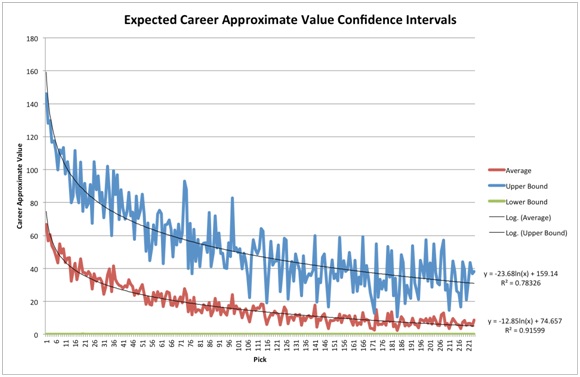
A few notes on the chart...
- I believe the upper bound is a true boundary, i.e., the single highest CAV in the study period for that draft position. I would like to see the median values plotted as opposed to the mean.
- I see where you are going with your line at pick 45, but were you to represent the curve with three straight lines, then the first might cover as low as #11, the second #55-ish and the last the rest.
- There appears to be a "sweet spot" between #33 and #51 where the average spends almost all its time at or above the curve fitted line.
- The opposite appears to be true for the interval between #115 and 140.
- Both the above likely normalize as the sample size expands, but are interesting occurrences... especially the "sweet spot" where a lot of one time first rounders who fall get taken.
Ah... the dictionary card hits the table.
Have you honestly ever thought of "a couple" and "a few" as synonyms, Ag?
Nah. A couple is 2 and few is 3. Maybe 4 in a stretch. Certainly not 5 for me. That there is a "bunch" where I come from.

But seriously I was thinking 3 when I first typed it in. 4 if we got really really lucky.
-
Just as High School players get culled in college, so, too, do college kids get culled in the Pros. Always has been that way; always will be that way.
Sometimes it is simply a matter of no longer being able to control whomever is in front of you... because "whomever" is suddenly a different player, one much better than the one you blocked/tackled/covered at the last level.
complacency at it's finest.
only a beat down browns fan thinks that way.
OK... in that case I'll not mention the the cited synonym of "handful"...

complacency at it's finest.
only a beat down browns fan thinks that way.
Maybe you can give me some lessons in faux outrage, mik? You know, so I can be a better "fan".
On 2nd thought.... Nah... I'd rather stay in touch with reality.
-
as long as you're alright with it tour then browns nation is alright with it.
just like we aren't tanking it this year.
losing is one thing. not giving a shit about it is another. 1 year. 2 year. 3 year. 4 year plan.
a broken record with no new turntable.
-
as long as you're alright with it tour then browns nation is alright with it.
just like we aren't tanking it this year.
losing is one thing. not giving a shit about it is another. 1 year. 2 year. 3 year. 4 year plan.
a broken record with no new turntable.
a broken record with no new turntable.
Trust me, my friend... I have plenty of turntables...
Anyone need a refurbished AR-XA?
"When you have a shared vision it is a lot easier to make unpopular decisions." - Paul DePodesta "When you win, say nothing. When you lose, say less." - Paul Brown Complete 2017 Browns Board Mock: http://thebrownsboard.com/forums/index.php?showtopic=46196 -
Ah... the dictionary card hits the table.
Have you honestly ever thought of "a couple" and "a few" as synonyms, Ag?
That's a fine way to look at it when assuming you're going to get the average player for that pick and you are trying to amass foundational talent... however I am of the opinion we are at a spot where we are looking to strike on high-impact players with a higher chance of achieving a high CAV - and statistics say that it is easier to do that with higher picks rather than lower ones.
I don't think we're going to be mortgaging the future by any means, but I believe we'll be using our capital to nab four, if not five, early round picks that, statistically speaking, have a higher probability of having above average careers. Looking at the (admittedly dated) charts, that puts you firmly in the 0-45 range, as even the lower boundary is still higher than the higher boundary of many mid-to-late round picks, starting as early as the third round.The lower boundary what? The lower boundary is 0 across the entire range... so not sure what you are referring to. Nonetheless I think that I better understand where you're going now... so I can more firmly disagree.
First, I do not think we are at that "spot" as yet. Too many holes remain alongside too many marginal incumbents.Second, were I trying to still amass foundational talent, then I'd be advocating trading down. I'm not and I don't need to as we've amassed a good number of 2017 picks thanks to our 2016 trading and lack of UFA retention.
I see 2016 as having been the great amassing... 2017 as the year of standing pat... and 2018 being the year of adding pieces. In other words I'm a year behind you. In that vein I would not be shocked to see "a couple" of the 3rd/4th rounders you see as being traded up this year instead being traded up and out to 2018 creating more ammo.
A few notes on the chart...
- I believe the upper bound is a true boundary, i.e., the single highest CAV in the study period for that draft position. I would like to see the median values plotted as opposed to the mean.
- I see where you are going with your line at pick 45, but were you to represent the curve with three straight lines, then the first might cover as low as #11, the second #55-ish and the last the rest.
- There appears to be a "sweet spot" between #33 and #51 where the average spends almost all its time at or above the curve fitted line.
- The opposite appears to be true for the interval between #115 and 140.
- Both the above likely normalize as the sample size expands, but are interesting occurrences... especially the "sweet spot" where a lot of one time first rounders who fall get taken.
<p>
Ah... the dictionary card hits the table.
Have you honestly ever thought of "a couple" and "a few" as synonyms, Ag?
The lower boundary what? The lower boundary is 0 across the entire range... so not sure what you are referring to. Nonetheless I think that I better understand where you're going now... so I can more firmly disagree.
First, I do not think we are at that "spot" as yet. Too many holes remain alongside too many marginal incumbents.
Second, were I trying to still amass foundational talent, then I'd be advocating trading down. I'm not and I don't need to as we've amassed a good number of 2017 picks thanks to our 2016 trading and lack of UFA retention.
I see 2016 as having been the great amassing... 2017 as the year of standing pat... and 2018 being the year of adding pieces. In other words I'm a year behind you. In that vein I would not be shocked to see "a couple" of the 3rd/4th rounders you see as being traded up this year instead being traded up and out to 2018 creating more ammo.
A few notes on the chart...
- I believe the upper bound is a true boundary, i.e., the single highest CAV in the study period for that draft position. I would like to see the median values plotted as opposed to the mean.
- I see where you are going with your line at pick 45, but were you to represent the curve with three straight lines, then the first might cover as low as #11, the second #55-ish and the last the rest.
- There appears to be a "sweet spot" between #33 and #51 where the average spends almost all its time at or above the curve fitted line.
- The opposite appears to be true for the interval between #115 and 140.
- Both the above likely normalize as the sample size expands, but are interesting occurrences... especially the "sweet spot" where a lot of one time first rounders who fall get taken.
Sorry...the lower boundary, to me, is the average CAV line.
IMO, anything below the average CAV for that draft position is considered a bust, therefore the average position is the lowest acceptable boundary for me in this scenario.
The difference in our philosophies is that I don't foresee a
bad team as ever being a position of standing pat. To me, you are either building or striking. You don't stand pat until you've become routinely competitive.
Since I don't believe in standing pat for us, and since I believe we've added a wide foundation of young talent, I naturally believe we've transitioned into a phase of striking
I've been saying for years (as have you IIRC, I remember having similar conversations in the past) that we needed not to build our roster from the top down, but first from the bottom up. I believe we've achieved this. Guys like Reiter, Boddy-Calhoun, Reynolds, Burley, DeValve, Kessler, Meder, Davis, Johnson, Lemonier, Kindred, etc. are our new bottom. Each has shown at least one or two flashes enough to warrant extended looks, meaning they possess enough talent to earn a paycheck in this league...something I don't believe we've had at the bottom of our roster in a while. Most of our bottom feeders were rarely able to hang on with other clubs. Hell, many of our top players were barely able to hang on.
And here's the kicker: A team consisting almost solely of bottoms (yeah, yeah...I get it) has been able to stay competitive in multiple games this season.
Now is not the time to continue to feed from the bottom, now is the time we add talent from the top down. And I don't see us being able to do that with fourth rounders.
- I agree about the three stages of the draft, I just believe that 11-45 range to have the highest ROI. It would simply cost too much to break into the top ten, but that mid first to early second region is cheaper and can still provide you with legitimate franchise-changing potential.
-
Since it's a statistical confidence limit chart the boundaries are not open to definition, but I hear you wanting above average prospects... who doesn't?
Pretty sure you understand, but just to be sure... when I say "stand pat" I am only talking about this draft... as in letting it come to us. To me it is the logical intermediate step between amassing picks via trading down and targeting high-impact prospects.
I, too, recall discussions we've had around building a team. I know I've always been a proponent of front to back and, especially on D, inside out. Bottom up? Don't recall thinking of it that way, but, sure... if the general sense of through the draft without being tempted by FA shortcuts is where you are, then so am I. And our current disagreement may be over how complete our foundation is.
Couple more interesting observations on the graph...
- the multiple between the two, fitted trend-lines increases from ~2x for #1 to ~6x for pick #220+;
- since all pick sets include at least one 0 CAV draftee then the above multiple is a reflection of the variance of each pick's data; and
- the ratio of the difference between the mean and the upper boundary line, and the value of the upper boundary line approximates the percentage of below average CAVs for a given pick.
The last point takes you from ~50/50 for pick #1 to about 6 in 7, or 86/14 for the late picks.
-
Geek talk is fun.
-
The problem with looking at CAV numbers and saying "draft picks x->y produce the best ROI therefore we should be aiming for that area" is that you'll end up trading down almost indefinitely. Assuming you are using draft picks as currency, and subsequently view a UDFA as 'free', your model leads you to basically only go for UDFAs as the return on investment is infinite. Obviously you are forced to spend some draft picks, so you end up trading down and taking 35 guys on day three, as the CAV of them will probably be more than the CAV of two guys drafted in the top 50. BUT, you're obviously limited on the number of guys you can have on the roster, and the field. So there are constraints there.
The big thing is, you of course want guys that outperform their draft status, but a team of 50 sixth rounders playing like 50 fourth rounders is going to get routinely destroyed by a team with a sprinkling of elite talent.
So there's more to it than looking for the best ROI. Sometimes you have to accept you're paying over the odds (ie a high first round pick) for a guy who is going to have the same CAV as two third round guys combined, but will put you over the top in to being a winning team.
For example, do you think this team would be better with Khalil Mack, or Ogbah and Kirksey? Those two may combine for as many sacks, tackles, PDs etc as Mack but they're not going to have the same impact.
Maybe you've already covered it and I missed it, but it's worth talking about.
-
OK, the IR guys.
Who are the guys on IR that you want to run?
That too is listed in the OP......not gonna rewrite it for ya Gip.....#tryreading
-
I am going to pop a cap in a few of your asses...........now you tell me how many and which of you are going to get capped.

-
The problem with looking at CAV numbers and saying "draft picks x->y produce the best ROI therefore we should be aiming for that area" is that you'll end up trading down almost indefinitely. Assuming you are using draft picks as currency, and subsequently view a UDFA as 'free', your model leads you to basically only go for UDFAs as the return on investment is infinite. Obviously you are forced to spend some draft picks, so you end up trading down and taking 35 guys on day three, as the CAV of them will probably be more than the CAV of two guys drafted in the top 50. BUT, you're obviously limited on the number of guys you can have on the roster, and the field. So there are constraints there.
The big thing is, you of course want guys that outperform their draft status, but a team of 50 sixth rounders playing like 50 fourth rounders is going to get routinely destroyed by a team with a sprinkling of elite talent.
So there's more to it than looking for the best ROI. Sometimes you have to accept you're paying over the odds (ie a high first round pick) for a guy who is going to have the same CAV as two third round guys combined, but will put you over the top in to being a winning team.
For example, do you think this team would be better with Khalil Mack, or Ogbah and Kirksey? Those two may combine for as many sacks, tackles, PDs etc as Mack but they're not going to have the same impact.
Maybe you've already covered it and I missed it, but it's worth talking about.
I'm sure you will think you have, Gip...
For example, do you think this team would be better with Khalil Mack, or Ogbah and Kirksey? Those two may combine for as many sacks, tackles, PDs etc as Mack but they're not going to have the same impact.
Maybe you've already covered it and I missed it, but it's worth talking about.
I think that is pretty much what we've ended up debating, Chris, but your spin has crystallized it for me...
The attraction... the payoff of taking the "right" impact player high is undeniable, but part of a roster's readiness for targeting those picks is its readiness to absorb the possible outcome that the target turns out to be merely good... or worse.
And if you have to trade up for that shot???
IMO we're just not there yet... doesn't mean retreat... we should shoot the ammo we have, if it's appropriate for the target(s) we have in sight.







Hello! It looks like you're interested in this conversation, but you don't have an account yet.
Getting fed up of having to scroll through the same posts each visit? When you register for an account, you'll always come back to exactly where you were before, and choose to be notified of new replies (either via email, or push notification). You'll also be able to save bookmarks and upvote posts to show your appreciation to other community members.
With your input, this post could be even better 💗
Register Login