
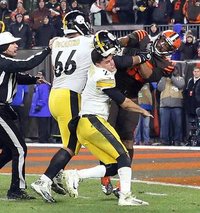
No one talking about the targeting hit on mayfield?
-
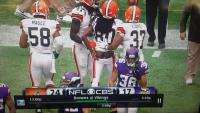
Mahomes gets a shove in the back running out of bounds and draws a flag.
But Mayfield takes the crown of a helmet to his ear hole...and nothing.
The NFL has been consistently inconsistent on their interpretations of this rule.
-
How NFL has enforced helmet rule: Warning letters, not flags
play
8:25 AM PT-
 Kevin SeifertNFL Nation
The Cleveland Browns were livid Sunday afternoon, for all the wrong reasons, when referee Shawn Hochuli picked up a flag for an illegal hit to the head of quarterback Baker Mayfield. Although Mayfield appeared to be giving himself up in a slide, Hochuli ruled that he was in fact still a runner and did not have protection against such hits.
"That was different from what I know," Browns coach Hue Jackson said, while No. 1 receiver Jarvis Landry remarked, "Every other quarterback gets that call."
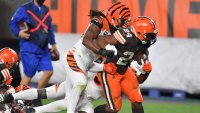
ADVERTISEMENTBut both the postgame debate and Hochuli's explanation failed to address an entirely different but no less obvious foul. Whether or not Mayfield deserved quarterback protection on the play, Tampa Bay Buccaneers defensive back Jordan Whitehead had clearly, without question, violated the new NFL rule prohibiting players from lowering their helmets to initiate contact on an opponent. In real time, at least, no one seemed to notice.
Replays showed Whitehead boring the top of his helmet into the side of Mayfield's head -- with a running start, no less -- and utilizing the linear posture that NFL research has shown increases the likelihood of head and neck injuries. Whitehead's hit was so flagrant, and his ability to avoid it so clear, that he might have fit the league's stated criteria for ejection. The foul went unmentioned by the Browns, Hochuli and the broadcast announcing crew, in the process cementing the disappearance of the helmet rule from our national consciousness.
The no-call isn't entirely unexpected, though, given how the NFL is implementing the helmet rule. In a highly irregular but understandable approach, the NFL has intentionally delayed enforcement of a major rule, largely because it recognized that immediate and full application would have required an unrealistic adjustment for players.
Instead, the league has presented a soft rollout, penalizing players only occasionally to avoid flag-filled games but following up with more-than-occasional fines and dozens of warning letters to players and teams. The warning letters spell out violations that went uncalled, with video, and advise that similar hits will be penalized in the future.
"In the offseason it's an easy thing to discuss and an easy thing to put tape to," said Rich McKay, chairman of the NFL competition committee, during a meeting with reporters last week. "But when you actually practice it, it's a totally different thing. Players are still trying to adjust because it's not the natural way that they have played the game over the last five years or in college. …
"The one thing we did is go through the tape and say [to officials], 'If you don't see it end to end and don't see all three elements of it, then remember we can fine it on Monday and we can get the conduct corrected.'"
Through the first six weeks of the season, officials threw just seven flags for use of helmet fouls but issued 11 fines and sent 65 warning letters. (Through Sunday night's game, there has been only one additional flag. Week 7 fines and warning letters, if any, will go out later this week.) Those numbers suggest the league has allowed about 90 percent of violations to go unaddressed during games.
It is not uncommon for the league to fine players for fouls that were not penalized by on-field officials. Nor is it unusual for it to send warning letters. But the size of the differential -- the number of warning letters and fines compared with the number of flags -- is unprecedented in recent league history, according to several people I spoke with who have institutional knowledge of the way the league approaches rule enforcement.
The simple explanation is the league has never attempted to eliminate a behavior that had become so ingrained and common in the game.
When owners unexpectedly adopted the helmet rule last spring, responding to league research that showed the dangers of a head-down and linear position, officials in the league's football operations department inspected tape of the 2017 season. They estimated the rule would add between 4-5 additional penalties per game if strictly enforced. With all else being equal, the league would see a 31 percent increase in flags over the course of the season. And at 15 yards a pop, total penalty yardage would jump 64 percent.
No one wanted that. More importantly, a two-day football summit in May made it clear that players would need time to learn the techniques and develop the muscle memory that would break the habit of lowering their heads ahead of contact.
"There are certain things that are incidental contact and just part of this sport," Troy Vincent, the NFL's executive vice president of football operations, said at the time. "There are certain things you just have to live with and be OK with. And then there is the part of our role and responsibility. What do we want to coach out and then the players have to adjust to? Some of these things are more long term.
"To think that an individual player will make some of the adjustments between May 1 and the start of the season, when this is what I have done all of my life? That's unrealistic. That's truly unrealistic."
The first two weeks of the preseason offered a preview of what could be expected by relatively strict enforcement. Officials threw 51 flags in the first 33 preseason games before the competition committee clarified that it never wanted incidental or inadvertent contact to be called. For 2018, at least, the league wants flags thrown only when an official spots, from start to finish, obvious and intentional instances of a player lowering his helmet and using it for initial and forcible contact.
Even with that edict, we've seen some obvious and high-profile plays when the helmet rule could have been called. It seems likely that Whitehead will receive a fine or a warning letter for his hit on Mayfield. Kansas City Chiefs running back Kareem Hunt was fined $26,739 for a contact in Week 4 that he was not penalized for. New England Patriots running back Sony Michel wasn't penalized for contact that gave Indianapolis Colts defensive back Clayton Geathers a concussion in Week 5, but senior vice president Al Riveron later used the play in a public video to demonstrate that it was in fact a foul.
This approach makes sense for the purposes of game flow and fairness, but it also raises some fair questions. Why have a rule book if some of its requirements aren't enforced? If administration is selective, does that increase the chance it will favor or hurt particular teams? And if most of the violations have been addressed only in warning letters, should that call into question whether this whole episode has been for show? Has the NFL in essence written a check that it can't cash, simply to appear concerned about the head and neck health of players?
I don't think that's the case. The NFL already has provided too much public information about the root of the rule and its enforcement to carry out an effective ruse. At the end of the season and beyond, we'll know via relatively objective numbers whether contact decreased between lowered helmets. The real question is whether the NFL can achieve its goals via warning letters or fines, or if the day will come that we see multiple flags per game, rather than perhaps one for all games of the week combined, to change the behavior.
McKay said last week that "we like where the data is starting to take us with helmet impacts" but that full answers will be more apparent at the end of the season when the league compiles and analyzes the data. It typically makes public its annual concussion numbers. In the meantime, Vincent did not rule out stricter enforcement as the weeks go on.
"We hope that [through] the education process, that there is greater accountability, so we don’t have to fine," he said. "Players have to get the shoulder in and head out. The helmet is a piece of protective equipment. It's not being used to harm your opponent. We hope we don't have to get there but it's a progression."
We knew from the beginning that the NFL was attempting a sizable change with the helmet rule. What we didn't realize was that the league would follow an alternative path to get there. The approach is unusual in its scope and should be employed sparingly with future rule changes, but in this case seems preferable to a massive spike in penalties. Will it work? We'll find out soon enough.
-
-
How NFL has enforced helmet rule: Warning letters, not flags
play
8:25 AM PT-
Kevin SeifertNFL Nation
The Cleveland Browns were livid Sunday afternoon, for all the wrong reasons, when referee Shawn Hochuli picked up a flag for an illegal hit to the head of quarterback Baker Mayfield. Although Mayfield appeared to be giving himself up in a slide, Hochuli ruled that he was in fact still a runner and did not have protection against such hits.
"That was different from what I know," Browns coach Hue Jackson said, while No. 1 receiver Jarvis Landry remarked, "Every other quarterback gets that call."
ADVERTISEMENTBut both the postgame debate and Hochuli's explanation failed to address an entirely different but no less obvious foul. Whether or not Mayfield deserved quarterback protection on the play, Tampa Bay Buccaneers defensive back Jordan Whitehead had clearly, without question, violated the new NFL rule prohibiting players from lowering their helmets to initiate contact on an opponent. In real time, at least, no one seemed to notice.
Replays showed Whitehead boring the top of his helmet into the side of Mayfield's head -- with a running start, no less -- and utilizing the linear posture that NFL research has shown increases the likelihood of head and neck injuries. Whitehead's hit was so flagrant, and his ability to avoid it so clear, that he might have fit the league's stated criteria for ejection. The foul went unmentioned by the Browns, Hochuli and the broadcast announcing crew, in the process cementing the disappearance of the helmet rule from our national consciousness.
The no-call isn't entirely unexpected, though, given how the NFL is implementing the helmet rule. In a highly irregular but understandable approach, the NFL has intentionally delayed enforcement of a major rule, largely because it recognized that immediate and full application would have required an unrealistic adjustment for players.
Instead, the league has presented a soft rollout, penalizing players only occasionally to avoid flag-filled games but following up with more-than-occasional fines and dozens of warning letters to players and teams. The warning letters spell out violations that went uncalled, with video, and advise that similar hits will be penalized in the future.
"In the offseason it's an easy thing to discuss and an easy thing to put tape to," said Rich McKay, chairman of the NFL competition committee, during a meeting with reporters last week. "But when you actually practice it, it's a totally different thing. Players are still trying to adjust because it's not the natural way that they have played the game over the last five years or in college. …
"The one thing we did is go through the tape and say [to officials], 'If you don't see it end to end and don't see all three elements of it, then remember we can fine it on Monday and we can get the conduct corrected.'"
Through the first six weeks of the season, officials threw just seven flags for use of helmet fouls but issued 11 fines and sent 65 warning letters. (Through Sunday night's game, there has been only one additional flag. Week 7 fines and warning letters, if any, will go out later this week.) Those numbers suggest the league has allowed about 90 percent of violations to go unaddressed during games.
It is not uncommon for the league to fine players for fouls that were not penalized by on-field officials. Nor is it unusual for it to send warning letters. But the size of the differential -- the number of warning letters and fines compared with the number of flags -- is unprecedented in recent league history, according to several people I spoke with who have institutional knowledge of the way the league approaches rule enforcement.
The simple explanation is the league has never attempted to eliminate a behavior that had become so ingrained and common in the game.
When owners unexpectedly adopted the helmet rule last spring, responding to league research that showed the dangers of a head-down and linear position, officials in the league's football operations department inspected tape of the 2017 season. They estimated the rule would add between 4-5 additional penalties per game if strictly enforced. With all else being equal, the league would see a 31 percent increase in flags over the course of the season. And at 15 yards a pop, total penalty yardage would jump 64 percent.
No one wanted that. More importantly, a two-day football summit in May made it clear that players would need time to learn the techniques and develop the muscle memory that would break the habit of lowering their heads ahead of contact.
"There are certain things that are incidental contact and just part of this sport," Troy Vincent, the NFL's executive vice president of football operations, said at the time. "There are certain things you just have to live with and be OK with. And then there is the part of our role and responsibility. What do we want to coach out and then the players have to adjust to? Some of these things are more long term.
"To think that an individual player will make some of the adjustments between May 1 and the start of the season, when this is what I have done all of my life? That's unrealistic. That's truly unrealistic."
The first two weeks of the preseason offered a preview of what could be expected by relatively strict enforcement. Officials threw 51 flags in the first 33 preseason games before the competition committee clarified that it never wanted incidental or inadvertent contact to be called. For 2018, at least, the league wants flags thrown only when an official spots, from start to finish, obvious and intentional instances of a player lowering his helmet and using it for initial and forcible contact.
Even with that edict, we've seen some obvious and high-profile plays when the helmet rule could have been called. It seems likely that Whitehead will receive a fine or a warning letter for his hit on Mayfield. Kansas City Chiefs running back Kareem Hunt was fined $26,739 for a contact in Week 4 that he was not penalized for. New England Patriots running back Sony Michel wasn't penalized for contact that gave Indianapolis Colts defensive back Clayton Geathers a concussion in Week 5, but senior vice president Al Riveron later used the play in a public video to demonstrate that it was in fact a foul.
This approach makes sense for the purposes of game flow and fairness, but it also raises some fair questions. Why have a rule book if some of its requirements aren't enforced? If administration is selective, does that increase the chance it will favor or hurt particular teams? And if most of the violations have been addressed only in warning letters, should that call into question whether this whole episode has been for show? Has the NFL in essence written a check that it can't cash, simply to appear concerned about the head and neck health of players?
I don't think that's the case. The NFL already has provided too much public information about the root of the rule and its enforcement to carry out an effective ruse. At the end of the season and beyond, we'll know via relatively objective numbers whether contact decreased between lowered helmets. The real question is whether the NFL can achieve its goals via warning letters or fines, or if the day will come that we see multiple flags per game, rather than perhaps one for all games of the week combined, to change the behavior.
McKay said last week that "we like where the data is starting to take us with helmet impacts" but that full answers will be more apparent at the end of the season when the league compiles and analyzes the data. It typically makes public its annual concussion numbers. In the meantime, Vincent did not rule out stricter enforcement as the weeks go on.
"We hope that [through] the education process, that there is greater accountability, so we don’t have to fine," he said. "Players have to get the shoulder in and head out. The helmet is a piece of protective equipment. It's not being used to harm your opponent. We hope we don't have to get there but it's a progression."
We knew from the beginning that the NFL was attempting a sizable change with the helmet rule. What we didn't realize was that the league would follow an alternative path to get there. The approach is unusual in its scope and should be employed sparingly with future rule changes, but in this case seems preferable to a massive spike in penalties. Will it work? We'll find out soon enough.
But both the postgame debate and Hochuli's explanation failed to address an entirely different but no less obvious foul. Whether or not Mayfield deserved quarterback protection on the play, Tampa Bay Buccaneers defensive back Jordan Whitehead had clearly, without question, violated the new NFL rule prohibiting players from lowering their helmets to initiate contact on an opponent. In real time, at least, no one seemed to notice.
The boldfaced was what I asked my TV yesterday.
When the rule came out it was supposed to be in effect for all players, including Offensive players, in all plays, not just for QBs in the pocket and defenseless WRs.
I'm still waiting on an answer.
-
-
honestly im ok with that call as long as they give browns players the same benefit of the doubt. I dont want QB's protected that hard. Baker clearly only started to.slide once he saw the guy coming. Had he commited himself to the slide a shade early. he might have drawn a flag.
-
honestly im ok with that call as long as they give browns players the same benefit of the doubt. I dont want QB's protected that hard. Baker clearly only started to.slide once he saw the guy coming. Had he commited himself to the slide a shade early. he might have drawn a flag.
honestly im ok with that call as long as they give browns players the same benefit of the doubt. I dont want QB's protected that hard. Baker clearly only started to.slide once he saw the guy coming. Had he commited himself to the slide a shade early. he might have drawn a flag.
The problem is when you see calls like the one on Mahomes last night where he was pushed from behind when he was maybe a yard or so out of bounds and that draws a flag. He didn't even fall down from it. There was no chance of him being hurt on the play whereas the play with Baker could've ended the game for both players and thats what they're trying to avoid.
-
honestly im ok with that call as long as they give browns players the same benefit of the doubt. I dont want QB's protected that hard. Baker clearly only started to.slide once he saw the guy coming. Had he commited himself to the slide a shade early. he might have drawn a flag.
The problem is when you see calls like the one on Mahomes last night where he was pushed from behind when he was maybe a yard or so out of bounds and that draws a flag. He didn't even fall down from it. There was no chance of him being hurt on the play whereas the play with Baker could've ended the game for both players and thats what they're trying to avoid.
The problem is when you see calls like the one on Mahomes last night where he was pushed from behind when he was maybe a yard or so out of bounds and that draws a flag. He didn't even fall down from it. There was no chance of him being hurt on the play whereas the play with Baker could've ended the game for both players and thats what they're trying to avoid.
yeah i agree, the consistency is appalling. Im vastly more infuriated tho by 2 straight weeks of the most obvious false starts not called thst ive ecer seen in 30 years of watching football. Never seen that sht. Winston was noticeably astonished there was no whistle.
-
The problem is when you see calls like the one on Mahomes last night where he was pushed from behind when he was maybe a yard or so out of bounds and that draws a flag. He didn't even fall down from it. There was no chance of him being hurt on the play whereas the play with Baker could've ended the game for both players and thats what they're trying to avoid.
yeah i agree, the consistency is appalling. Im vastly more infuriated tho by 2 straight weeks of the most obvious false starts not called thst ive ecer seen in 30 years of watching football. Never seen that sht. Winston was noticeably astonished there was no whistle.
yeah i agree, the consistency is appalling. Im vastly more infuriated tho by 2 straight weeks of the most obvious false starts not called thst ive ecer seen in 30 years of watching football. Never seen that sht. Winston was noticeably astonished there was no whistle.
The calls are pretty atrocious across the board in all games. Dallas got totally hosed on the game tying FG attempt on a terrible call. At least this time, not calling the false start helped us because we got a sack on the play.
-
honestly im ok with that call as long as they give browns players the same benefit of the doubt. I dont want QB's protected that hard. Baker clearly only started to.slide once he saw the guy coming. Had he commited himself to the slide a shade early. he might have drawn a flag.
honestly im ok with that call as long as they give browns players the same benefit of the doubt. I dont want QB's protected that hard. Baker clearly only started to.slide once he saw the guy coming. Had he commited himself to the slide a shade early. he might have drawn a flag.
how can you be o.k with it ? the defender lead with the crown of his helmet
-
honestly im ok with that call as long as they give browns players the same benefit of the doubt. I dont want QB's protected that hard. Baker clearly only started to.slide once he saw the guy coming. Had he commited himself to the slide a shade early. he might have drawn a flag.
how can you be o.k with it ? the defender lead with the crown of his helmet
how can you be o.k with it ? the defender lead with the crown of his helmet
had baker stayed upright he would have been hit lower. He started his slide late. In real time i thought for sure penalty but when they replsyed it, like i said i dont want qb's that coddled.
-
had baker stayed upright he would have been hit lower. He started his slide late. In real time i thought for sure penalty but when they replsyed it, like i said i dont want qb's that coddled.
Too late for that. Just see the penalty that was called on Mahomes last night when he didn't even fall down from it.
-
had baker stayed upright he would have been hit lower. He started his slide late. In real time i thought for sure penalty but when they replsyed it, like i said i dont want qb's that coddled.
but the rule is a defender may not lower the crown of his helmet and that go's for any player,,so again i asked how could you or anyone for that matter be o.k with that
-
This Atom fella is a lot smarter than syd ever was...
"When you have a shared vision it is a lot easier to make unpopular decisions." - Paul DePodesta "When you win, say nothing. When you lose, say less." - Paul Brown Complete 2017 Browns Board Mock: http://thebrownsboard.com/forums/index.php?showtopic=46196 -
had baker stayed upright he would have been hit lower. He started his slide late. In real time i thought for sure penalty but when they replsyed it, like i said i dont want qb's that coddled.
but the rule is a defender may not lower the crown of his helmet and that go's for any player,,so again i asked how could you or anyone for that matter be o.k with that
but the rule is a defender may not lower the crown of his helmet and that go's for any player,,so again i asked how could you or anyone for that matter be o.k with that
goes against the "heads up" tackling technique the NFL is trying to enforce. Both players are lucky to walk away from that hit with no injuries. It's frustrating when the NFL is so inconsistent with their calls, getting ridiculous now.
-
IMO the most disturbing part of it all is that despite the official closest to the hit throwing his flag - the referee over-ruling him and waiving it off started that play positioned in our backfield 5-7 yards behind Baker and didn't move downfield until after Baker crossed the LOS. Not only that, when Baker crossed from 1 side of the field to the other - the Referee that is trailing the action looks for blocks in the back and holding on all the pursuit also crossing from 1 side to the other. In other words, there were a lot of obstructions and distractions for the Ref to see through in order to have a superior view that would enable him to waive off the flag.
Now, add the hit Garrett had on the 260 lb Roethlisberger OUTSIDE of the pocket which gave them a first and goal inside our 5 yard line instead of the FG they should have had. They got a TD from it instead of just 3 points in a game that went into OT. Over the years, how many times has Roethlisberger broken arm tackles outside of the pocket run or pass?
There's 2 of our OT games where the BAD calls went against this team coming off an 0-16 season where bullshitt apologies mean nothing more than "it's only the Cleveland Browns." Until I see otherwise from this league - they don't give me too many reasons to feel otherwise. Please spare me the lectures of all teams get bad calls against them because it's not nearly as frequent as this team takes it up the dumpster from them. They also made sure they weren't going to allow Derek Carr's fumble that would have provided the game over knockout punch. There's 3 wins they've taken from our players IMO.
I welcome the only Defensive Coordinator to earn a Superbowl Ring in New Orleans while understanding Revenge of the Nerds is a sequel. "Come get some!" -
Guys, let’s face it, the NFL and it’s officiating is BS. Just gotta roll with the punches and overcome.
-
Guys, let’s face it, the NFL and it’s officiating is BS. Just gotta roll with the punches and overcome.
Guys, let’s face it, the NFL and it’s officiating is BS. Just gotta roll with the punches and overcome.
When these players are working hard to be thought of as something better than the 0-16 record many in this country still see them as - it sure would have been nice if Garrett's hit on Ben outside of the pocket didn't get flagged (ultimately giving Pitt a TD instead of the FG they would have settled on). That's a 4 point swing on a game that wouldn't have required OT. It would have been just as nice if the Referee didn't over rule the official not only in better position of the hit but also exhibiting better understanding of what is supposed to be a HUGE priority to enforce. Instead, it sure seems like officiating crews are still defaulting to "it's only the Cleveland Browns that never make the playoffs anyway." I wish I could feel different but there's also the Derek Carr fumble which would have been the knockout punch that would ended the comeback. That's 3 wins I count taken out of this team's hands. YES, all teams have bad calls go against them but none of them are coming off an 0-16 football season in terms of ability to overcome that.
I welcome the only Defensive Coordinator to earn a Superbowl Ring in New Orleans while understanding Revenge of the Nerds is a sequel. "Come get some!" -
Guys, let’s face it, the NFL and it’s officiating is BS. Just gotta roll with the punches and overcome.
Guys, let’s face it, the NFL and it’s officiating is BS. Just gotta roll with the punches and overcome.
With all due respect, I don't think we should keep rolling with it. The glass chin they keep shattering is knocking us out more so than our opponents are able to. If that's not a problem worth fighting - we're all wasting serious time following this league. The league seems to care more about pleasing customers in England and Mexico City than long time fans/customers like us and player safety of our 1st overall investment. Somebody at the top of our organization needs to show us he has 2 testicles here with a video collage of specific examples the refs boning us up the asss without the vaseline.
I welcome the only Defensive Coordinator to earn a Superbowl Ring in New Orleans while understanding Revenge of the Nerds is a sequel. "Come get some!"






Hello! It looks like you're interested in this conversation, but you don't have an account yet.
Getting fed up of having to scroll through the same posts each visit? When you register for an account, you'll always come back to exactly where you were before, and choose to be notified of new replies (either via email, or push notification). You'll also be able to save bookmarks and upvote posts to show your appreciation to other community members.
With your input, this post could be even better 💗
Register Login