
Purge - 2017 - what'll happen?
-
Well the most obvious solution is to use multiple picks to move up and fill this team with a few first rate players.
Won't happen.
Not a matter of won't... it's a matter of "can't". You simply cannot land "a few first rate players" in a single draft... it cannot be done.
The only thing your solution obviously is? Impractical...
You give them far more credit than they have deserved thus far Tim. But we shall see if they are fast learners, slow learners or uneducables.
Or you give them far less...
Not a matter of won't... it's a matter of "can't". You simply cannot land "a few first rate players" in a single draft... it cannot be done.
The only thing your solution obviously is? Impractical...
Ah, but it was indeed done Tour- once. How about 4 HOF guys? 1974 Steelers. Probably never be repeated, but we can hope......

*Lynn Swann, wide receiver, USC, first round, 21st overall.
*Jack Lambert, linebacker, Kent State, second round, 46th overall.
*John Stallworth, wide receiver, Alabama A&M, fourth round, 82nd overall.
*Mike Webster, center, Wisconsin, fifth round, 125th overall
-
I could see us packaging some of our mid round capital to take another player in the second, still leaving us with a surplus of picks. I don't think we'll attempt to get two top ten picks or anything like that.
If we use the Harvard chart, as I suspect we do for obvious reasons, instead of the "standard" NFL chart, then we value picks too much to package and move up.
I don't think it will take as long as people think for us to be competitive.
For the division? 2018... as much due to others decline as our rise.
For the conference? Much harder call...
If we use the Harvard chart, as I suspect we do for obvious reasons, instead of the "standard" NFL chart, then we value picks too much to package and move up.
At a base level, maybe, since the chart indicates that there might not be a significant drop off in career value from the second to the third round...or even from the first to the second.
However, applying sample data here is a dangerous game, since we are dealing with individuals and not groups. What's more important, in my opinion, is the variance. That's what allows for more informed decisions when applying sample data to the individual - exactly what we're doing when we make draft picks.
For example, the coefficient of variation drastically increases the further in the draft you move along, meaning that later picks are infinitely more volatile and harder to predict compared to earlier picks, contrary to what many in here have stated.
Yes, it's true...a first round bust hurts much more than a fifth round bust. But that doesn't mean that picking a first round player is harder. On the contrary, the Harvard study shows that you have a statistically better chance of picking a legitimate contributing player in the early rounds compared to the later rounds.
The "Harvard chart" draws three broadstroke conclusions:
- On average, there isn't as drastic of a statistical dropoff in players careers from one round to the next as we thought.
- There is a much larger degree of variance in the career trajectories of late round picks than there is in early round players.
- The potential of picking a superstar player significantly diminishes the further into the draft you get.
Looking at this roster, I'm not seeing a lack of contributing members, I'm seeing a lack of high-level superstar potential.
At a very generalized level, the article calls Josh McCown essentially "Mr. NFL Average" - a CAV of 15 and what should be expected for a third round pick based on their findings. He's a marginal player who is, at best, a spot starter but really is a mid-to-high level backup. Meanwhile, the first overall pick is a Rodney Harrison.
We have a ton of Josh McCown's, yet few Rodney Harrison's.
If I'm in this FO, I'm looking at the revamped "Harvard chart" and putting my eggs in the 10-40 pick range. That allows us the chance to take a handful of players that are more statistically likely to be above the "McCown-level", with the distinct possibility of achieving the "Harrison-level".
(And, though it shouldn't have to be said, this study shows that one should never expect a Manning-level contributor, even at the top pick. Those are an anomaly. The highest you should ever expect from a #1 QB is a career similar to that of Rich Gannon or Drew Bledsoe. Just want to make sure that's noted again.)
I'm awesome, and I fuck dolphins. Ghoolie 12/2/2012: I have absolutely no skills, training or pride -
I'm still willing to give the FO the benefit of the doubt... it's only been 1 year in a 3 to 5-year plan, since the owner wishes to build through the draft - which means NO high priced free agent signings... which everyone seems to ignore on these boards... Translation: no instant-gratification-1-year-turnaround.
They needed bodies with the first draft. They went after them. 1 year isn't enough to evaluate anyone's career. I didn't think they got enough for the trade-down from 8 to 15, but we will see.
They didn't see a franchise QB, so didn't draft a mediocre one. Great call. I give them excellent marks for that.
They still need more bodies, so the next draft might be similar, but in year 2 of this plan I would also expect them to use the picks instead of trading them. Maybe this year the trade down from 2 to 8 nets an actual pick, instead of another trade... which they didn't get enough for last time, IMO
The FO expectation for this year was probably 2-4 wins. Couple of early games they should have won, but didn't. Still can win 2 of last 4. Still looks like they're competing to me. They're in every game until the last 1.5 quarters.
Year 2 of this rebuild was probably a 6-8 win projection for this FO. Doable.
Follow the process.
There are no instant turn arounds when you are building through the draft and there aren't many players who walk off college field and onto pro and are instant superstars. Don't need a lot of analytics to figure that one out.
If they're in the same spot next year, i'll be much more critical, but this isn't the time to start calling for people's heads.
-
Man this 'we're gonna sit on our rookie roster and watch them develop ' thing is just horseshit. Too many seasons and too many busts to put up with it anymore. I don't care if you were a top ten pick or a 5th round pick, you've been playing football good enough half your life to make it to the nfl now all of a sudden you can't block tackle or cover? GTFO. Theses guys are young for sure but to show that product on the field rests in the lap of the FO and coaching staff.
Pitiful. -
Man this 'we're gonna sit on our rookie roster and watch them develop ' thing is just horseshit. Too many seasons and too many busts to put up with it anymore. I don't care if you were a top ten pick or a 5th round pick, you've been playing football good enough half your life to make it to the nfl now all of a sudden you can't block tackle or cover? GTFO. Theses guys are young for sure but to show that product on the field rests in the lap of the FO and coaching staff.
Pitiful.
Agree. I've been told that they can't make any halftime adjustments to the game plan for lack of talent. The kids know how to play the game. It's our GM quadrafuck that doesn't get it and coaching that doesn't or can't make game time adjustments.Man this 'we're gonna sit on our rookie roster and watch them develop ' thing is just horseshit. Too many seasons and too many busts to put up with it anymore. I don't care if you were a top ten pick or a 5th round pick, you've been playing football goodvenough half your life to make it to the nfl now all of a sudden you can't block tackle or cover? GTFO. Theses guys are young for sure but to show that product on the field rests in the lap of the FO and coaching staff.
Pitiful.
Hell, even the News Herald is yelling at the Haslam's that they should petition the NFL for a name change. They don't deserve the name Cleveland Browns
-
Not a matter of won't... it's a matter of "can't". You simply cannot land "a few first rate players" in a single draft... it cannot be done.
The only thing your solution obviously is? Impractical...
Ah, but it was indeed done Tour- once. How about 4 HOF guys? 1974 Steelers. Probably never be repeated, but we can hope......
*Lynn Swann, wide receiver, USC, first round, 21st overall.
*Jack Lambert, linebacker, Kent State, second round, 46th overall.
*John Stallworth, wide receiver, Alabama A&M, fourth round, 82nd overall.
*Mike Webster, center, Wisconsin, fifth round, 125th overall
Ah, but it was indeed done Tour- once. How about 4 HOF guys? 1974 Steelers. Probably never be repeated, but we can hope......
*Lynn Swann, wide receiver, USC, first round, 21st overall.
*Jack Lambert, linebacker, Kent State, second round, 46th overall.
*John Stallworth, wide receiver, Alabama A&M, fourth round, 82nd overall.
*Mike Webster, center, Wisconsin, fifth round, 125th overall
lol... if it helps you sleep better, h, then I'll not mention that you're one player shy of "a few" by my count...

At a base level, maybe, since the chart indicates that there might not be a significant drop off in career value from the second to the third round...or even from the first to the second.
However, applying sample data here is a dangerous game, since we are dealing with individuals and not groups. What's more important, in my opinion, is the variance. That's what allows for more informed decisions when applying sample data to the individual - exactly what we're doing when we make draft picks.
No doubt... if there's a prospect who is in danger of leaving the board that we have to have, then, yes, there's a chance we'll try to make a trade. But the difference in valuations of the 2 charts is so vastly different that it is hard to see us pulling the trigger.
Let's say we want to move our 1st pick in R3 (#65 overall) to R2's 53rd overall. By the traditional chart the 53rd's value is 370 and our 65th overall's is 265. Depending on the number of compensatories handed out at the end of R3 our first pick in R4 should make up the difference of ~100 points. So a traditional deal of:
#65 + #98 ---> #65... or in points 265+108 = 373 ---> 370
should get done.
But looking at the deal through Harvard's eyes brings a much different points evaluation of:
128.0+89.5 = 217.5 -----> 142.8!!!
In essence Harvard's chart says you are trading away half again, 150%, of the value you are getting. And if you believe in the Harvard chart then the player you'd be targeting has to be a faller you had pegged for the late first round... a player you'd already presumably have passed over three times including early in R2 when his value was first in line with your pick.
The only way I'd pursue such a deal is if I saw a gap developing in my board that devalued the two picks I was trading away and I did not see an advantageous trade-down developing.
This does not mean we can't get "that player" as there is another, far more economical means to land him/them ... reaching/over-drafting them. Not that this is a spur of the moment thing... it's not... it's an outcome of our big board process. It's what we did pretty clearly did with Kessler and arguably a "few" others in the 2016 draft. I look for a repeat in 2017.
Man this 'we're gonna sit on our rookie roster and watch them develop ' thing is just horseshit. Too many seasons and too many busts to put up with it anymore. I don't care if you were a top ten pick or a 5th round pick, you've been playing football goodvenough half your life to make it to the nfl now all of a sudden you can't block tackle or cover? GTFO. Theses guys are young for sure but to show that product on the field rests in the lap of the FO and coaching staff.
Just as High School players get culled in college, so, too, do college kids get culled in the Pros. Always has been that way; always will be that way.
Sometimes it is simply a matter of no longer being able to control whomever is in front of you... because "whomever" is suddenly a different player, one much better than the one you blocked/tackled/covered at the last level.
"When you have a shared vision it is a lot easier to make unpopular decisions." - Paul DePodesta "When you win, say nothing. When you lose, say less." - Paul Brown Complete 2017 Browns Board Mock: http://thebrownsboard.com/forums/index.php?showtopic=46196 -
Why do you come up with the number of 20. If they draft 13-14, and they want to keep them all, wouldn't that number be 13 or 14?
its in the op.....I also listed 6 players returning from IR....14+6 = 20
its in the op.....I also listed 6 players returning from IR....14+6 = 20
OK, the IR guys.
Who are the guys on IR that you want to run?
-
Not a matter of won't... it's a matter of "can't". You simply cannot land "a few first rate players" in a single draft... it cannot be done.
Id say most teams have a goal to score 2 -3 players each draft......and they are allotted 7 picks each.....
So....with that in mind.....what is the goal when you have 14 picks?....and 5 inside the top 65?......
Definitely should have at least a "few first rate players" as your objective.....
Id say most teams have a goal to score 2 -3 players each draft......and they are allotted 7 picks each.....
So....with that in mind.....what is the goal when you have 14 picks?....and 5 inside the top 65?......
Definitely should have at least a "few first rate players" as your objective.....
Well....ordinarily you would have had a number of your previous first round picks serving as a veteran base....
But, in the Browns case they have like only 3 of those guys.....2 of which go back a long way: Haden/Thomas.
So, to me, 4 out of those top 5 need to become solid starters for this team pretty much off the bat. And eventually 1 or two stars.
(the QB and one other....though a 1974 Steelers like draft would be nice, no?)
-
Not a matter of won't... it's a matter of "can't". You simply cannot land "a few first rate players" in a single draft... it cannot be done.
The only thing your solution obviously is? Impractical...
Ah, but it was indeed done Tour- once. How about 4 HOF guys? 1974 Steelers. Probably never be repeated, but we can hope......
*Lynn Swann, wide receiver, USC, first round, 21st overall.
*Jack Lambert, linebacker, Kent State, second round, 46th overall.
*John Stallworth, wide receiver, Alabama A&M, fourth round, 82nd overall.
*Mike Webster, center, Wisconsin, fifth round, 125th overall
Ah, but it was indeed done Tour- once. How about 4 HOF guys? 1974 Steelers. Probably never be repeated, but we can hope......
*Lynn Swann, wide receiver, USC, first round, 21st overall.
*Jack Lambert, linebacker, Kent State, second round, 46th overall.
*John Stallworth, wide receiver, Alabama A&M, fourth round, 82nd overall.
*Mike Webster, center, Wisconsin, fifth round, 125th overall
How about at least a Browns 1978 draft? Actually, we need better than that. While the Browns got Clay Matthews and Ozzie Newsone...not a single other draft pick that year was much good. Except maybe Johnny Evans, the punter they took.
-
If we use the Harvard chart, as I suspect we do for obvious reasons, instead of the "standard" NFL chart, then we value picks too much to package and move up.
At a base level, maybe, since the chart indicates that there might not be a significant drop off in career value from the second to the third round...or even from the first to the second.
However, applying sample data here is a dangerous game, since we are dealing with individuals and not groups. What's more important, in my opinion, is the variance. That's what allows for more informed decisions when applying sample data to the individual - exactly what we're doing when we make draft picks.
For example, the coefficient of variation drastically increases the further in the draft you move along, meaning that later picks are infinitely more volatile and harder to predict compared to earlier picks, contrary to what many in here have stated.
Yes, it's true...a first round bust hurts much more than a fifth round bust. But that doesn't mean that picking a first round player is harder. On the contrary, the Harvard study shows that you have a statistically better chance of picking a legitimate contributing player in the early rounds compared to the later rounds.
The "Harvard chart" draws three broadstroke conclusions:
- On average, there isn't as drastic of a statistical dropoff in players careers from one round to the next as we thought.
- There is a much larger degree of variance in the career trajectories of late round picks than there is in early round players.
- The potential of picking a superstar player significantly diminishes the further into the draft you get.
Looking at this roster, I'm not seeing a lack of contributing members, I'm seeing a lack of high-level superstar potential.
At a very generalized level, the article calls Josh McCown essentially "Mr. NFL Average" - a CAV of 15 and what should be expected for a third round pick based on their findings. He's a marginal player who is, at best, a spot starter but really is a mid-to-high level backup. Meanwhile, the first overall pick is a Rodney Harrison.
We have a ton of Josh McCown's, yet few Rodney Harrison's.
If I'm in this FO, I'm looking at the revamped "Harvard chart" and putting my eggs in the 10-40 pick range. That allows us the chance to take a handful of players that are more statistically likely to be above the "McCown-level", with the distinct possibility of achieving the "Harrison-level".
(And, though it shouldn't have to be said, this study shows that one should never expect a Manning-level contributor, even at the top pick. Those are an anomaly. The highest you should ever expect from a #1 QB is a career similar to that of Rich Gannon or Drew Bledsoe. Just want to make sure that's noted again.)
At a base level, maybe, since the chart indicates that there might not be a significant drop off in career value from the second to the third round...or even from the first to the second.
However, applying sample data here is a dangerous game, since we are dealing with individuals and not groups. What's more important, in my opinion, is the variance. That's what allows for more informed decisions when applying sample data to the individual - exactly what we're doing when we make draft picks.
For example, the coefficient of variation drastically increases the further in the draft you move along, meaning that later picks are infinitely more volatile and harder to predict compared to earlier picks, contrary to what many in here have stated.
Yes, it's true...a first round bust hurts much more than a fifth round bust. But that doesn't mean that picking a first round player is harder. On the contrary, the Harvard study shows that you have a statistically better chance of picking a legitimate contributing player in the early rounds compared to the later rounds.
The "Harvard chart" draws three broadstroke conclusions:
- On average, there isn't as drastic of a statistical dropoff in players careers from one round to the next as we thought.
- There is a much larger degree of variance in the career trajectories of late round picks than there is in early round players.
- The potential of picking a superstar player significantly diminishes the further into the draft you get.
Looking at this roster, I'm not seeing a lack of contributing members, I'm seeing a lack of high-level superstar potential.
At a very generalized level, the article calls Josh McCown essentially "Mr. NFL Average" - a CAV of 15 and what should be expected for a third round pick based on their findings. He's a marginal player who is, at best, a spot starter but really is a mid-to-high level backup. Meanwhile, the first overall pick is a Rodney Harrison.
We have a ton of Josh McCown's, yet few Rodney Harrison's.
If I'm in this FO, I'm looking at the revamped "Harvard chart" and putting my eggs in the 10-40 pick range. That allows us the chance to take a handful of players that are more statistically likely to be above the "McCown-level", with the distinct possibility of achieving the "Harrison-level".
(And, though it shouldn't have to be said, this study shows that one should never expect a Manning-level contributor, even at the top pick. Those are an anomaly. The highest you should ever expect from a #1 QB is a career similar to that of Rich Gannon or Drew Bledsoe. Just want to make sure that's noted again.)
There are always exceptions to the rule. In the Browns case....taking a first round pick is almost certain to mean he is a bust.
But...OK, hopefully that will change and they will become somewhat normal.
-
Ah, but it was indeed done Tour- once. How about 4 HOF guys? 1974 Steelers. Probably never be repeated, but we can hope......
*Lynn Swann, wide receiver, USC, first round, 21st overall.
*Jack Lambert, linebacker, Kent State, second round, 46th overall.
*John Stallworth, wide receiver, Alabama A&M, fourth round, 82nd overall.
*Mike Webster, center, Wisconsin, fifth round, 125th overall
lol... if it helps you sleep better, h, then I'll not mention that you're one player shy of "a few" by my count...
At a base level, maybe, since the chart indicates that there might not be a significant drop off in career value from the second to the third round...or even from the first to the second.
However, applying sample data here is a dangerous game, since we are dealing with individuals and not groups. What's more important, in my opinion, is the variance. That's what allows for more informed decisions when applying sample data to the individual - exactly what we're doing when we make draft picks.
No doubt... if there's a prospect who is in danger of leaving the board that we have to have, then, yes, there's a chance we'll try to make a trade. But the difference in valuations of the 2 charts is so vastly different that it is hard to see us pulling the trigger.
Let's say we want to move our 1st pick in R3 (#65 overall) to R2's 53rd overall. By the traditional chart the 53rd's value is 370 and our 65th overall's is 265. Depending on the number of compensatories handed out at the end of R3 our first pick in R4 should make up the difference of ~100 points. So a traditional deal of:
#65 + #98 ---> #65... or in points 265+108 = 373 ---> 370
should get done.
But looking at the deal through Harvard's eyes brings a much different points evaluation of:
128.0+89.5 = 217.5 -----> 142.8!!!
In essence Harvard's chart says you are trading away half again, 150%, of the value you are getting. And if you believe in the Harvard chart then the player you'd be targeting has to be a faller you had pegged for the late first round... a player you'd already presumably have passed over three times including early in R2 when his value was first in line with your pick.
The only way I'd pursue such a deal is if I saw a gap developing in my board that devalued the two picks I was trading away and I did not see an advantageous trade-down developing.
This does not mean we can't get "that player" as there is another, far more economical means to land him/them ... reaching/over-drafting them. Not that this is a spur of the moment thing... it's not... it's an outcome of our big board process. It's what we did pretty clearly did with Kessler and arguably a "few" others in the 2016 draft. I look for a repeat in 2017.
Man this 'we're gonna sit on our rookie roster and watch them develop ' thing is just horseshit. Too many seasons and too many busts to put up with it anymore. I don't care if you were a top ten pick or a 5th round pick, you've been playing football goodvenough half your life to make it to the nfl now all of a sudden you can't block tackle or cover? GTFO. Theses guys are young for sure but to show that product on the field rests in the lap of the FO and coaching staff.
Just as High School players get culled in college, so, too, do college kids get culled in the Pros. Always has been that way; always will be that way.
Sometimes it is simply a matter of no longer being able to control whomever is in front of you... because "whomever" is suddenly a different player, one much better than the one you blocked/tackled/covered at the last level.
lol... if it helps you sleep better, h, then I'll not mention that you're one player shy of "a few" by my count...
No doubt... if there's a prospect who is in danger of leaving the board that we have to have, then, yes, there's a chance we'll try to make a trade. But the difference in valuations of the 2 charts is so vastly different that it is hard to see us pulling the trigger.
Let's say we want to move our 1st pick in R3 (#65 overall) to R2's 53rd overall. By the traditional chart the 53rd's value is 370 and our 65th overall's is 265. Depending on the number of compensatories handed out at the end of R3 our first pick in R4 should make up the difference of ~100 points. So a traditional deal of:
#65 + #98 ---> #65... or in points 265+108 = 373 ---> 370
should get done.
But looking at the deal through Harvard's eyes brings a much different points evaluation of:
128.0+89.5 = 217.5 -----> 142.8!!!
In essence Harvard's chart says you are trading away half again, 150%, of the value you are getting. And if you believe in the Harvard chart then the player you'd be targeting has to be a faller you had pegged for the late first round... a player you'd already presumably have passed over three times including early in R2 when his value was first in line with your pick.
The only way I'd pursue such a deal is if I saw a gap developing in my board that devalued the two picks I was trading away and I did not see an advantageous trade-down developing.
https://harvardsportsanalysis.files.wordpress.com/2011/11/career-value1.jpg
https://harvardsportsanalysis.files.wordpress.com/2011/11/variatoin.jpg
That's a fine way to look at it when assuming you're going to get the average player for that pick and you are trying to amass foundational talent... however I am of the opinion we are at a spot where we are looking to strike on high-impact players with a higher chance of achieving a high CAV - and statistics say that it is easier to do that with higher picks rather than lower ones.
I don't think we're going to be mortgaging the future by any means, but I believe we'll be using our capital to nab four, if not five, early round picks that, statistically speaking, have a higher probability of having above average careers. Looking at the (admittedly dated) charts, that puts you firmly in the 0-45 range, as even the lower boundary is still higher than the higher boundary of many mid-to-late round picks, starting as early as the third round.
Given that there is essentially a leveling off after round three, it's not outside the realm of reason that we package our third and fourth round picks to move up into the second, while still maintaining our fifth, sixth and seventh round picks. Statistically speaking, we are still be able to achieve the same success with late round picks as we are with mid-round picks. The variance is higher, but the floor is not that much lower at pick 106 than it is at 206 (or later)....while the ceiling is almost equally as high.
I haven't been able to find this study, but I'd venture a bet to say that most Super Bowl teams have at least X number of "superstar" players - that is, players with a CAV of at least Y. At some point we have to strike at talent.
I'm awesome, and I fuck dolphins. Ghoolie 12/2/2012: I have absolutely no skills, training or pride -
fewfyo͞o/adjective & pronoundeterminer: few; adjective: few; comparative adjective: fewer; superlative adjective: fewest
-
1.a small number of."may I ask a few questions?"
synonyms:
a small number, a handful, one or two, a couple, two or three; Morenot many, hardly any"there weren't many biscuits, but we saved you a few" -
2.used to emphasize how small a number of people or things is."he had few friends"
synonyms:
scarce, scant, meager, insufficient, in short supply; More
-
-
-
OK, the IR guys.
Who are the guys on IR that you want to run?
That too is listed in the OP......not gonna rewrite it for ya Gip.....#tryreading
-
lol... if it helps you sleep better, h, then I'll not mention that you're one player shy of "a few" by my count...
No doubt... if there's a prospect who is in danger of leaving the board that we have to have, then, yes, there's a chance we'll try to make a trade. But the difference in valuations of the 2 charts is so vastly different that it is hard to see us pulling the trigger.
Let's say we want to move our 1st pick in R3 (#65 overall) to R2's 53rd overall. By the traditional chart the 53rd's value is 370 and our 65th overall's is 265. Depending on the number of compensatories handed out at the end of R3 our first pick in R4 should make up the difference of ~100 points. So a traditional deal of:
#65 + #98 ---> #65... or in points 265+108 = 373 ---> 370
should get done.
But looking at the deal through Harvard's eyes brings a much different points evaluation of:
128.0+89.5 = 217.5 -----> 142.8!!!
In essence Harvard's chart says you are trading away half again, 150%, of the value you are getting. And if you believe in the Harvard chart then the player you'd be targeting has to be a faller you had pegged for the late first round... a player you'd already presumably have passed over three times including early in R2 when his value was first in line with your pick.
The only way I'd pursue such a deal is if I saw a gap developing in my board that devalued the two picks I was trading away and I did not see an advantageous trade-down developing.
https://harvardsportsanalysis.files.wordpress.com/2011/11/career-value1.jpg
https://harvardsportsanalysis.files.wordpress.com/2011/11/variatoin.jpg
That's a fine way to look at it when assuming you're going to get the average player for that pick and you are trying to amass foundational talent... however I am of the opinion we are at a spot where we are looking to strike on high-impact players with a higher chance of achieving a high CAV - and statistics say that it is easier to do that with higher picks rather than lower ones.
I don't think we're going to be mortgaging the future by any means, but I believe we'll be using our capital to nab four, if not five, early round picks that, statistically speaking, have a higher probability of having above average careers. Looking at the (admittedly dated) charts, that puts you firmly in the 0-45 range, as even the lower boundary is still higher than the higher boundary of many mid-to-late round picks, starting as early as the third round.
Given that there is essentially a leveling off after round three, it's not outside the realm of reason that we package our third and fourth round picks to move up into the second, while still maintaining our fifth, sixth and seventh round picks. Statistically speaking, we are still be able to achieve the same success with late round picks as we are with mid-round picks. The variance is higher, but the floor is not that much lower at pick 106 than it is at 206 (or later)....while the ceiling is almost equally as high.
I haven't been able to find this study, but I'd venture a bet to say that most Super Bowl teams have at least X number of "superstar" players - that is, players with a CAV of at least Y. At some point we have to strike at talent.
Ah... the dictionary card hits the table.
Have you honestly ever thought of "a couple" and "a few" as synonyms, Ag?
That's a fine way to look at it when assuming you're going to get the average player for that pick and you are trying to amass foundational talent... however I am of the opinion we are at a spot where we are looking to strike on high-impact players with a higher chance of achieving a high CAV - and statistics say that it is easier to do that with higher picks rather than lower ones.
I don't think we're going to be mortgaging the future by any means, but I believe we'll be using our capital to nab four, if not five, early round picks that, statistically speaking, have a higher probability of having above average careers. Looking at the (admittedly dated) charts, that puts you firmly in the 0-45 range, as even the lower boundary is still higher than the higher boundary of many mid-to-late round picks, starting as early as the third round.The lower boundary what? The lower boundary is 0 across the entire range... so not sure what you are referring to. Nonetheless I think that I better understand where you're going now... so I can more firmly disagree.
First, I do not think we are at that "spot" as yet. Too many holes remain alongside too many marginal incumbents.Second, were I trying to still amass foundational talent, then I'd be advocating trading down. I'm not and I don't need to as we've amassed a good number of 2017 picks thanks to our 2016 trading and lack of UFA retention.
I see 2016 as having been the great amassing... 2017 as the year of standing pat... and 2018 being the year of adding pieces. In other words I'm a year behind you. In that vein I would not be shocked to see "a couple" of the 3rd/4th rounders you see as being traded up this year instead being traded up and out to 2018 creating more ammo.
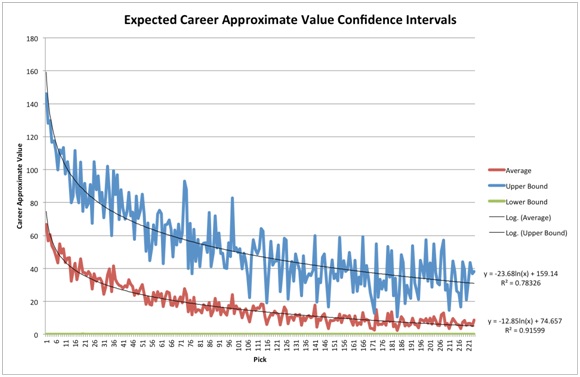
A few notes on the chart...
- I believe the upper bound is a true boundary, i.e., the single highest CAV in the study period for that draft position. I would like to see the median values plotted as opposed to the mean.
- I see where you are going with your line at pick 45, but were you to represent the curve with three straight lines, then the first might cover as low as #11, the second #55-ish and the last the rest.
- There appears to be a "sweet spot" between #33 and #51 where the average spends almost all its time at or above the curve fitted line.
- The opposite appears to be true for the interval between #115 and 140.
- Both the above likely normalize as the sample size expands, but are interesting occurrences... especially the "sweet spot" where a lot of one time first rounders who fall get taken.
"When you have a shared vision it is a lot easier to make unpopular decisions." - Paul DePodesta "When you win, say nothing. When you lose, say less." - Paul Brown Complete 2017 Browns Board Mock: http://thebrownsboard.com/forums/index.php?showtopic=46196 -
Ah, but it was indeed done Tour- once. How about 4 HOF guys? 1974 Steelers. Probably never be repeated, but we can hope......
*Lynn Swann, wide receiver, USC, first round, 21st overall.
*Jack Lambert, linebacker, Kent State, second round, 46th overall.
*John Stallworth, wide receiver, Alabama A&M, fourth round, 82nd overall.
*Mike Webster, center, Wisconsin, fifth round, 125th overall
lol... if it helps you sleep better, h, then I'll not mention that you're one player shy of "a few" by my count...
At a base level, maybe, since the chart indicates that there might not be a significant drop off in career value from the second to the third round...or even from the first to the second.
However, applying sample data here is a dangerous game, since we are dealing with individuals and not groups. What's more important, in my opinion, is the variance. That's what allows for more informed decisions when applying sample data to the individual - exactly what we're doing when we make draft picks.
No doubt... if there's a prospect who is in danger of leaving the board that we have to have, then, yes, there's a chance we'll try to make a trade. But the difference in valuations of the 2 charts is so vastly different that it is hard to see us pulling the trigger.
Let's say we want to move our 1st pick in R3 (#65 overall) to R2's 53rd overall. By the traditional chart the 53rd's value is 370 and our 65th overall's is 265. Depending on the number of compensatories handed out at the end of R3 our first pick in R4 should make up the difference of ~100 points. So a traditional deal of:
#65 + #98 ---> #65... or in points 265+108 = 373 ---> 370
should get done.
But looking at the deal through Harvard's eyes brings a much different points evaluation of:
128.0+89.5 = 217.5 -----> 142.8!!!
In essence Harvard's chart says you are trading away half again, 150%, of the value you are getting. And if you believe in the Harvard chart then the player you'd be targeting has to be a faller you had pegged for the late first round... a player you'd already presumably have passed over three times including early in R2 when his value was first in line with your pick.
The only way I'd pursue such a deal is if I saw a gap developing in my board that devalued the two picks I was trading away and I did not see an advantageous trade-down developing.
This does not mean we can't get "that player" as there is another, far more economical means to land him/them ... reaching/over-drafting them. Not that this is a spur of the moment thing... it's not... it's an outcome of our big board process. It's what we did pretty clearly did with Kessler and arguably a "few" others in the 2016 draft. I look for a repeat in 2017.
Man this 'we're gonna sit on our rookie roster and watch them develop ' thing is just horseshit. Too many seasons and too many busts to put up with it anymore. I don't care if you were a top ten pick or a 5th round pick, you've been playing football goodvenough half your life to make it to the nfl now all of a sudden you can't block tackle or cover? GTFO. Theses guys are young for sure but to show that product on the field rests in the lap of the FO and coaching staff.
Just as High School players get culled in college, so, too, do college kids get culled in the Pros. Always has been that way; always will be that way.
Sometimes it is simply a matter of no longer being able to control whomever is in front of you... because "whomever" is suddenly a different player, one much better than the one you blocked/tackled/covered at the last level.
Just as High School players get culled in college, so, too, do college kids get culled in the Pros. Always has been that way; always will be that way.
Sometimes it is simply a matter of no longer being able to control whomever is in front of you... because "whomever" is suddenly a different player, one much better than the one you blocked/tackled/covered at the last level.
complacency at it's finest.
only a beat down browns fan thinks that way.
-
Ah... the dictionary card hits the table.
Have you honestly ever thought of "a couple" and "a few" as synonyms, Ag?
That's a fine way to look at it when assuming you're going to get the average player for that pick and you are trying to amass foundational talent... however I am of the opinion we are at a spot where we are looking to strike on high-impact players with a higher chance of achieving a high CAV - and statistics say that it is easier to do that with higher picks rather than lower ones.
I don't think we're going to be mortgaging the future by any means, but I believe we'll be using our capital to nab four, if not five, early round picks that, statistically speaking, have a higher probability of having above average careers. Looking at the (admittedly dated) charts, that puts you firmly in the 0-45 range, as even the lower boundary is still higher than the higher boundary of many mid-to-late round picks, starting as early as the third round.The lower boundary what? The lower boundary is 0 across the entire range... so not sure what you are referring to. Nonetheless I think that I better understand where you're going now... so I can more firmly disagree.
First, I do not think we are at that "spot" as yet. Too many holes remain alongside too many marginal incumbents.Second, were I trying to still amass foundational talent, then I'd be advocating trading down. I'm not and I don't need to as we've amassed a good number of 2017 picks thanks to our 2016 trading and lack of UFA retention.
I see 2016 as having been the great amassing... 2017 as the year of standing pat... and 2018 being the year of adding pieces. In other words I'm a year behind you. In that vein I would not be shocked to see "a couple" of the 3rd/4th rounders you see as being traded up this year instead being traded up and out to 2018 creating more ammo.
A few notes on the chart...
- I believe the upper bound is a true boundary, i.e., the single highest CAV in the study period for that draft position. I would like to see the median values plotted as opposed to the mean.
- I see where you are going with your line at pick 45, but were you to represent the curve with three straight lines, then the first might cover as low as #11, the second #55-ish and the last the rest.
- There appears to be a "sweet spot" between #33 and #51 where the average spends almost all its time at or above the curve fitted line.
- The opposite appears to be true for the interval between #115 and 140.
- Both the above likely normalize as the sample size expands, but are interesting occurrences... especially the "sweet spot" where a lot of one time first rounders who fall get taken.
Ah... the dictionary card hits the table.
Have you honestly ever thought of "a couple" and "a few" as synonyms, Ag?
Nah. A couple is 2 and few is 3. Maybe 4 in a stretch. Certainly not 5 for me. That there is a "bunch" where I come from.

But seriously I was thinking 3 when I first typed it in. 4 if we got really really lucky.
-
Just as High School players get culled in college, so, too, do college kids get culled in the Pros. Always has been that way; always will be that way.
Sometimes it is simply a matter of no longer being able to control whomever is in front of you... because "whomever" is suddenly a different player, one much better than the one you blocked/tackled/covered at the last level.
complacency at it's finest.
only a beat down browns fan thinks that way.
OK... in that case I'll not mention the the cited synonym of "handful"...
complacency at it's finest.
only a beat down browns fan thinks that way.
Maybe you can give me some lessons in faux outrage, mik? You know, so I can be a better "fan".
On 2nd thought.... Nah... I'd rather stay in touch with reality.
-
as long as you're alright with it tour then browns nation is alright with it.
just like we aren't tanking it this year.
losing is one thing. not giving a shit about it is another. 1 year. 2 year. 3 year. 4 year plan.
a broken record with no new turntable.
-
as long as you're alright with it tour then browns nation is alright with it.
just like we aren't tanking it this year.
losing is one thing. not giving a shit about it is another. 1 year. 2 year. 3 year. 4 year plan.
a broken record with no new turntable.
a broken record with no new turntable.
Trust me, my friend... I have plenty of turntables...
Anyone need a refurbished AR-XA?
"When you have a shared vision it is a lot easier to make unpopular decisions." - Paul DePodesta "When you win, say nothing. When you lose, say less." - Paul Brown Complete 2017 Browns Board Mock: http://thebrownsboard.com/forums/index.php?showtopic=46196







Hello! It looks like you're interested in this conversation, but you don't have an account yet.
Getting fed up of having to scroll through the same posts each visit? When you register for an account, you'll always come back to exactly where you were before, and choose to be notified of new replies (either via email, or push notification). You'll also be able to save bookmarks and upvote posts to show your appreciation to other community members.
With your input, this post could be even better 💗
Register Login